
Good afternoon,
515.509.8883
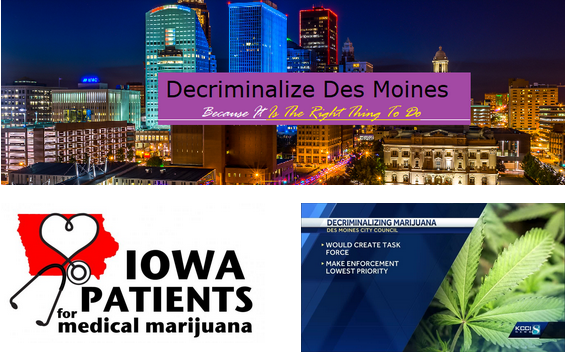
IOWA PATIENTS FOR MEDICAL MARIJUANA POLICY RECOMMENDATIONS AND COMMENTS
Des Moines City Council Marijuana Enforcement Task Force
August 17, 2020
- Oregon state officials during August 2020 analyzed and reported that a decriminalization measure to decriminalize all drugs, on the ballot to be voted on in November 2020, would lead to a “95 percent drop in racial disparities for possession arrests.”[1] The document is available at this link: https://www.theskanner.com/images/stories/2020/August/IP44-REI-Statement-Supplement.pdf[2]
- Another important example for state policy is in Portugal. Please reference the Cato Institute’s reports on Portugal’s effectiveness at reducing poverty, stigma, unnecessary criminalization, and rates of drug use, here[3] and here.[4] Please note that Glenn Greenwald, a noted journalist, was the individual who first brought this report to the world through the Cato Institute. Emphasis added: this video[5] by The Economist explains Portugal’s drug policy successes as well. Of interest and relevant personal note, I met with and spoke for a few minutes with Iowa’s top drug task force official in 2011 after he testified against medical marijuana. I asked him if he had at that point in time yet heard of Portugal’s successes, or the Cato Institute’s article by Glenn Greenwald. He stated he had not. At that time, I told him that once he had learned of decriminalization, that he would find we were on the same side, and that our goals insofar as keeping kids off drugs were shared and similar, even if our policy conclusions did not yet align. It was a very congenial discussion, but I never saw him again at the Capitol during hearings.
Until this year, my work on drug policy has frustratingly found the people working on drug policy issues have been remarkably uninformed about decriminalization policies and their successes and weaknesses worldwide. I believe this is due to Schedule I restrictions forbidding people (researchers, office of drug control policy employees) who work on drug policy issues and receive certain funding from talking about decriminalization policies by law. Please look into Schedule I funding restrictions for drug policy advisors, researchers, and/or policy makers, who allow discussion of the medical use of marijuana or other positive aspects and whether these funding restrictions are hampering shared goals regarding reducing problematic drug use.
- Please see this report[6] concerning legalization not increasing, but instead decreasing, youth usage rates of marijuana experimentation. Myself included, most serious marijuana policy advocates have predicted this result of legalization. While counterintuitive to non-serious policy analysts it seemed obvious to the rest of us, and I think it’s important to note that and not miss that detail. While those who have stubbornly refused to depoliticize the issue of drug use have failed to see the obvious, those of us who are both against recreational drug use, and for decriminalization, see those two values aligning perfectly, while the prohibitionists who took the hard line remain publicly confused due to their failure to lead effectively. Most youth admissions to treatment for drug use are due to bad marijuana laws, not actual need, and this is a waste of resources that results in kids becoming educated on more harmful drugs, the use of which are easier to hide. When we make realistic policy instead of idealistic, we can get those who really need drug treatment access to better programs, stop wasting resources while introducing and incentivizing young kids to use harder drugs, and we will see lower rates of overall use.
- I would encourage the city council task force, and all future Iowa task forces on decriminalization, to establish proportional amounts of addiction centers within the context of community need and resources available. Making addiction centers a priority of decriminalization initiatives, even if initially a small priority, will both set important precedent for the intention of our drug policies and assist in pivoting towards more community-inclusive models of dealing with problematic drug use. While intention does not determine good policy, but rather the results, intention is still important when setting policy, agendas, and priorities during ongoing and long-term discussions. By establishing addiction centers, and also emphasizing throughout these continual discussions the intent on truly solving and lessening the drug problems in communities as they come and go, we can help assist those who may prefer to analyze policy through emotional lenses instead of actual results come to a more effectual solution. We have decades of decriminalization policy to look at from all over the world and have no excuse to continue this abuse of human rights and dehumanization of those who simply do not deserve it now that we are aware of what we have done wrong.
- The 50 state laboratories afforded to us by our system of governance are critical to solve drug addiction and issues surrounding it. While hard prohibitionist policies made drugs cheaper, more conveniently available, and very popular, decriminalization reverses those unintended effects. While various facets of each state’s individual decriminalization policies must be tailored to timely and localized needs, the overall consensus is rapidly approaching what was obvious from the beginning: prohibition was not based on science, and the harms from those misguided policies — still being done to disenfranchised communities especially — must be reversed as effectively as possible with due diligence and hard work over the years to come.
- Police will understandably show resistance to full compliance with any decriminalization initiatives that may bring up safety concerns. Personal friends on the Des Moines police force have told me that when it comes to giving Narcan, for example, police may be concerned about drug users being violent when reawakened made them reluctant, as well as concerns that they are law enforcers, not medical personnel. This may not be too terribly relevant when it comes to decriminalization of marijuana, but when it comes to dealing with addiction, drug overdoses, and the like, it may be the case that we could use another specialized organization, or variety of organizations, that can tackle these problems from more creative angles than one of law and order alone. I would urge any councils working on decriminalization policies to avoid putting undue burdens onto police to solve this problem, who are already overly tasked as it is. Asking too much of the police is not right to drug users and leads to frustrations. I would also submit the problem is not solved with punishment alone, as it makes the problem of drug abuse, a problem which is rooted in a lack of human connection, worse.
- Expungement of all marijuana criminal records not involving violence or distribution would be a welcome inclusion to the discussion. Refunds for marijuana fines should be a part of the discussion as well. Those two specific reparations will go a long way towards rebuilding community trust and is but a small fraction of the financial damages done to those who have marijuana possession on their record. Marijuana being on people’s records impacts job opportunities for 10 years and longer, and should be removed immediately, by whatever means necessary. It’s also the Christian thing to do.
- Establishing a state level Marijuana Enforcement Task Force – where at all possible, I would encourage the Des Moines City Council, and other city councils throughout Iowa working on marijuana decriminalization, to both officially submit recommendations to establish a state level marijuana task force to also work on decriminalizing marijuana and to work with that task force once it is established.
- Lessen fines for personal production of cannabis – homegrown cannabis should not result in loss of student loans, or even a criminal record. Within reason, personal homegrown marijuana should be decriminalized. When someone grows a few plants in their home, as shown by the case of the Jamaica Iowa mayor, the community overwhelmingly favors keeping these small-time crimes outside of the larger crimes that grant people entry into the prison system. Fines, penalties, and court sentences should be reduced wherever possible for small, personal home grow marijuana gardens.
- Restrictions on free speech regarding marijuana should be taken into account in the Des Moines area schools. Especially now that millions of dollars worth of medical marijuana is grown in Des Moines every year now, normalizing marijuana, and removing its stigma, is key to lessening the attraction to illegal use of marijuana. Des Moines area schools policies regarding permissible discussion surrounding drug use must be revised to more appropriately and honestly address what marijuana actually is.
- I would urge the Des Moines City Council to consider allowing the marijuana enforcement task force to be established as a biennial institutional board, as these discussions must continue over the years, as they are issues of sociology, civil rights, and justice, which take time to perfect or begin to understand.
- Whereas addiction is both a consequence and coping mechanism for lack of connection and community inclusion, those who have been discouraged from attending school due to marijuana possession criminal convictions should be offered an Iowa State grant for school, amount TBD, for having successfully completed all probationary requirements or sentences. Other alternative forms of encouraging post-secondary education for former marijuana convicts inclusion within the community includes and is not limited to work-study prioritization, reduced tuition, forgivable loans upon completion of degrees, technical training grants or waivers, transportation assistance within Des Moines or programs for recovering marijuana convicts to get to and from jobs or educational opportunities, and job fairs hosted by the city of Des Moines for those convicted of marijuana possession or other non-violent drug crimes.
- I would urge the Des Moines City Council and Iowa State Legislature to create an annual award for recipients nominated for best drug policy analyst, worker, advocate, or something of the kind, of the year. The important civil rights work of repairing the racial injustices of the anti-scientific prohibition of drugs should be acknowledged for what it is. Awarding people for reducing addiction, crime, drug cartel activity, black market violence, and unnecessary criminalization of classes of people will encourage others to take this issue seriously as well and remove the emotional cloud of irrationality that prohibitionists have long relied upon to disenfranchise or silence any dissent or concerns about drug user rights, humanity, and safety from being heard clearly.
- Make fines for marijuana possession in Des Moines $4.20 per ticket, with unlimited repeat offenses.
- Exempt public displays of marijuana smoking as forms of free speech, civil disobedience, and public awareness.
- Exempt marijuana churches from all fines and tickets when operating within the private confines of their personal sanctuaries during their required religious rituals, rites, or practices.
- Sharing of marijuana with friends for non-profit use, such as passing a joint, or sharing a personal amount of marijuana, should be included in decriminalization concerns.
- Des Moines City Council Marijuana Enforcement Task Force should work with other city councils, especially Cedar Rapids and Iowa City as well as Ames.
- Des Moines City Council Marijuana Enforcement Task Force should bear in mind that all work, communications, and considerations can be done with the express intent of being duplicated as painlessly as possible at the state level as well as in other Iowa cities.
- Des Moines City Council Marijuana Enforcement Task Force should be thanked with deep gratitude for reducing an indescribably painful wound upon families, individual liberty, and the basic promise of the American dream, and thanked repeatedly for all future work in this regard.
- Des Moines City Council Marijuana Enforcement Task Force can and should to the extent of its jurisdictional capabilities allow for patient marijuana collectives and/or cooperatives, transportation of medicine to patients in rural areas or who cannot afford travel, and allow for public gatherings of patient medicating events, such as PTSD “Paint and Puff” events at local dispensaries which would allow part of the healing process of marijuana – community inclusion – to take place without criminalization. Currently under Iowa law, legal mCBD (medical Cannabidiol) patients with Iowa mCBD cards cannot legally pass a vaporization pen. Any well-versed addiction therapist understands the role that sharing marijuana as a sacrament plays in breaking down barriers, opening up communication, and healing people who have issues with connecting with other people. In short, decriminalize patients sharing marijuana, and also, decriminalize public events allowing patients to connect with each other to the full scope that marijuana medicines allow.
- Make the decriminalization age of marijuana possession be included at a younger age than 21. Prohibiting young people from using marijuana is what increases use; by normalizing and reducing stigma, use is discouraged. Therefore, keep the age for decriminalizing marijuana at 18, if not younger, so as not to continue disenfranchising young people and excluding them from educational or job opportunities. Keeping harsh punitive laws for those in the 18-21-year-old age range for marijuana possession increases the likelihood of more serious crimes being committed after their introduction to the criminal justice system, so decriminalizing marijuana possession for those 18 and older is advised.
- Remove the third strike penalty for marijuana possession from the Iowa Code. Under Iowa law, a third offense personal possession of marijuana charge is an automatic enhanced felony. That creates disrespect and mockery of the law. Remove the offense and restore sanity to the legal system immediately.
- Create a community college degree or certificate program or both, that allows Iowa students to study marijuana. This can be easily done at Des Moines Area Community College. Muscatine Community College already has, for one example, an industrial hemp production program.[7] Any educational program at DMACC that helps students get jobs in the marijuana field, or learn about how to help the marijuana industry grow in a regulated, safe, legal manner, is in patient best interests.
- To the extent that state policy can, use government regulatory power to disallow social media censorship of marijuana related pages, topics, issues, news, and data.
- To the extent that state policy can, use government regulatory power to reverse the high taxation Iowa medical cannabis patients currently pay due to Schedule I restrictions on business related expense deductions during tax season. These costs passed on to consumers can and should be fixed easily this next legislative session and seem within the scope of the city council task force and legislature and is not a tall order. Remove Schedule I.
- Recently Minnesota held a series OF cannabis town halls around the state to gather best practice data and input.[8] Total cannabis town halls held in the fall of 2019 was 15. Following Minnesota’s lead prior to the Minnesota House voting to legalize highly restrictive recreational cannabis regulations, The Minnesota House of Representatives, as of August 14th, 2020, also has a website[9] set up for gathering citizen input.
- Families having children taken from them, or any DHS Involvement, over marijuana, should be reviewed and updated. DHS is especially a problem for communities that are victims of selective marijuana enforcement penalties. To the extent this can be addressed by Des Moines and the state, DHS involvement over personal marijuana possession should be terminated.
- Marijuana drug tests should not be required for public employee positions. If an employee receives state taxpayer funding for their job, they should not be punished for having THC in their system, or any other part of the cannabis plant.
- Along with line item 29, allow police in Des Moines to take part in the Iowa mCBD program legally without any repercussion. Police suffer from PTSD too and should be allowed the full scope of medicine available to the public without fear of persecution.
- Expunge all marijuana distribution records for people convicted of sharing cannabis for profit, for non-profit, purposes, having been then convicted. Whether passing a joint to a friend or selling marijuana for profit, expunge all distribution records.
- Allow Iowa patients with qualifying conditions who are approved in the legal Iowa mCBD medical cannabis program to have THC in their systems while on probation, i.e., do not drug test probationers for THC use. Probationers have been granted exemption or other alternatives to being tested for THC on probation before, as in a Minnesota Rastafarian case from 2011 where a Rasta minister was granted exemption from probation drug testing to use marijuana as part of his personal and private religious practice.[10]
- Regulate marijuana. Currently, marijuana is unregulated in the state of Iowa. Patients who are forced to use black market marijuana do not have consistent, safe, tested, clean marijuana to rely on. Absent regulations for marijuana, black market access to cannabis is not optimal for patients in Iowa due to market problems with quality, consistency, and scalability or reproducibility. At the state and local level, marijuana should be regulated so as to reduce youth usage rates and ease of access, increase tax revenue, make addiction treatment be evidence instead of revenue based, and restore respect for an overburdened criminal justice system and court system.
- Give tax credits, or some other variation of incentive, to businesses who employ recently released marijuana convicts, or those who have had marijuana on their record cause them issues with employment.
- Disallow smell of marijuana, whether smoked or raw form, to be basis for probable cause searches of people’s property.
- Allow addiction treatment centers to recommend medical cannabis use for patient assistance in recovery.[11]
- Officially condemn, and encourage other Iowa state government entities working on the serious issue of medical cannabis and civil liberties related to medical cannabis, Kim Reynolds refusal to research, perform any due diligence whatsoever, or take seriously our concerns. Condemn her veto as the tyrannical anti-liberty bully move that it is, and clarify the frustrating obstruction Kim’s refusal to get personally educated on marijuana – or even to meet with or speak to marijuana advocates respectably – has caused for those of us working to change marijuana laws in society’s best interest. Such poor leadership from one of the most powerful individuals in the state must be addressed by those who are working on this issue and not consented to by silent majority.
- Require and provide funding for law enforcement to receive annual or semi-annual education opportunities on the latest cutting edge technology and knowledge regarding marijuana, the marijuana industry, and impact on traffic safety. The more state officials are educated effectively on marijuana, the safer marijuana users and distributors will be.
- Terminate all funding to the Governor’s Office of Drug Control Policy.
- Defund Iowa drug task forces and funnel that wasted revenue away from militarized police forces and into community support services such as addiction treatment centers or needle exchange programs, or non-profit harm reduction drug policy organization such as the Iowa Harm Reduction Coalition.[12]
- Eliminate the drug tax stamp in Iowa code 553B.
- Allow Iowa collegiate athletes to use CBD or THC legally under Iowa law without being penalized at their school of choice. Many colleagues who are top-level professional or semi-professional athletes prefer cannabis for post-game recovery or injuries instead of more dangerous narcotic painkillers.
- Prohibit employment discrimination. Establish an Iowa prohibition on inquiring about criminal record for employment and encourage lawmakers to adopt “ban the box” legislation.
- Eliminate drug testing for state and federal benefits. Another misstep punitive policy makers make is the myth that drug testing welfare recipients is cost effective or accomplishes it’s goals. Like marijuana prohibition, when you disconnect poor people from community resources like food stamps, or jobs, they increase their drug use. Eliminate drug testing, which is dehumanizing and an ineffective backwards way to address problematic drug use in poorer populations.
- Authorize a grant program specifically for providing social, health, and other services to communities most harmed by drug law enforcement (poorer communities, communities impacted by racial disparities in sentencing and prosecutions).
- Expand access to low barrier substance use disorder treatment, including medications for addiction treatment, that is evidence-informed, trauma-informed, culturally responsive, patient-centered, and non-judgmental. This is not limited to marijuana use or marijuana use disorder alone and necessitates a clarification that the totality of the drug war must be addressed when considering the context for decriminalizing or better, regulating, marijuana.
- Work to repeal the ban on federal benefits for needy families. TANF and food/nutrition benefits (21 U.S. Code S 862a); educational benefits (20 USC S 1091(r)); and prohibit public housing agencies from denying access to housing for marijuana users, medical users, or those convicted of marijuana related charges.
- Repeal land use prohibitions – repeal any codes, ordinances or statutes criminalizing “maintaining a drug dwelling,” “maintaining drug-involved premises,” or any related charges thereof.
- Eliminate immigration and removal consequences. Iowa has a disproportionate impact on national politics, and, has been the center of discussion by Steve King, former lawmaker, concerning marijuana related offenses being a source of reason to permanently prohibit immigrants from coming into Iowa or being welcome here. Abolish those racist immigration consequences for marijuana related offenses and welcome immigrants back into Iowa who have been deported for marijuana related offenses by amending relevant laws.
- Prohibit no-knock warrants by state and federal officials for marijuana related offenses within the state of Iowa.
- Amend findings and intent of all marijuana related laws in Iowa codes and ordinances to articulate the harms of criminalization and the health and reparative justice intent of the updated laws.
- Expand research. Require universities, in cooperation with government agencies, existing currently or established for this express purpose, to expand research into the harms of criminalization, harm reduction services as recommended and evaluated by the Iowa Harm Reduction Coalition[13], effectiveness of non-prohibitionist models of regulation, safe supply, and treatment, and patterns of marijuana use.
- Prohibit surveillance technologies: prohibit state and federal agencies operating in Iowa from using location-tracking technologies, cell-site simulators, and predictive-policing technologies for the investigation of solely drug related offenses in the absence of particularized suspicion of a violent offense.
- Prohibit distribution of military equipment to state law enforcement for drug enforcement.
- Prohibit use of federal funds provided through any federal program for the investigation, arrest, prosecution or incarceration in relation to alleged drug possession violations. In California, activists failed to work to address federal law due to threats of federal funding being removed if they did so, which is why we have the confusion between state and federal governments regarding marijuana laws still persisting today. Federal funding concerns are a major deterrent of states working to address federal marijuana laws. Resisting this conflict of interest by eliminating it will go a long way toward fixing this civil rights issue of denied liberty and freedom that disproportionately impacts poor communities.
- Defund and abolish the Iowa Medical Cannabidiol Advisory Board. While having done excellent work and having had an important role to possibly play as scientific advisors, marijuana laws are a matter of greater scope than science. In many cases science and data points have lead to harmful unintended outcomes of marijuana policy or laws resulting from scientific recommendations. To the extent that the Iowa Medical Cannabidiol Advisory Board was created to expressly limit marijuana laws from being made based on best evidence-based practices by limiting the scope of the board’s scientific review to pre-determined outcomes that took political interest and legislative decision making into account when making recommendations, the Board has served it’s purpose, and shown us that we need to speed things up with fixing marijuana laws. Since no evidence has shown that marijuana is harmful to Iowa since the establishment of dispensaries, the burden of proof now needs reversed, and we need to open up and liberalize marijuana laws and bring them back into alignment with core values now that we have recognized our policy mistakes.
- Define personal use thresholds. Establish a rulemaking task force, that includes among other stakeholders, people who use marijuana, advocates for the marijuana community, advocates for communities disparately impacted by past prohibitionist policies, organizations representing public defenders, addiction treatment professionals, and representatives of harm reduction services or organizations like the Iowa Harm Reduction Coalition[14] to draft a rule defining “personal use quantities” and procedures for facilitating voluntary access to services for those seeking addiction treatment for marijuana use disorder. Require that personal use thresholds be regularly reviewed and updated based on peer-reviewed scientific analysis.
- Decarcerate. Mandate the automatic reopening of sentencing proceedings for Iowans convicted solely of offenses related to the possession or distribution of quantities of marijuana or smaller manufacturing (growing) of marijuana charges. Require immediate release pending resentencing and dismissal of proceedings for all qualifying individuals who have pending cases currently in Polk County.
- Provide evidence-based drug education. Explicitly proscribe using of any appropriated funds for “drug education” programs. Shift all jurisdiction of marijuana related prevention programs from law enforcement agencies or DOC to Iowa DHHS.
- Allow marijuana dispensaries to deliver mCBD to patients within the Polk County area. At the state level, allow dispensaries in other locations to deliver.
- Lift all arbitrary limitations on statewide licenses allowed for marijuana dispensaries.
- Expressly clarify in writing in Iowa statutes that the Iowa mCBD program is not in violation of federal law and is exempt from federal law. This was made available in writing by Iowa lawmakers in 2020 as an amendment to a bill but did not make it through to the final version and needs to be fully addressed and not tabled through 2021.
- Create grant programs in any area necessary to help children whose parents, especially black fathers, have been in prison for any length of time in the past or currently for marijuana cases. Of especial import to inner city kids needs are: transportation assistance, access to nutritious food, and safe after school programs that are affordable. Grant ideas include and are not limited to: scholarship for high schoolers qualifying for advanced college level courses; scholarships to assist in purchasing of musical instruments for K-12 students; scholarships to help purchasing of quality, name-brand athletic equipment that helps bridge the competitive gap for youth sport competitors; funding programs for mentors to help children whose families have been adversely impacted by the drug war. Financial need is the singular factor uniting children who are at need due to having a father figure in prison and should be taken in mind when assisting children’s access to educational and personal development opportunities. Financial need is the singular factor uniting children who are at need due to having a father figure in prison and should be taken in mind when assisting children’s access to educational and personal development opportunities. Children whose parents have been incarcerated are likelier to become offenders themselves and it’s much cheaper to educate than incarcerate, so preventative financial assistance to this often left out demographic is highly encouraged.
- Edit and address college curriculum requirements for healthcare practitioners (physicians (MD/DO), Physician Assistants (PAs), Advanced Registered Nurse Practitioners (ARNPs), Podiatrists) to make marijuana courses accessible. Develop and recruit professionals to develop college level curriculum offered within Iowa that meets continuing educational requirements. Ensure all healthcare practitioners are educated on both medical cannabis and interactions with other medications before being certified in their chosen profession to prevent denial of service or discrimination to medical cannabis patients.
- Good Samaritan exemption: people in possession of marijuana and marijuana paraphernalia should be exempted from any punishment whatsoever when engaged in the duty of contacting emergency authorities to relay life-critical information regarding crimes, accidents, or injuries.
All marijuana decriminalization initiatives that violate the law, the law being liberty, cannot uphold and upkeep the respect for law required to live in a peaceable society. To the extent that full liberty to use marijuana in any capacity I see fit that does not harm others is denied, I object to decriminalization, and require full liberty, and my civil rights under the law restored immediately.
For a reminder of just how perverted marijuana prohibition has twisted the law please repeatedly refer to these basic concepts of liberty and law from Black’s Law Dictionary:
What is Color of Law?
The appearance or semblance, without the substance, of legal right. McCain v. Des Moines, 174 U. S. 108, 19 Sup. Ct. (H4, 43 L. Ed. 936)[15]
What is Color of Authority?
That semblance or presumption of authority sustaining the acts of a public officer which is derived from his apparent title to the office or from a writ or other process in his hands apparently valid and regular. State v. Oates, 80 Wis. 634, 57 N. W. 290, 39 Am. St. Rep. 912; Wyatt v. Monroe, 27 Tex. 208.[16]
What is Color?
An appearance, semblance, or simulacrum, as distinguished from that which Is real. A prima facie or apparent right. Hence, a deceptive appearance; a plausible, assumed exterior, concealing a lack of reality; a disguise or pretext. Railroad Co. v. Allfree, 64 Iowa, 500, 20 N. W. 779; Berks County v. Railroad Co., 107 Pa. 102, 31 Atl. 474; Broughton v. Haywood, 01 N. C. 383. In pleading. Ground of action admitted to subsist in the opposite party by the pleading of one of the parties to an action, which Is so set out as to be apparently valid, but which is in reality legally insufficient. This was a term of the ancient rhetoricians, and early adopted into the language of pleading. It was an apparent or prima facie right; and the meaning of the rule that pleadings in confession and avoidance should give color was that they should confess the matter adversely alleged, to such an extent, at least, as to admit some apparent right in the opposite party, which required to be encountered and avoided by the allegation of new matter. Color was either express, i. c., inserted in the pleading, or implied, which was naturally inherent in the structure of the pleading. Steph. PI. 233; Merten v. Bank, 5 Old. 5S5, 49 Pac. 913.[17]
What is Liberty?
1. Freedom; exemption from extraneous control. The power of the will, in its moral freedom, to follow the dictates of its unrestricted choice, and to direct the external acts of the individual without restraint, coercion, or control from other persons. See Booth v. Illinois, 1S4 U. S. 425, 22 Sup. Ct. 425, 46 L. Ed. 623 ; Munn v. Illinois, 94 U. S. 142. 24 L. Ed. 77; People v. Warden of City Prison. 157 N. Y. 116, 51 N. E. 1006. 43 L. R. A. 264, 68 Am. St. Rep. 7i [18]
What is Tyranny?
Arbitrary or despotic government; the severe and autocratic exercise of sovereign power, either vested constitutionally in one ruler, or usurped by him by breaking down the division and distribution of governmental powers.[19]
What is Actus Non Facit Reum, Nisi Mens Sit Rea?
An act does not make [the doer of it] guilty, unless the mind be guilty; that is, unless the intention be criminal. 3 Inst. 107. The intent and the act must both concur to constitute the crime. Lord Kenyon, C. J., 7 Term 514; Broom, Max. 300.[20]
What is Criminal Intent?
The intent to commit a crime: malice, as evidenced by a criminal act; an intent to deprive or defraud the true owner of his property. People v. Moore. 3 N. Y. Cr. R. 458. (source: Black’s Law Dictionary)[21]
What is Legal Fraud?
The name given to the actions that are meant to mislead and deceive that may not have been the original intent.[22]
What is Fraud?
Fraud consists of some deceitful practice or willful device, resorted to with intent to deprive another of his right, or in some manner to do him an injury. As distinguished from negligence, it is always positive, intentional. Maher v. Hibernia Ins. Co.,67 N. Y. 292; Alexander v. Church, 53 Conn. 501, 4 Atl. 103; Studer v. Bleistein. 115 N.Y. 31G, 22 X. E. 243, 7 L. R. A. 702; Moore v. Crawford, 130 U. S. 122, 9 Sup. Ct. 447,32 L. Ed. 878; Fechheimer v. Baum (C. C.) 37 Fed. 167; U. S. v. Beach (D. C.) 71 Fed.160; Gardner v. Ileartt, 3 Denio (N. Y.) 232; Monroe Mercantile Co. v. Arnold, 108 Ga. 449, 34 S. E. 176.Fraud, as applied to contracts, is the cause of an error bearing on a material part of the contract, created or continued by artifice, with design to obtain some unjust advantage to the one party, or to cause an inconvenience or loss to the other. Civil Code La. art. 1S47. Fraud, In the sense of a court of equity, properly Includes all acts, omissions, and concealments which involve a breach of legal or equitable duty, trust, or confidence justly reposed, and are injurious to another, or by which an undue and unconscientious advantage is taken of another. 1 Story, Eq. Jur.[23]
[cf. Natural Law: law “which so necessarily agrees with the nature and state of manthat, without observing its maxims, the peace and happiness of society can never be preserved…Knowledge of natural laws may be attained merely by the light of reason, from the facts of their essential agreeableness with the constitution of human nature.” Natural law exists regardless of whether it is enacted as positive law, although there may be instances where natural law cannot be judicially enforced. – Barron’s Law Dictionary 6th Edition];
[cf. James 1
Therefore, casting aside all uncleanness and abundance of malice, with meekness receive the engrafted word, which is able to save your souls. But be doers of the word, and not hearers only, deceiving yourselves. For if anyone is a hearer of the word, and not a doer, he is like aa man looking at his natural face in a mirror: and presently he forgets what kind of man he is. But he who has looked carefully into the perfect law of liberty and has remained in it, not becoming a forgetful hearer but a doer of the work, shall be blessed in his deed.
[cf. James 2
If, however, you fulfill the royal law, according to scripture, “Thou shalt love thy neighbor as they self”, you do well. But if you show partiality towards persons, you commit sin, being convicted by the law as transgressors…so speak and act as men about to be judged by the law of liberty. For judgment is without mercy to him who has not shown mercy; but mercy triumphs over judgment.
[cf. Luke 11
But one of the lawyers, answering, said to him, “Master, in saying these things, thou insultest us also.” But he said, “Woe to you lawyers also! Because you load men with oppressive burdens and you yourselves with one of your fingers do not touch the burdens.”
Thank you for your time,
Jason Karimi
Executive Director, Iowa Patients for Medical Marijuana
7688 NW 86th Street
Johnston, Iowa 50131
Jahkingdomcome23@gmail.com
515.509.8883
http://www.weedpress.wordpress.com
August 17, 2020
[1] Oregon Officials Explain How Decriminalized Drugs and Legal Psilocybin Therapy Would Impact the State https://www.marijuanamoment.net/oregon-officials-explain-how-decriminalized-drugs-and-legal-psilocybin-therapy-would-impact-the-state/ — SEE ALSO Oregon Drug Decriminalization Measure Will Reduce Racial Disparities and Save Money State Officials Say https://www.marijuanamoment.net/oregon-drug-decriminalization-measure-will-reduce-racial-disparities-and-save-money-state-officials-say /
[2] Document also available here: https://weedpress.wordpress.com/2020/08/14/oregon-criminal-justice-commissions-august-5th-racial-and-ethnic-impact-statement-on-ip-44-the-2020-drug-addiction-treatment-and-recovery-act/
[3] When Portugal Decriminalized Drugs | Cato Institute https://www.cato.org/blog/when-portugal-decriminalized-drugs
[4] Drug Decriminalization in Portugal: Lessons for Creating Fair and Successful Drug Policies | Cato Institute https://www.cato.org/publications/white-paper/drug-decriminalization-portugal-lessons-creating-fair-successful-drug-policies
[5] How Portugal and Colorado solved their drug problems | The Economist https://www.youtube.com/watch?v=Y7LKfLxVtzE
[6] White House Anti-Marijuana Official Admits Youth Use Has Fallen Since Legalization https://www.marijuanamoment.net/white-house-anti-marijuana-official-admits-youth-use-has-fallen-since-legalization/
[7] https://weedpress.wordpress.com/2020/04/13/students-industrial-hemp-production-diploma-now-being-offered-at-muscatine-community-college/
[8] https://www.twincities.com/2019/08/29/mn-democrats-kick-off-statewide-town-halls-for-pot-legalization-calling-it-a-top-priority/
[9] https://www.house.leg.state.mn.us/cannabis/
[10] “[T]he defense has proven a colorable claim of religious right to ceremonial use of cannibus, otherwise known as marijuana. Ceremonial use is intermittent use, but because of our chemistry and how we do UAs, it would seem to me that even with limited ceremonial use that a UA would come up dirty on a regular basis. I’m specifically not ordering that Mr. Arend abstain from the use of marijuana and I’m specifically not authorizing UAs to defendant for marijuana. If probation is concerned about use of other illegal substances, probation may then perform UAs for other illegal substances.” https://www.tokeofthetown.com/2011/10/us_rastafarian_is_exempt_from_probation_pot_testin.php/
[11] “Experimental studies converge to find that CBD reduces the overall level of alcohol drinking in animal models of AUD by reducing ethanol intake, motivation for ethanol, relapse, and by decreasing anxiety and impulsivity.” https://www.marijuanamoment.net/cbd-might-help-you-cut-back-on-drinking-alcohol-and-reduce-its-damaging-effects-study-says/
[12] https://www.iowaharmreductioncoalition.org/
[13] https://www.iowaharmreductioncoalition.org/
[14] https://www.iowaharmreductioncoalition.org/
[15] https://thelawdictionary.org/color-of-law/
[16] https://thelawdictionary.org/color-of-authority/
[17] https://thelawdictionary.org/color/
[18] https://thelawdictionary.org/liberty/
[19] https://thelawdictionary.org/tyranny/
[20] https://thelawdictionary.org/actns-non-facit-reum-nisi-mens-sit-rea/
[21] https://thelawdictionary.org/criminal-intent/
[22] https://thelawdictionary.org/legal-fraud/
[23] https://thelawdictionary.org/fraud/
Original invitation:
August 4 2020
Jason Karimi
Iowa Patients For Medical Marijuana
Dear Mr. Karimi:
On June 22, 2020, the Des Moines City Council approved Resolution 20-1065, which established a task force to study ways to minimize criminal enforcement of possession of marijuana for personal use. On July 30, 2020, the task force held an organizational meeting and set forth the tentative timeline:
Date: Action Item:
August 3rd through August 21st Solicit public input
Week of August 23rd Task Force Meeting
Week of August 30th Publish policy proposals & Solicit written comments proposals
Second week of September Task Force meeting for public comment on policy
Last week of September Task Force meeting to discuss draft report
First week of October Submit final report to City Council
As chair, I write to invite you to provide suggestions to the Task Force for policy proposals that fit within the following criteria set forth in the City Council’s resolution:
- Any proposed action or policy the state legislature or city council could take to lower the enforcement priority of the crime of possession of marijuana for personal use;
- Proposals should be based on best practices implemented in other cities or states; and
- No proposed action or policy should result in the loss of accreditation of any Des Moines Police officer or the Des Moines Regional Police Academy or otherwise result in the denial of state or federal funding.
Please email suggestions to Alex Hassel at athassel@dmgov.org by the close of business on August 21, 2020. To facilitate the Task Force’s work, please clearly identify with specificity the proposed action, the current state or city best practice upon which it is based, and separately provide any supporting data you wish to be considered with attribution to the original source.
I also invite you to provide feedback concerning the policy proposals during the written comment period and the public meeting in September. Please follow the City of Des Moines meeting calendar for specific dates and agendas:
https://www.dsm.city/government/council_meetingss_and_agendas/index.php
In the meantime, if you have any questions or comments, please email them to athassel@dmgov.org, and Ms. Hassel will forward them to my attention.
I look forward to your response.
Sincerely,
Gary Dickey
Chair, Marijuana Enforcement Task Force
 WeedPress: The Paper Trail
Leave a comment