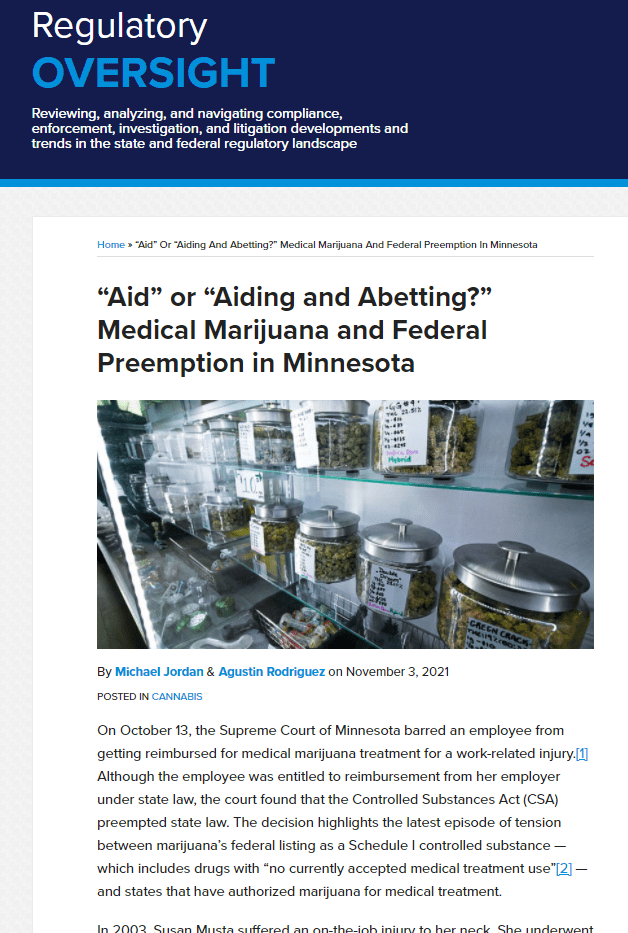
After a Minnesota medical marijuana patient’s employer was ordered to reimburse the costs of marijuana medicines, the employer appealed, and won a Minnesota Supreme Court ruling in the employer’s favor. The employer successfully argued that reimbursing the employee for state authorized marijuana use would be a crime under federal law. A companion case was also issued. Both cases are below in full text.
Here’s a really good summary of one of these two recent MN Supreme Court rulings that discuss the current tension between state and federal marijuana laws, Musta v. Mendota Heights Dental Center:

Prior to these two important October 13th, 2021 Minnesota Supreme Court case rulings, Minnesota law required employers to pay for employees medical cannabis under Minnesota Stat. § 176.135, subd. 1(a)(2020). That law is no longer in effect in Minnesota, according to these rulings from the Minnesota Supreme Court. Minnesota lawmakers had drafted a bill that would have fixed this problem, House File 1023, earlier in 2021, but the bill failed to pass both the House and Senate. Text of House File 1023 is at the end of this article.
In both of these cases, Justice Chutich issued insightful dissent. This case may be ripe for SCOTUS to resolve the long standing and unnecessary conflict between state and federal drug laws.
Rulings like these from the Minnesota Supreme Court signal yet again WeedPress’s number one message for over ten years now. We have been blogging here telling the medical cannabis states that it’s important to work on gaining exemptions to federal law for state medical cannabis programs. To the leadership’s credit there, the state of Minnesota has been working to gain federal exemption for it’s state medical cannabis experiment. Minnesota joins Hawaii and Iowa as the only three states to have successfully educated lawmakers on the in’s and out’s of how to navigate the process of gaining protective federal exemptions to state cannabis marijuana programs.
The Minnesota House bill, House File 1023, would have begun the process of gaining federal exemption. BUT, these below court rulings show crucially why efforts in Minnesota to gain federal exemption for cannabis patients is long overdue.
The text of the two recent Minnesota Supreme Court rulings, Musta v. Mendota Heights Dental Center and also the case Bierbach v. Digger’s Polaris and State Auto/United Fire and Casualty Group, are here on WeedPress below:
https://mn.gov/law-library-stat/archive/supct/2021/OPA201551-101321.pdf
https://mn.gov/law-library-stat/archive/supct/2021/OPA201525-101321.pdf
And here’s the text of House File 1023 from the Minnesota House in 2021:
https://www.revisor.mn.gov/bills/text.php?number=HF1023&version=latest&session=92&session_number=0&session_year=2021
1.1 A bill for an act
1.2 relating to health; requiring the commissioner of health to apply for a federal
1.3 Schedule I exemption for the medical use of cannabis; reclassifying marijuana and
1.4 nonsynthetic THC from a Schedule I to a Schedule II controlled substance; changing
1.5 provisions to the patient registry program; amending Minnesota Statutes 2020,
1.6 sections 152.01, subdivision 23; 152.02, subdivisions 2, 3; 152.11, by adding a
1.7 subdivision; 152.12, by adding a subdivision; 152.125, subdivision 3; 152.32,
1.8 subdivisions 1, 2.
1.9 BE IT ENACTED BY THE LEGISLATURE OF THE STATE OF MINNESOTA:
1.10 Section 1. Minnesota Statutes 2020, section 152.01, subdivision 23, is amended to read:
1.11 Subd. 23.Analog. (a) Except as provided in paragraph (b), “analog” means a substance,
1.12 the chemical structure of which is substantially similar to the chemical structure of a
1.13 controlled substance in Schedule I or II:
1.14 (1) that has a stimulant, depressant, or hallucinogenic effect on the central nervous system
1.15 that is substantially similar to or greater than the stimulant, depressant, or hallucinogenic
1.16 effect on the central nervous system of a controlled substance in Schedule I or II; or
1.17 (2) with respect to a particular person, if the person represents or intends that the substance
1.18 have a stimulant, depressant, or hallucinogenic effect on the central nervous system that is
1.19 substantially similar to or greater than the stimulant, depressant, or hallucinogenic effect
1.20 on the central nervous system of a controlled substance in Schedule I or II.
1.21 (b) “Analog” does not include:
1.22 (1) a controlled substance;
1.23 (2) any substance for which there is an approved new drug application under the Federal
1.24 Food, Drug, and Cosmetic Act; or
2.1 (3) with respect to a particular person, any substance, if an exemption is in effect for
2.2 investigational use, for that person, as provided by United States Code, title 21, section 355,
2.3 and the person is registered as a controlled substance researcher as required under section
2.4 152.12, subdivision 3, to the extent conduct with respect to the substance is pursuant to the
2.5 exemption and registration; or
2.6 (4) marijuana or tetrahydrocannabinols naturally contained in a plant of the genus
2.7 cannabis or in the resinous extractives of the plant.
2.8 EFFECTIVE DATE. This section is effective August 1, 2021, and applies to crimes
2.9 committed on or after that date.
2.10 Sec. 2. Minnesota Statutes 2020, section 152.02, subdivision 2, is amended to read:
2.11 Subd. 2.Schedule I. (a) Schedule I consists of the substances listed in this subdivision.
2.12 (b) Opiates. Unless specifically excepted or unless listed in another schedule, any of the
2.13 following substances, including their analogs, isomers, esters, ethers, salts, and salts of
2.14 isomers, esters, and ethers, whenever the existence of the analogs, isomers, esters, ethers,
2.15 and salts is possible:
2.16 (1) acetylmethadol;
2.17 (2) allylprodine;
2.18 (3) alphacetylmethadol (except levo-alphacetylmethadol, also known as levomethadyl
2.19 acetate);
2.20 (4) alphameprodine;
2.21 (5) alphamethadol;
2.22 (6) alpha-methylfentanyl benzethidine;
2.23 (7) betacetylmethadol;
2.24 (8) betameprodine;
2.25 (9) betamethadol;
2.26 (10) betaprodine;
2.27 (11) clonitazene;
2.28 (12) dextromoramide;
2.29 (13) diampromide;
3.1 (14) diethyliambutene;
3.2 (15) difenoxin;
3.3 (16) dimenoxadol;
3.4 (17) dimepheptanol;
3.5 (18) dimethyliambutene;
3.6 (19) dioxaphetyl butyrate;
3.7 (20) dipipanone;
3.8 (21) ethylmethylthiambutene;
3.9 (22) etonitazene;
3.10 (23) etoxeridine;
3.11 (24) furethidine;
3.12 (25) hydroxypethidine;
3.13 (26) ketobemidone;
3.14 (27) levomoramide;
3.15 (28) levophenacylmorphan;
3.16 (29) 3-methylfentanyl;
3.17 (30) acetyl-alpha-methylfentanyl;
3.18 (31) alpha-methylthiofentanyl;
3.19 (32) benzylfentanyl beta-hydroxyfentanyl;
3.20 (33) beta-hydroxy-3-methylfentanyl;
3.21 (34) 3-methylthiofentanyl;
3.22 (35) thenylfentanyl;
3.23 (36) thiofentanyl;
3.24 (37) para-fluorofentanyl;
3.25 (38) morpheridine;
3.26 (39) 1-methyl-4-phenyl-4-propionoxypiperidine;
3.27 (40) noracymethadol;
4.1 (41) norlevorphanol;
4.2 (42) normethadone;
4.3 (43) norpipanone;
4.4 (44) 1-(2-phenylethyl)-4-phenyl-4-acetoxypiperidine (PEPAP);
4.5 (45) phenadoxone;
4.6 (46) phenampromide;
4.7 (47) phenomorphan;
4.8 (48) phenoperidine;
4.9 (49) piritramide;
4.10 (50) proheptazine;
4.11 (51) properidine;
4.12 (52) propiram;
4.13 (53) racemoramide;
4.14 (54) tilidine;
4.15 (55) trimeperidine;
4.16 (56) N-(1-Phenethylpiperidin-4-yl)-N-phenylacetamide (acetyl fentanyl);
4.17 (57) 3,4-dichloro-N-[(1R,2R)-2-(dimethylamino)cyclohexyl]-N-
4.18 methylbenzamide(U47700);
4.19 (58) N-phenyl-N-[1-(2-phenylethyl)piperidin-4-yl]furan-2-carboxamide(furanylfentanyl);
4.20 (59) 4-(4-bromophenyl)-4-dimethylamino-1-phenethylcyclohexanol (bromadol);
4.21 (60) N-(1-phenethylpiperidin-4-yl)-N-phenylcyclopropanecarboxamide (Cyclopropryl
4.22 fentanyl);
4.23 (61) N-(1-phenethylpiperidin-4-yl)-N-phenylbutanamide) (butyryl fentanyl);
4.24 (62) 1-cyclohexyl-4-(1,2-diphenylethyl)piperazine) (MT-45);
4.25 (63) N-(1-phenethylpiperidin-4-yl)-N-phenylcyclopentanecarboxamide (cyclopentyl
4.26 fentanyl);
4.27 (64) N-(1-phenethylpiperidin-4-yl)-N-phenylisobutyramide (isobutyryl fentanyl);
4.28 (65) N-(1-phenethylpiperidin-4-yl)-N-phenylpentanamide (valeryl fentanyl);
5.1 (66) N-(4-chlorophenyl)-N-(1-phenethylpiperidin-4-yl)isobutyramide
5.2 (para-chloroisobutyryl fentanyl);
5.3 (67) N-(4-fluorophenyl)-N-(1-phenethylpiperidin-4-yl)butyramide (para-fluorobutyryl
5.4 fentanyl);
5.5 (68) N-(4-methoxyphenyl)-N-(1-phenethylpiperidin-4-yl)butyramide
5.6 (para-methoxybutyryl fentanyl);
5.7 (69) N-(2-fluorophenyl)-2-methoxy-N-(1-phenethylpiperidin-4-yl)acetamide (ocfentanil);
5.8 (70) N-(4-fluorophenyl)-N-(1-phenethylpiperidin-4-yl)isobutyramide (4-fluoroisobutyryl
5.9 fentanyl or para-fluoroisobutyryl fentanyl);
5.10 (71) N-(1-phenethylpiperidin-4-yl)-N-phenylacrylamide (acryl fentanyl or
5.11 acryloylfentanyl);
5.12 (72) 2-methoxy-N-(1-phenethylpiperidin-4-yl)-N-phenylacetamide (methoxyacetyl
5.13 fentanyl);
5.14 (73) N-(2-fluorophenyl)-N-(1-phenethylpiperidin-4-yl)propionamide (ortho-fluorofentanyl
5.15 or 2-fluorofentanyl);
5.16 (74) N-(1-phenethylpiperidin-4-yl)-N-phenyltetrahydrofuran-2-carboxamide
5.17 (tetrahydrofuranyl fentanyl); and
5.18 (75) Fentanyl-related substances, their isomers, esters, ethers, salts and salts of isomers,
5.19 esters and ethers, meaning any substance not otherwise listed under another federal
5.20 Administration Controlled Substance Code Number or not otherwise listed in this section,
5.21 and for which no exemption or approval is in effect under section 505 of the Federal Food,
5.22 Drug, and Cosmetic Act, United States Code , title 21, section 355, that is structurally related
5.23 to fentanyl by one or more of the following modifications:
5.24 (i) replacement of the phenyl portion of the phenethyl group by any monocycle, whether
5.25 or not further substituted in or on the monocycle;
5.26 (ii) substitution in or on the phenethyl group with alkyl, alkenyl, alkoxyl, hydroxyl, halo,
5.27 haloalkyl, amino, or nitro groups;
5.28 (iii) substitution in or on the piperidine ring with alkyl, alkenyl, alkoxyl, ester, ether,
5.29 hydroxyl, halo, haloalkyl, amino, or nitro groups;
5.30 (iv) replacement of the aniline ring with any aromatic monocycle whether or not further
5.31 substituted in or on the aromatic monocycle; or
6.1 (v) replacement of the N-propionyl group by another acyl group.
6.2 (c) Opium derivatives. Any of the following substances, their analogs, salts, isomers,
6.3 and salts of isomers, unless specifically excepted or unless listed in another schedule,
6.4 whenever the existence of the analogs, salts, isomers, and salts of isomers is possible:
6.5 (1) acetorphine;
6.6 (2) acetyldihydrocodeine;
6.7 (3) benzylmorphine;
6.8 (4) codeine methylbromide;
6.9 (5) codeine-n-oxide;
6.10 (6) cyprenorphine;
6.11 (7) desomorphine;
6.12 (8) dihydromorphine;
6.13 (9) drotebanol;
6.14 (10) etorphine;
6.15 (11) heroin;
6.16 (12) hydromorphinol;
6.17 (13) methyldesorphine;
6.18 (14) methyldihydromorphine;
6.19 (15) morphine methylbromide;
6.20 (16) morphine methylsulfonate;
6.21 (17) morphine-n-oxide;
6.22 (18) myrophine;
6.23 (19) nicocodeine;
6.24 (20) nicomorphine;
6.25 (21) normorphine;
6.26 (22) pholcodine; and
6.27 (23) thebacon.
7.1 (d) Hallucinogens. Any material, compound, mixture or preparation which contains any
7.2 quantity of the following substances, their analogs, salts, isomers (whether optical, positional,
7.3 or geometric), and salts of isomers, unless specifically excepted or unless listed in another
7.4 schedule, whenever the existence of the analogs, salts, isomers, and salts of isomers is
7.5 possible:
7.6 (1) methylenedioxy amphetamine;
7.7 (2) methylenedioxymethamphetamine;
7.8 (3) methylenedioxy-N-ethylamphetamine (MDEA);
7.9 (4) n-hydroxy-methylenedioxyamphetamine;
7.10 (5) 4-bromo-2,5-dimethoxyamphetamine (DOB);
7.11 (6) 2,5-dimethoxyamphetamine (2,5-DMA);
7.12 (7) 4-methoxyamphetamine;
7.13 (8) 5-methoxy-3, 4-methylenedioxyamphetamine;
7.14 (9) alpha-ethyltryptamine;
7.15 (10) bufotenine;
7.16 (11) diethyltryptamine;
7.17 (12) dimethyltryptamine;
7.18 (13) 3,4,5-trimethoxyamphetamine;
7.19 (14) 4-methyl-2, 5-dimethoxyamphetamine (DOM);
7.20 (15) ibogaine;
7.21 (16) lysergic acid diethylamide (LSD);
7.22 (17) mescaline;
7.23 (18) parahexyl;
7.24 (19) N-ethyl-3-piperidyl benzilate;
7.25 (20) N-methyl-3-piperidyl benzilate;
7.26 (21) psilocybin;
7.27 (22) psilocyn;
7.28 (23) tenocyclidine (TPCP or TCP);
8.1 (24) N-ethyl-1-phenyl-cyclohexylamine (PCE);
8.2 (25) 1-(1-phenylcyclohexyl) pyrrolidine (PCPy);
8.3 (26) 1-[1-(2-thienyl)cyclohexyl]-pyrrolidine (TCPy);
8.4 (27) 4-chloro-2,5-dimethoxyamphetamine (DOC);
8.5 (28) 4-ethyl-2,5-dimethoxyamphetamine (DOET);
8.6 (29) 4-iodo-2,5-dimethoxyamphetamine (DOI);
8.7 (30) 4-bromo-2,5-dimethoxyphenethylamine (2C-B);
8.8 (31) 4-chloro-2,5-dimethoxyphenethylamine (2C-C);
8.9 (32) 4-methyl-2,5-dimethoxyphenethylamine (2C-D);
8.10 (33) 4-ethyl-2,5-dimethoxyphenethylamine (2C-E);
8.11 (34) 4-iodo-2,5-dimethoxyphenethylamine (2C-I);
8.12 (35) 4-propyl-2,5-dimethoxyphenethylamine (2C-P);
8.13 (36) 4-isopropylthio-2,5-dimethoxyphenethylamine (2C-T-4);
8.14 (37) 4-propylthio-2,5-dimethoxyphenethylamine (2C-T-7);
8.15 (38) 2-(8-bromo-2,3,6,7-tetrahydrofuro [2,3-f][1]benzofuran-4-yl)ethanamine
8.16 (2-CB-FLY);
8.17 (39) bromo-benzodifuranyl-isopropylamine (Bromo-DragonFLY);
8.18 (40) alpha-methyltryptamine (AMT);
8.19 (41) N,N-diisopropyltryptamine (DiPT);
8.20 (42) 4-acetoxy-N,N-dimethyltryptamine (4-AcO-DMT);
8.21 (43) 4-acetoxy-N,N-diethyltryptamine (4-AcO-DET);
8.22 (44) 4-hydroxy-N-methyl-N-propyltryptamine (4-HO-MPT);
8.23 (45) 4-hydroxy-N,N-dipropyltryptamine (4-HO-DPT);
8.24 (46) 4-hydroxy-N,N-diallyltryptamine (4-HO-DALT);
8.25 (47) 4-hydroxy-N,N-diisopropyltryptamine (4-HO-DiPT);
8.26 (48) 5-methoxy-N,N-diisopropyltryptamine (5-MeO-DiPT);
8.27 (49) 5-methoxy-?-methyltryptamine (5-MeO-AMT);
9.1 (50) 5-methoxy-N,N-dimethyltryptamine (5-MeO-DMT);
9.2 (51) 5-methylthio-N,N-dimethyltryptamine (5-MeS-DMT);
9.3 (52) 5-methoxy-N-methyl-N-isopropyltryptamine (5-MeO-MiPT);
9.4 (53) 5-methoxy-?-ethyltryptamine (5-MeO-AET);
9.5 (54) 5-methoxy-N,N-dipropyltryptamine (5-MeO-DPT);
9.6 (55) 5-methoxy-N,N-diethyltryptamine (5-MeO-DET);
9.7 (56) 5-methoxy-N,N-diallyltryptamine (5-MeO-DALT);
9.8 (57) methoxetamine (MXE);
9.9 (58) 5-iodo-2-aminoindane (5-IAI);
9.10 (59) 5,6-methylenedioxy-2-aminoindane (MDAI);
9.11 (60) 2-(4-bromo-2,5-dimethoxyphenyl)-N-(2-methoxybenzyl)ethanamine (25B-NBOMe);
9.12 (61) 2-(4-chloro-2,5-dimethoxyphenyl)-N-(2-methoxybenzyl)ethanamine (25C-NBOMe);
9.13 (62) 2-(4-iodo-2,5-dimethoxyphenyl)-N-(2-methoxybenzyl)ethanamine (25I-NBOMe);
9.14 (63) 2-(2,5-Dimethoxyphenyl)ethanamine (2C-H);
9.15 (64) 2-(4-Ethylthio-2,5-dimethoxyphenyl)ethanamine (2C-T-2);
9.16 (65) N,N-Dipropyltryptamine (DPT);
9.17 (66) 3-[1-(Piperidin-1-yl)cyclohexyl]phenol (3-HO-PCP);
9.18 (67) N-ethyl-1-(3-methoxyphenyl)cyclohexanamine (3-MeO-PCE);
9.19 (68) 4-[1-(3-methoxyphenyl)cyclohexyl]morpholine (3-MeO-PCMo);
9.20 (69) 1-[1-(4-methoxyphenyl)cyclohexyl]-piperidine (methoxydine, 4-MeO-PCP);
9.21 (70) 2-(2-Chlorophenyl)-2-(ethylamino)cyclohexan-1-one (N-Ethylnorketamine,
9.22 ethketamine, NENK);
9.23 (71) methylenedioxy-N,N-dimethylamphetamine (MDDMA);
9.24 (72) 3-(2-Ethyl(methyl)aminoethyl)-1H-indol-4-yl (4-AcO-MET); and
9.25 (73) 2-Phenyl-2-(methylamino)cyclohexanone (deschloroketamine).
9.26 (e) Peyote. All parts of the plant presently classified botanically as Lophophora williamsii
9.27 Lemaire, whether growing or not, the seeds thereof, any extract from any part of the plant,
9.28 and every compound, manufacture, salts, derivative, mixture, or preparation of the plant,
10.1 its seeds or extracts. The listing of peyote as a controlled substance in Schedule I does not
10.2 apply to the nondrug use of peyote in bona fide religious ceremonies of the American Indian
10.3 Church, and members of the American Indian Church are exempt from registration. Any
10.4 person who manufactures peyote for or distributes peyote to the American Indian Church,
10.5 however, is required to obtain federal registration annually and to comply with all other
10.6 requirements of law.
10.7 (f) Central nervous system depressants. Unless specifically excepted or unless listed in
10.8 another schedule, any material compound, mixture, or preparation which contains any
10.9 quantity of the following substances, their analogs, salts, isomers, and salts of isomers
10.10 whenever the existence of the analogs, salts, isomers, and salts of isomers is possible:
10.11 (1) mecloqualone;
10.12 (2) methaqualone;
10.13 (3) gamma-hydroxybutyric acid (GHB), including its esters and ethers;
10.14 (4) flunitrazepam;
10.15 (5) 2-(2-Methoxyphenyl)-2-(methylamino)cyclohexanone (2-MeO-2-deschloroketamine,
10.16 methoxyketamine);
10.17 (6) tianeptine;
10.18 (7) clonazolam;
10.19 (8) etizolam;
10.20 (9) flubromazolam; and
10.21 (10) flubromazepam.
10.22 (g) Stimulants. Unless specifically excepted or unless listed in another schedule, any
10.23 material compound, mixture, or preparation which contains any quantity of the following
10.24 substances, their analogs, salts, isomers, and salts of isomers whenever the existence of the
10.25 analogs, salts, isomers, and salts of isomers is possible:
10.26 (1) aminorex;
10.27 (2) cathinone;
10.28 (3) fenethylline;
10.29 (4) methcathinone;
10.30 (5) methylaminorex;
11.1 (6) N,N-dimethylamphetamine;
11.2 (7) N-benzylpiperazine (BZP);
11.3 (8) methylmethcathinone (mephedrone);
11.4 (9) 3,4-methylenedioxy-N-methylcathinone (methylone);
11.5 (10) methoxymethcathinone (methedrone);
11.6 (11) methylenedioxypyrovalerone (MDPV);
11.7 (12) 3-fluoro-N-methylcathinone (3-FMC);
11.8 (13) methylethcathinone (MEC);
11.9 (14) 1-benzofuran-6-ylpropan-2-amine (6-APB);
11.10 (15) dimethylmethcathinone (DMMC);
11.11 (16) fluoroamphetamine;
11.12 (17) fluoromethamphetamine;
11.13 (18) ?-methylaminobutyrophenone (MABP or buphedrone);
11.14 (19) 1-(1,3-benzodioxol-5-yl)-2-(methylamino)butan-1-one (butylone);
11.15 (20) 2-(methylamino)-1-(4-methylphenyl)butan-1-one (4-MEMABP or BZ-6378);
11.16 (21) 1-(naphthalen-2-yl)-2-(pyrrolidin-1-yl) pentan-1-one (naphthylpyrovalerone or
11.17 naphyrone);
11.18 (22) (alpha-pyrrolidinopentiophenone (alpha-PVP);
11.19 (23) (RS)-1-(4-methylphenyl)-2-(1-pyrrolidinyl)-1-hexanone (4-Me-PHP or MPHP);
11.20 (24) 2-(1-pyrrolidinyl)-hexanophenone (Alpha-PHP);
11.21 (25) 4-methyl-N-ethylcathinone (4-MEC);
11.22 (26) 4-methyl-alpha-pyrrolidinopropiophenone (4-MePPP);
11.23 (27) 2-(methylamino)-1-phenylpentan-1-one (pentedrone);
11.24 (28) 1-(1,3-benzodioxol-5-yl)-2-(methylamino)pentan-1-one (pentylone);
11.25 (29) 4-fluoro-N-methylcathinone (4-FMC);
11.26 (30) 3,4-methylenedioxy-N-ethylcathinone (ethylone);
11.27 (31) alpha-pyrrolidinobutiophenone (?-PBP);
12.1 (32) 5-(2-Aminopropyl)-2,3-dihydrobenzofuran (5-APDB);
12.2 (33) 1-phenyl-2-(1-pyrrolidinyl)-1-heptanone (PV8);
12.3 (34) 6-(2-Aminopropyl)-2,3-dihydrobenzofuran (6-APDB);
12.4 (35) 4-methyl-alpha-ethylaminopentiophenone (4-MEAPP);
12.5 (36) 4′-chloro-alpha-pyrrolidinopropiophenone (4′-chloro-PPP);
12.6 (37) 1-(1,3-Benzodioxol-5-yl)-2-(dimethylamino)butan-1-one (dibutylone, bk-DMBDB);
12.7 (38) 1-(3-chlorophenyl) piperazine (meta-chlorophenylpiperazine or mCPP);
12.8 (39) 1-(1,3-benzodioxol-5-yl)-2-(ethylamino)-pentan-1-one (N-ethylpentylone, ephylone);
12.9 and
12.10 (40) any other substance, except bupropion or compounds listed under a different
12.11 schedule, that is structurally derived from 2-aminopropan-1-one by substitution at the
12.12 1-position with either phenyl, naphthyl, or thiophene ring systems, whether or not the
12.13 compound is further modified in any of the following ways:
12.14 (i) by substitution in the ring system to any extent with alkyl, alkylenedioxy, alkoxy,
12.15 haloalkyl, hydroxyl, or halide substituents, whether or not further substituted in the ring
12.16 system by one or more other univalent substituents;
12.17 (ii) by substitution at the 3-position with an acyclic alkyl substituent;
12.18 (iii) by substitution at the 2-amino nitrogen atom with alkyl, dialkyl, benzyl, or
12.19 methoxybenzyl groups; or
12.20 (iv) by inclusion of the 2-amino nitrogen atom in a cyclic structure.
12.21 (h) Marijuana, Synthetic tetrahydrocannabinols, and synthetic cannabinoids. Unless
12.22 specifically excepted or unless listed in another schedule, any natural or synthetic material,
12.23 compound, mixture, or preparation that contains any quantity of the following substances,
12.24 their analogs, isomers, esters, ethers, salts, and salts of isomers, esters, and ethers, whenever
12.25 the existence of the isomers, esters, ethers, or salts is possible:
12.26 (1) marijuana;
12.27 (2) (1) synthetic tetrahydrocannabinols naturally contained in a plant of the genus
12.28 Cannabis, that are the synthetic equivalents of the substances contained in the cannabis
12.29 plant or in the resinous extractives of the plant, or synthetic substances with similar chemical
12.30 structure and pharmacological activity to those substances contained in the plant or resinous
13.1 extract, including, but not limited to, 1 cis or trans tetrahydrocannabinol, 6 cis or trans
13.2 tetrahydrocannabinol, and 3,4 cis or trans tetrahydrocannabinol;
13.3 (3) (2) synthetic cannabinoids, including the following substances:
13.4 (i) Naphthoylindoles, which are any compounds containing a 3-(1-napthoyl)indole
13.5 structure with substitution at the nitrogen atom of the indole ring by an alkyl, haloalkyl,
13.6 alkenyl, cycloalkylmethyl, cycloalkylethyl, 1-(N-methyl-2-piperidinyl)methyl or
13.7 2-(4-morpholinyl)ethyl group, whether or not further substituted in the indole ring to any
13.8 extent and whether or not substituted in the naphthyl ring to any extent. Examples of
13.9 naphthoylindoles include, but are not limited to:
13.10 (A) 1-Pentyl-3-(1-naphthoyl)indole (JWH-018 and AM-678);
13.11 (B) 1-Butyl-3-(1-naphthoyl)indole (JWH-073);
13.12 (C) 1-Pentyl-3-(4-methoxy-1-naphthoyl)indole (JWH-081);
13.13 (D) 1-[2-(4-morpholinyl)ethyl]-3-(1-naphthoyl)indole (JWH-200);
13.14 (E) 1-Propyl-2-methyl-3-(1-naphthoyl)indole (JWH-015);
13.15 (F) 1-Hexyl-3-(1-naphthoyl)indole (JWH-019);
13.16 (G) 1-Pentyl-3-(4-methyl-1-naphthoyl)indole (JWH-122);
13.17 (H) 1-Pentyl-3-(4-ethyl-1-naphthoyl)indole (JWH-210);
13.18 (I) 1-Pentyl-3-(4-chloro-1-naphthoyl)indole (JWH-398);
13.19 (J) 1-(5-fluoropentyl)-3-(1-naphthoyl)indole (AM-2201).
13.20 (ii) Napthylmethylindoles, which are any compounds containing a
13.21 1H-indol-3-yl-(1-naphthyl)methane structure with substitution at the nitrogen atom of the
13.22 indole ring by an alkyl, haloalkyl, alkenyl, cycloalkylmethyl, cycloalkylethyl,
13.23 1-(N-methyl-2-piperidinyl)methyl or 2-(4-morpholinyl)ethyl group, whether or not further
13.24 substituted in the indole ring to any extent and whether or not substituted in the naphthyl
13.25 ring to any extent. Examples of naphthylmethylindoles include, but are not limited to:
13.26 (A) 1-Pentyl-1H-indol-3-yl-(1-naphthyl)methane (JWH-175);
13.27 (B) 1-Pentyl-1H-indol-3-yl-(4-methyl-1-naphthyl)methane (JWH-184).
13.28 (iii) Naphthoylpyrroles, which are any compounds containing a 3-(1-naphthoyl)pyrrole
13.29 structure with substitution at the nitrogen atom of the pyrrole ring by an alkyl, haloalkyl,
13.30 alkenyl, cycloalkylmethyl, cycloalkylethyl, 1-(N-methyl-2-piperidinyl)methyl or
13.31 2-(4-morpholinyl)ethyl group whether or not further substituted in the pyrrole ring to any
14.1 extent, whether or not substituted in the naphthyl ring to any extent. Examples of
14.2 naphthoylpyrroles include, but are not limited to,
14.3 (5-(2-fluorophenyl)-1-pentylpyrrol-3-yl)-naphthalen-1-ylmethanone (JWH-307).
14.4 (iv) Naphthylmethylindenes, which are any compounds containing a naphthylideneindene
14.5 structure with substitution at the 3-position of the indene ring by an alkyl, haloalkyl, alkenyl,
14.6 cycloalkylmethyl, cycloalkylethyl, 1-(N-methyl-2-piperidinyl)methyl or
14.7 2-(4-morpholinyl)ethyl group whether or not further substituted in the indene ring to any
14.8 extent, whether or not substituted in the naphthyl ring to any extent. Examples of
14.9 naphthylemethylindenes include, but are not limited to,
14.10 E-1-[1-(1-naphthalenylmethylene)-1H-inden-3-yl]pentane (JWH-176).
14.11 (v) Phenylacetylindoles, which are any compounds containing a 3-phenylacetylindole
14.12 structure with substitution at the nitrogen atom of the indole ring by an alkyl, haloalkyl,
14.13 alkenyl, cycloalkylmethyl, cycloalkylethyl, 1-(N-methyl-2-piperidinyl)methyl or
14.14 2-(4-morpholinyl)ethyl group whether or not further substituted in the indole ring to any
14.15 extent, whether or not substituted in the phenyl ring to any extent. Examples of
14.16 phenylacetylindoles include, but are not limited to:
14.17 (A) 1-(2-cyclohexylethyl)-3-(2-methoxyphenylacetyl)indole (RCS-8);
14.18 (B) 1-pentyl-3-(2-methoxyphenylacetyl)indole (JWH-250);
14.19 (C) 1-pentyl-3-(2-methylphenylacetyl)indole (JWH-251);
14.20 (D) 1-pentyl-3-(2-chlorophenylacetyl)indole (JWH-203).
14.21 (vi) Cyclohexylphenols, which are compounds containing a
14.22 2-(3-hydroxycyclohexyl)phenol structure with substitution at the 5-position of the phenolic
14.23 ring by an alkyl, haloalkyl, alkenyl, cycloalkylmethyl, cycloalkylethyl,
14.24 1-(N-methyl-2-piperidinyl)methyl or 2-(4-morpholinyl)ethyl group whether or not substituted
14.25 in the cyclohexyl ring to any extent. Examples of cyclohexylphenols include, but are not
14.26 limited to:
14.27 (A) 5-(1,1-dimethylheptyl)-2-[(1R,3S)-3-hydroxycyclohexyl]-phenol (CP 47,497);
14.28 (B) 5-(1,1-dimethyloctyl)-2-[(1R,3S)-3-hydroxycyclohexyl]-phenol
14.29 (Cannabicyclohexanol or CP 47,497 C8 homologue);
14.30 (C) 5-(1,1-dimethylheptyl)-2-[(1R,2R)-5-hydroxy-2-(3-hydroxypropyl)cyclohexyl]
14.31 -phenol (CP 55,940).
15.1 (vii) Benzoylindoles, which are any compounds containing a 3-(benzoyl)indole structure
15.2 with substitution at the nitrogen atom of the indole ring by an alkyl, haloalkyl, alkenyl,
15.3 cycloalkylmethyl, cycloalkylethyl, 1-(N-methyl-2-piperidinyl)methyl or
15.4 2-(4-morpholinyl)ethyl group whether or not further substituted in the indole ring to any
15.5 extent and whether or not substituted in the phenyl ring to any extent. Examples of
15.6 benzoylindoles include, but are not limited to:
15.7 (A) 1-Pentyl-3-(4-methoxybenzoyl)indole (RCS-4);
15.8 (B) 1-(5-fluoropentyl)-3-(2-iodobenzoyl)indole (AM-694);
15.9 (C) (4-methoxyphenyl-[2-methyl-1-(2-(4-morpholinyl)ethyl)indol-3-yl]methanone (WIN
15.10 48,098 or Pravadoline).
15.11 (viii) Others specifically named:
15.12 (A) (6aR,10aR)-9-(hydroxymethyl)-6,6-dimethyl-3-(2-methyloctan-2-yl)
15.13 -6a,7,10,10a-tetrahydrobenzo[c]chromen-1-ol (HU-210);
15.14 (B) (6aS,10aS)-9-(hydroxymethyl)-6,6-dimethyl-3-(2-methyloctan-2-yl)
15.15 -6a,7,10,10a-tetrahydrobenzo[c]chromen-1-ol (Dexanabinol or HU-211);
15.16 (C) 2,3-dihydro-5-methyl-3-(4-morpholinylmethyl)pyrrolo[1,2,3-de]
15.17 -1,4-benzoxazin-6-yl-1-naphthalenylmethanone (WIN 55,212-2);
15.18 (D) (1-pentylindol-3-yl)-(2,2,3,3-tetramethylcyclopropyl)methanone (UR-144);
15.19 (E) (1-(5-fluoropentyl)-1H-indol-3-yl)(2,2,3,3-tetramethylcyclopropyl)methanone
15.20 (XLR-11);
15.21 (F) 1-pentyl-N-tricyclo[3.3.1.13,7]dec-1-yl-1H-indazole-3-carboxamide
15.22 (AKB-48(APINACA));
15.23 (G) N-((3s,5s,7s)-adamantan-1-yl)-1-(5-fluoropentyl)-1H-indazole-3-carboxamide
15.24 (5-Fluoro-AKB-48);
15.25 (H) 1-pentyl-8-quinolinyl ester-1H-indole-3-carboxylic acid (PB-22);
15.26 (I) 8-quinolinyl ester-1-(5-fluoropentyl)-1H-indole-3-carboxylic acid (5-Fluoro PB-22);
15.27 (J) N-[(1S)-1-(aminocarbonyl)-2-methylpropyl]-1-pentyl-1H-indazole- 3-carboxamide
15.28 (AB-PINACA);
15.29 (K) N-[(1S)-1-(aminocarbonyl)-2-methylpropyl]-1-[(4-fluorophenyl)methyl]-
15.30 1H-indazole-3-carboxamide (AB-FUBINACA);
16.1 (L) N-[(1S)-1-(aminocarbonyl)-2-methylpropyl]-1-(cyclohexylmethyl)-1H-
16.2 indazole-3-carboxamide(AB-CHMINACA);
16.3 (M) (S)-methyl 2-(1-(5-fluoropentyl)-1H-indazole-3-carboxamido)-3- methylbutanoate
16.4 (5-fluoro-AMB);
16.5 (N) 1-(5-fluoropentyl)-1H-indazol-3-yl methanone (THJ-2201);
16.6 (O) (1-(5-fluoropentyl)-1H-benzo[d]imidazol-2-yl)(naphthalen-1-yl)methanone)
16.7 (FUBIMINA);
16.8 (P) (7-methoxy-1-(2-morpholinoethyl)-N-((1S,2S,4R)-1,3,3-trimethylbicyclo
16.9 [2.2.1]heptan-2-yl)-1H-indole-3-carboxamide (MN-25 or UR-12);
16.10 (Q) (S)-N-(1-amino-3-methyl-1-oxobutan-2-yl)-1-(5-fluoropentyl)
16.11 -1H-indole-3-carboxamide (5-fluoro-ABICA);
16.12 (R) N-(1-amino-3-phenyl-1-oxopropan-2-yl)-1-(5-fluoropentyl)
16.13 -1H-indole-3-carboxamide;
16.14 (S) N-(1-amino-3-phenyl-1-oxopropan-2-yl)-1-(5-fluoropentyl)
16.15 -1H-indazole-3-carboxamide;
16.16 (T) methyl 2-(1-(cyclohexylmethyl)-1H-indole-3-carboxamido) -3,3-dimethylbutanoate;
16.17 (U) N-(1-amino-3,3-dimethyl-1-oxobutan-2-yl)-1(cyclohexylmethyl)-1
16.18 H-indazole-3-carboxamide (MAB-CHMINACA);
16.19 (V) N-(1-Amino-3,3-dimethyl-1-oxo-2-butanyl)-1-pentyl-1H-indazole-3-carboxamide
16.20 (ADB-PINACA);
16.21  methyl (1-(4-fluorobenzyl)-1H-indazole-3-carbonyl)-L-valinate (FUB-AMB);
16.22 (X) N-[(1S)-2-amino-2-oxo-1-(phenylmethyl)ethyl]-1-(cyclohexylmethyl)-1H-Indazole-
16.23 3-carboxamide. (APP-CHMINACA);
16.24 (Y) quinolin-8-yl 1-(4-fluorobenzyl)-1H-indole-3-carboxylate (FUB-PB-22); and
16.25 (Z) methyl N-[1-(cyclohexylmethyl)-1H-indole-3-carbonyl]valinate (MMB-CHMICA).
16.26 (ix) Additional substances specifically named:
16.27 (A) 1-(5-fluoropentyl)-N-(2-phenylpropan-2-yl)-1
16.28 H-pyrrolo[2,3-B]pyridine-3-carboxamide (5F-CUMYL-P7AICA);
16.29 (B) 1-(4-cyanobutyl)-N-(2- phenylpropan-2-yl)-1 H-indazole-3-carboxamide
16.30 (4-CN-Cumyl-Butinaca);
17.1 (C) naphthalen-1-yl-1-(5-fluoropentyl)-1-H-indole-3-carboxylate (NM2201; CBL2201);
17.2 (D) N-(1-amino-3-methyl-1-oxobutan-2-yl)-1-(5-fluoropentyl)-1
17.3 H-indazole-3-carboxamide (5F-ABPINACA);
17.4 (E) methyl-2-(1-(cyclohexylmethyl)-1H-indole-3-carboxamido)-3,3-dimethylbutanoate
17.5 (MDMB CHMICA);
17.6 (F) methyl 2-(1-(5-fluoropentyl)-1H-indazole-3-carboxamido)-3,3-dimethylbutanoate
17.7 (5F-ADB; 5F-MDMB-PINACA); and
17.8 (G) N-(1-amino-3,3-dimethyl-1-oxobutan-2-yl)-1-(4-fluorobenzyl)
17.9 1H-indazole-3-carboxamide (ADB-FUBINACA).
17.10 (i) A controlled substance analog, to the extent that it is implicitly or explicitly intended
17.11 for human consumption.
17.12 EFFECTIVE DATE. This section is effective August 1, 2021, and applies to crimes
17.13 committed on or after that date.
17.14 Sec. 3. Minnesota Statutes 2020, section 152.02, subdivision 3, is amended to read:
17.15 Subd. 3.Schedule II. (a) Schedule II consists of the substances listed in this subdivision.
17.16 (b) Unless specifically excepted or unless listed in another schedule, any of the following
17.17 substances whether produced directly or indirectly by extraction from substances of vegetable
17.18 origin or independently by means of chemical synthesis, or by a combination of extraction
17.19 and chemical synthesis:
17.20 (1) Opium and opiate, and any salt, compound, derivative, or preparation of opium or
17.21 opiate.
17.22 (i) Excluding:
17.23 (A) apomorphine;
17.24 (B) thebaine-derived butorphanol;
17.25 (C) dextrophan;
17.26 (D) nalbuphine;
17.27 (E) nalmefene;
17.28 (F) naloxegol;
17.29 (G) naloxone;
18.1 (H) naltrexone; and
18.2 (I) their respective salts;
18.3 (ii) but including the following:
18.4 (A) opium, in all forms and extracts;
18.5 (B) codeine;
18.6 (C) dihydroetorphine;
18.7 (D) ethylmorphine;
18.8 (E) etorphine hydrochloride;
18.9 (F) hydrocodone;
18.10 (G) hydromorphone;
18.11 (H) metopon;
18.12 (I) morphine;
18.13 (J) oxycodone;
18.14 (K) oxymorphone;
18.15 (L) thebaine;
18.16 (M) oripavine;
18.17 (2) any salt, compound, derivative, or preparation thereof which is chemically equivalent
18.18 or identical with any of the substances referred to in clause (1), except that these substances
18.19 shall not include the isoquinoline alkaloids of opium;
18.20 (3) opium poppy and poppy straw;
18.21 (4) coca leaves and any salt, cocaine compound, derivative, or preparation of coca leaves
18.22 (including cocaine and ecgonine and their salts, isomers, derivatives, and salts of isomers
18.23 and derivatives), and any salt, compound, derivative, or preparation thereof which is
18.24 chemically equivalent or identical with any of these substances, except that the substances
18.25 shall not include decocainized coca leaves or extraction of coca leaves, which extractions
18.26 do not contain cocaine or ecgonine;
18.27 (5) concentrate of poppy straw (the crude extract of poppy straw in either liquid, solid,
18.28 or powder form which contains the phenanthrene alkaloids of the opium poppy).
19.1 (c) Any of the following opiates, including their isomers, esters, ethers, salts, and salts
19.2 of isomers, esters and ethers, unless specifically excepted, or unless listed in another schedule,
19.3 whenever the existence of such isomers, esters, ethers and salts is possible within the specific
19.4 chemical designation:
19.5 (1) alfentanil;
19.6 (2) alphaprodine;
19.7 (3) anileridine;
19.8 (4) bezitramide;
19.9 (5) bulk dextropropoxyphene (nondosage forms);
19.10 (6) carfentanil;
19.11 (7) dihydrocodeine;
19.12 (8) dihydromorphinone;
19.13 (9) diphenoxylate;
19.14 (10) fentanyl;
19.15 (11) isomethadone;
19.16 (12) levo-alpha-acetylmethadol (LAAM);
19.17 (13) levomethorphan;
19.18 (14) levorphanol;
19.19 (15) metazocine;
19.20 (16) methadone;
19.21 (17) methadone – intermediate, 4-cyano-2-dimethylamino-4, 4-diphenylbutane;
19.22 (18) moramide – intermediate, 2-methyl-3-morpholino-1, 1-diphenyl-propane-carboxylic
19.23 acid;
19.24 (19) pethidine;
19.25 (20) pethidine – intermediate – a, 4-cyano-1-methyl-4-phenylpiperidine;
19.26 (21) pethidine – intermediate – b, ethyl-4-phenylpiperidine-4-carboxylate;
19.27 (22) pethidine – intermediate – c, 1-methyl-4-phenylpiperidine-4-carboxylic acid;
19.28 (23) phenazocine;
20.1 (24) piminodine;
20.2 (25) racemethorphan;
20.3 (26) racemorphan;
20.4 (27) remifentanil;
20.5 (28) sufentanil;
20.6 (29) tapentadol;
20.7 (30) 4-Anilino-N-phenethylpiperidine.
20.8 (d) Unless specifically excepted or unless listed in another schedule, any material,
20.9 compound, mixture, or preparation which contains any quantity of the following substances
20.10 having a stimulant effect on the central nervous system:
20.11 (1) amphetamine, its salts, optical isomers, and salts of its optical isomers;
20.12 (2) methamphetamine, its salts, isomers, and salts of its isomers;
20.13 (3) phenmetrazine and its salts;
20.14 (4) methylphenidate;
20.15 (5) lisdexamfetamine.
20.16 (e) Unless specifically excepted or unless listed in another schedule, any material,
20.17 compound, mixture, or preparation which contains any quantity of the following substances
20.18 having a depressant effect on the central nervous system, including its salts, isomers, and
20.19 salts of isomers whenever the existence of such salts, isomers, and salts of isomers is possible
20.20 within the specific chemical designation:
20.21 (1) amobarbital;
20.22 (2) glutethimide;
20.23 (3) secobarbital;
20.24 (4) pentobarbital;
20.25 (5) phencyclidine;
20.26 (6) phencyclidine immediate precursors:
20.27 (i) 1-phenylcyclohexylamine;
20.28 (ii) 1-piperidinocyclohexanecarbonitrile;
20.29 (7) phenylacetone.
21.1 (f) Cannabis and cannabinoids:
21.2 (1) nabilone;
21.3 (2) unless specifically excepted or unless listed in another schedule, any natural material,
21.4 compound, mixture, or preparation that contains any quantity of the following substances,
21.5 their analogs, isomers, esters, ethers, salts, and salts of isomers, esters, and ethers, whenever
21.6 the existence of the isomers, esters, ethers, or salts is possible:
21.7 (i) marijuana; and
21.8 (ii) tetrahydrocannabinols naturally contained in a plant of the genus cannabis or in the
21.9 resinous extractives of the plant; and
21.10 (2) (3) dronabinol [(-)-delta-9-trans-tetrahydrocannabinol (delta-9-THC)] in an oral
21.11 solution in a drug product approved for marketing by the United States Food and Drug
21.12 Administration.
21.13 EFFECTIVE DATE. This section is effective August 1, 2021, and applies to crimes
21.14 committed on or after that date.
21.15 Sec. 4. Minnesota Statutes 2020, section 152.11, is amended by adding a subdivision to
21.16 read:
21.17 Subd. 5.Exception. References in this section to Schedule II controlled substances do
21.18 not extend to marijuana or tetrahydrocannabinols.
21.19 Sec. 5. Minnesota Statutes 2020, section 152.12, is amended by adding a subdivision to
21.20 read:
21.21 Subd. 6.Exception. References in this section to Schedule II controlled substances do
21.22 not extend to marijuana or tetrahydrocannabinols.
21.23 Sec. 6. Minnesota Statutes 2020, section 152.125, subdivision 3, is amended to read:
21.24 Subd. 3.Limits on applicability. This section does not apply to:
21.25 (1) a physician’s treatment of an individual for chemical dependency resulting from the
21.26 use of controlled substances in Schedules II to V of section 152.02;
21.27 (2) the prescription or administration of controlled substances in Schedules II to V of
21.28 section 152.02 to an individual whom the physician knows to be using the controlled
21.29 substances for nontherapeutic purposes;
22.1 (3) the prescription or administration of controlled substances in Schedules II to V of
22.2 section 152.02 for the purpose of terminating the life of an individual having intractable
22.3 pain; or
22.4 (4) the prescription or administration of a controlled substance in Schedules II to V of
22.5 section 152.02 that is not a controlled substance approved by the United States Food and
22.6 Drug Administration for pain relief; or
22.7 (5) the administration of medical cannabis under sections 152.22 to 152.37.
22.8 Sec. 7. Minnesota Statutes 2020, section 152.32, subdivision 1, is amended to read:
22.9 Subdivision 1.Presumption Presumptions. (a) There is a presumption that a patient
22.10 enrolled in the registry program under sections 152.22 to 152.37 is engaged in the authorized
22.11 use of medical cannabis.
22.12 (b) The presumption in paragraph (a) may be rebutted by evidence that conduct related
22.13 to use of medical cannabis was not for the purpose of treating or alleviating the patient’s
22.14 qualifying medical condition or symptoms associated with the patient’s qualifying medical
22.15 condition.
22.16 (c) Sections 152.22 to 152.37 do not create any positive conflict with federal drug laws
22.17 or regulations and are consistent with United States Code, title 21, section 903.
22.18 Sec. 8. Minnesota Statutes 2020, section 152.32, subdivision 2, is amended to read:
22.19 Subd. 2.Criminal and civil protections. (a) Subject to section 152.23, the following
22.20 are not violations under this chapter:
22.21 (1) use or possession of medical cannabis or medical cannabis products by a patient
22.22 enrolled in the registry program, or possession by a registered designated caregiver or the
22.23 parent, legal guardian, or spouse of a patient if the parent, legal guardian, or spouse is listed
22.24 on the registry verification;
22.25 (2) possession, dosage determination, or sale of medical cannabis or medical cannabis
22.26 products by a medical cannabis manufacturer, employees of a manufacturer, a laboratory
22.27 conducting testing on medical cannabis, or employees of the laboratory; and
22.28 (3) possession of medical cannabis or medical cannabis products by any person while
22.29 carrying out the duties required under sections 152.22 to 152.37.
22.30 (b) Medical cannabis obtained and distributed pursuant to sections 152.22 to 152.37 and
22.31 associated property is not subject to forfeiture under sections 609.531 to 609.5316.
23.1 (c) The commissioner, the commissioner’s staff, the commissioner’s agents or contractors,
23.2 and any health care practitioner are not subject to any civil or disciplinary penalties by the
23.3 Board of Medical Practice, the Board of Nursing, or by any business, occupational, or
23.4 professional licensing board or entity, solely for the participation in the registry program
23.5 under sections 152.22 to 152.37. A pharmacist licensed under chapter 151 is not subject to
23.6 any civil or disciplinary penalties by the Board of Pharmacy when acting in accordance
23.7 with the provisions of sections 152.22 to 152.37. Nothing in this section affects a professional
23.8 licensing board from taking action in response to violations of any other section of law.
23.9 (d) Notwithstanding any law to the contrary, the commissioner, the governor of
23.10 Minnesota, or an employee of any state agency may not be held civilly or criminally liable
23.11 for any injury, loss of property, personal injury, or death caused by any act or omission
23.12 while acting within the scope of office or employment under sections 152.22 to 152.37.
23.13 (e) Federal, state, and local law enforcement authorities are prohibited from accessing
23.14 the patient registry under sections 152.22 to 152.37 except when acting pursuant to a valid
23.15 search warrant.
23.16 (f) Notwithstanding any law to the contrary, neither the commissioner nor a public
23.17 employee may release data or information about an individual contained in any report,
23.18 document, or registry created under sections 152.22 to 152.37 or any information obtained
23.19 about a patient participating in the program, except as provided in sections 152.22 to 152.37.
23.20 (g) No information contained in a report, document, or registry or obtained from a patient
23.21 under sections 152.22 to 152.37 may be admitted as evidence in a criminal proceeding
23.22 unless independently obtained or in connection with a proceeding involving a violation of
23.23 sections 152.22 to 152.37.
23.24 (h) Notwithstanding section 13.09, any person who violates paragraph (e) or (f) is guilty
23.25 of a gross misdemeanor.
23.26 (i) An attorney may not be subject to disciplinary action by the Minnesota Supreme
23.27 Court or professional responsibility board for providing legal assistance to prospective or
23.28 registered manufacturers or others related to activity that is no longer subject to criminal
23.29 penalties under state law pursuant to sections 152.22 to 152.37.
23.30 (j) Possession of a registry verification or application for enrollment in the program by
23.31 a person entitled to possess or apply for enrollment in the registry program does not constitute
23.32 probable cause or reasonable suspicion, nor shall it be used to support a search of the person
23.33 or property of the person possessing or applying for the registry verification, or otherwise
23.34 subject the person or property of the person to inspection by any governmental agency.
24.1 (k) Subject to section 152.23, the listing of tetrahydrocannabinols as a Schedule I
24.2 controlled substance under this chapter does not apply to protected activities specified in
24.3 this subdivision.
24.4 Sec. 9. FEDERAL SCHEDULE I EXEMPTION APPLICATION FOR MEDICAL
24.5 USE OF CANNABIS.
24.6 By September 1, 2021, the commissioner of health shall apply to the Drug Enforcement
24.7 Administration’s Office of Diversion Control for an exception under Code of Federal
24.8 Regulations, title 21, section 1307.03, and request formal written acknowledgment that the
24.9 listing of marijuana, marijuana extract, and tetrahydrocannabinols as controlled substances
24.10 in federal Schedule I does not apply to the protected activities in Minnesota Statutes, section
24.11 152.32, subdivision 2, pursuant to the medical cannabis program established under Minnesota
24.12 Statutes, sections 152.22 to 152.37. The application shall include the list of presumptions
24.13 in Minnesota Statutes, section 152.32, subdivision 1.
 WeedPress: The Paper Trail
Leave a comment