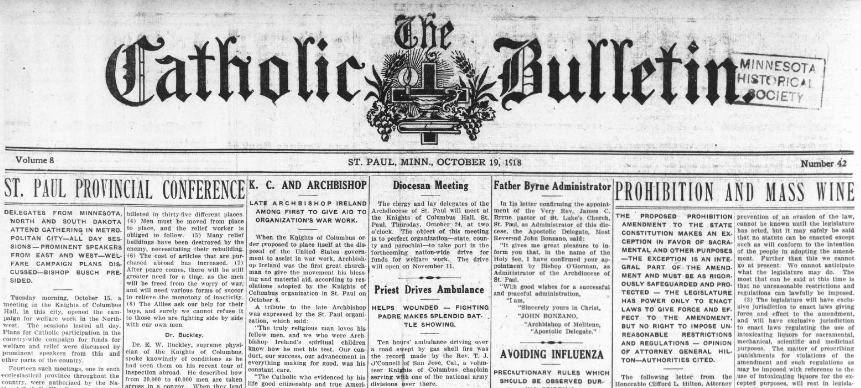
RAMP Minnesota citizen lobbyist Kurtis Hanna’s research has turned up an interesting letter from a former Minnesota Attorney General that discusses the laws around religious exemptions or exceptions to otherwise prohibitive laws. This letter is reproduced here at WeedPress below.
Follow WeedPress on Facebook!
The original document can be seen here:
- The Catholic bulletin. [volume] (St. Paul, Minn.), 19 Oct. 1918. Chronicling America: Historic American Newspapers. Lib. of Congress. <https://chroniclingamerica.loc.gov/lccn/sn90060976/1918-10-19/ed-1/seq-1/>
PROHIBITION AND MASS WINE
THE PROPOSED PROHIBITION AMENDMENT TO THE STATE CONSTITUTION MAKES AN EXCEPTION IN FAVOR OF SACRAMENTAL AND OTHER PURPOESS – -THE EXCEPTION IS AN INTEGRAL PART OF THE AMENDMENT AND MUST BE AS RIGOROUSLY SAFEGUARDED AND PROTECTED — THE LEGISLATURE HAS POWER ONLY TO ENACT LAWS TO GIVE FORCE AND EFFECT TO THE AMENDMENT, BUT NO RIGHT TO IMPOSE UNREASONABLE RESTRICTIONS AND REGULATIONS — OPINION OF ATTORNEY GENERAL HILTON — AUTHORITIES CITED.
______________________________________________________________________________________________________________
The following letter from the Honorable Clifford L Hilton, Attorney General of the State of Minnesota, to Norman E. Peterson, Esq., County Attorney, Albert Lea, Minnesota, is given t our readers as an official statement relative to the authority vested in the legislature and municipal governing bodies to enact laws governing the enforcement of prohibition, if the proposed amendment to the State Constitution be adopted at the coming election, and regulating the manufacture and regulating the manufacture, sale, etc., of wine for sacramental purposes in accordance with the intent of the amendment.
September 17, 1918
Norman E. Peterson, Esq.,
County Attorney,
Albert Lea, Minnesota
Dear Sir: In response to your inquiry as to the authority of the legislature and local municipal governing bodies in the matter of the enactment of laws with reference to the constitutional amendment prohibiting the manufacture and sale of intoxicating liquors in this state except for sacramental, mechanical, scientific, and medicinal purposes, if adopted at the coming election, you are advised:
(1) The prohibition as expressed in the amendment will be self-executing; but the legislature will no doubt enact laws with reference to prosecutions and punishments for violations thereof.
(2) The amendment excepts from its prohibition operation intoxicating liquors used for sacramental, mechanical, scientific and medicinal purposes. The language is clear, and will admit of no dispute as to the purposes for which such liquors may be manufactured, transported, sold, kept and used. The legislature will be without authority to add to or take from the substance of any of such exceptions. The manufacture, transportation, sale, possession and use of intoxicating liquors for sacramental, mechanical, scientific and medicinal purposes cannot by the legislature be declared illegal, for the amendment, if adopted, will be the supreme law upon the subject. But no doubt reasonable restrictions and regulations may be imposed by the legislature such as will insure against an exception being made a ruse or scheme for the accumulation of an unnecessary quantity of intoxicating liquor, and a disposition thereof for purposes other than those included within such exception. Just what restrictions and regulations the legislature may see fit to prescribe for the prevention of an evasion of the law, cannot be known until the legislature has acted, but it may safely be said that no statute can be enacted except such as will conform to the intention of the people in adopting the amendment. Further than this we cannot go at present. We cannot anticipate what the legislature may do. The most that can be said at this time is that no unreasonable restrictions and regulations can lawfully be imposed.
(3) The legislature will have exclusive jurisdiction to enact laws giving force and effect to the amendment, and will have exclusive jurisdiction to enact laws regulating the use of intoxicating liquors for sacramental, mechanical, scientific and medicinal purposes. The matter of prescribing punishments for violations of the amendment and such regulations as may be imposed with reference to the use of intoxicating liquors for the excepted purposes, will rest in legislative discretion.
(4) It is proper to call attention to the fact that if the proposed constitutional amendment is adopted, two things are provided for: (a) the prohibition generally of the manufacture, sale, etc., of intoxicating liquors in this state, and (b) the permission for the manufacture, sale, etc., of intoxicating liquors for sacramental, mechanical, scientific and medicinal purposes. The permission above referred to is just as much a part of the amendment as is the prohibition and must be as rigorously safeguarded and protected. It is altogether likely that the permission for sacramental purposes is in a somewhat different class than is the permission for mechanical, scientific and medicinal purposes. Our constitution expressly reserves “The right of every man to worship God according to the dictates of his own conscience” and expressly provides this right “shall never be infringed.” It is also further provided that, “nor shall any control of or interference with the rights of conscience be permitted.” A regulation that would be held reasonable under the amendment when applied to the manufacture, sale, etc., of intoxicating liquors for mechanical, scientific and medicinal purposes, might be held to be unreasonable when applied to “sacramental purposes” on account of the express provisions of our constitution above referred to. In the case of De Hasque vs. Atchinson, etc., Railway Co., 173 Pac. 73 (Okla.), it was held that, notwithstanding the prohibition provision in the constitution of the state of Oklahoma in which no exception was made permitting the transportation of intoxicating liquor for sacramental purposes, nevertheless the same was permissible for that purpose.
In addition to the case above cited I call your attention to the following cases and authorities as bearing upon the subject under consideration:
Fitch vs. State, 167 N.W. 417 (Neb.); State vs. Durein, 15 L.R.A.N.S. 908 (Kas.); State vs. G.N. Railway Co., 172 Pac. 546 (Wash.); City of Seattle vs. Brooklins, 167 Pac. 940 (Wash.); City of Delto vs. Charlesworth et al, 170 Pac. 965 (Col.); Sorris vs. Com., 83 Ky. 327; Woollen and Thornton on Law of Intoxicating Liquor, Sec. 507; Black on Intoxicating Liquor, Sec. 80.
Your truly,
Clifford L. Hilton,
Attorney General
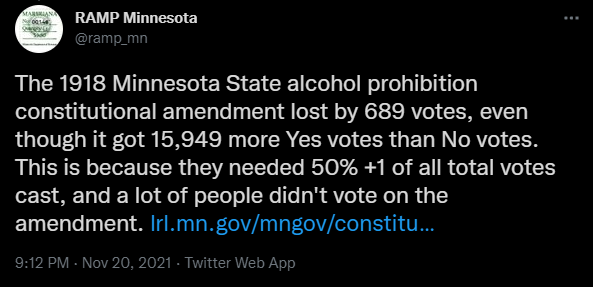
More information courtesy of RAMP Minnesota:
 WeedPress: The Paper Trail
Leave a comment