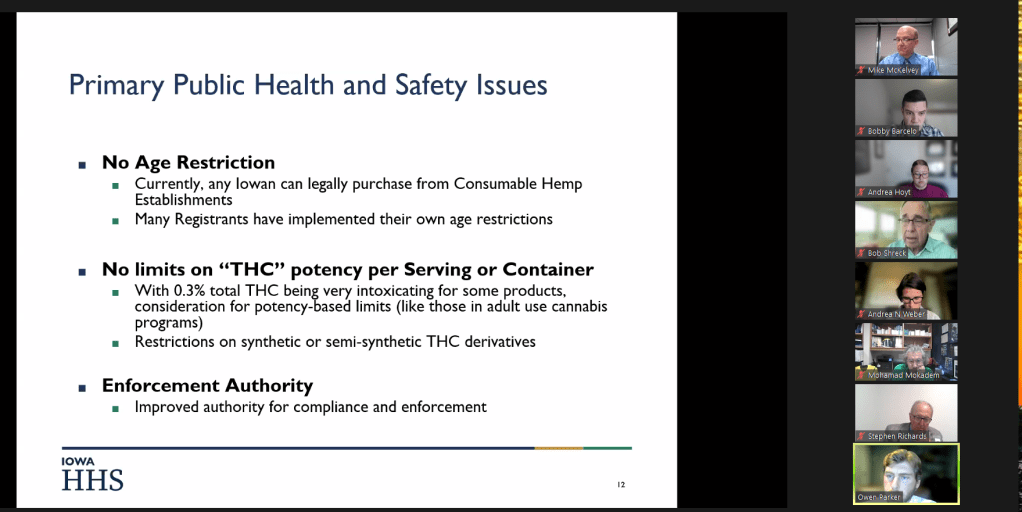
I missed the first part, but here is the final 55 minutes of video, audio, and transcribed text, from Friday’s meeting this month of Iowa’s medical cannabis advisory board meeting.
Medical Cannabidiol Board Meeting September 15 2023 (Transcript)
Owen Parker: [00:00:00] Yeah, so we’ve been able to do, like I can introduce some of the things we’ve done just to try to improve things initially. Iowa is a unique state relative to other programs. If there any registrant that wants to be a business in Iowa, they do have to submit a list of accurate products or an up to date list of products to us that include a certificate of analysis. And you have to think about it a thousand businesses. We’re dealing with dozens and dozens of businesses that have sometimes hundreds of products. It’s a lot of work to review all of them. But we are placing higher scrutiny on the intoxicating products. I think we’re comfortable with that position, just really taking those more to task, just knowing that those are requirements that we can enforce via the administrative rule. And just knowing that again the program was not intended specifically for the intoxicating products. So if they are able to get through, it’s going to be because they actually do pass the muster, the rules. So on the analyzer, one of the issues is they’re just objectively, there’s a lot of we’ll say fraudulence in the [] submitted with these products.
[00:01:26] We really don’t know a lot about them. Again these are the only requirements we can enforce. Some of them are a year old, some of them are multiple years old. There’s just a lot of inconsistency on that front. So we would like the ability to test some of these products if we go on a compliance inspection and we’re we don’t think that a product is under that 0.3 threshold. There are Enfield and cannabis analyzers now that will give you a pretty idea. Again, it’s not ISO 17025 like thousandths of a percent accurate or anything like that quantified. But it will tell us very quickly. It will tell me the difference between 9% and 0.3%. It will tell me if any of these products are way overshooting that threshold. And so we hope again trying to be solution oriented while we have communicated, we would need legislative support for some of these gaps just trying to do what we can. And I think that will help, just again, give us some teeth, going out in the field and being able to test those real time.
[00:02:37] Those are being used by Border Patrol. Those are being used by agencies all over the country, law enforcement and regulatory. And this is just going to be Iowa’s first one. So you said, there’s two months in, we were just happy to make the deadline for the alignment. That was our first goal. So we’ll continue to figure things out. I did have a couple of other items just for the board. Dr. Shaggy did send a note. And actually I was a little bit surprised by it, too. I did complete a report, I think back in June. It was about the board and just the roles and maintaining it and what would be the implications if it wasn’t present. I didn’t really know what was happening after that. But there was a panel recently that again as a part of alignment, just making decisions on whether there was any boards that could be consolidated or maybe weren’t necessary anymore or needed to be maintained. But this is one board I provided full support for maintaining and all the important reasons why.
[00:03:54] And I believe it was of the 215, there was only, I think somewhere around 60 that were just maintained as the way as they are. And this was one of those boards. Also definitely recognize the importance. And I did want to talk also just briefly about the board vacancies. So now at this point, again, with Dr. Stoken out, that’s the four vacancies that we have, which does require all of the current board members to be present at every meeting. So we really can’t conduct formal business unless everyone here is present going forward. I do know we did have a couple of candidates for the pharmacy position. Other one will not be able to do it. So actually, Dr. Weber, I know you’d had a recommendation, so I will reach out to him and that was a pharmacy recommendation. But I haven’t heard any chatter. I usually get notifications from the system if people submit materials. I’ve not gotten anything on any of the positions. So this is more welcome to recommend solutions now or any recommendations you have. But I think in general it’s just a call for you and your network that if you know of anybody in these specialties to maybe put a bug in there.
Mohamad Mokadem: [00:05:23] Hi. Sorry, I’m trying to catch up since I missed the last meeting. I was out of country, and I have a lot of questions, so I guess I’m may just send them or can chat for later. I don’t want to take much of the time, but at least if I want to just get to the main question that [] have right now on my list. So for the vacancies how the department is searching for those candidates just out of the reachability, is it based on a quest to look or it’s open and advertised for people to come in? That’s the first question before, like having possible candidates to recommend.
Owen Parker: [00:06:04] Yeah. There is the website that the governor’s office hosts that lists the vacancies. We haven’t done a specific outreach, I think in probably a couple of years. Dr. Mukadam we have used the Board of Medicine’s listserv before. The Board of Medicine has been supportive. And we’ve given them a link to that website where the materials are, list the vacancies that we have and their entire listserv. We actually weren’t able to get any bites there.
Mohamad Mokadem: [00:06:39] How people know that there is a vacancy among those who can or may be qualified. How would they know that unless they are actually going and searching that there is, how would the pool of possible candidates would be aware of this position?
Owen Parker: [00:06:59] Yeah, No, that’s a good point. And I think we do have a dedicated navigation on our website for the board. I think we haven’t added just our almost like a job posting. I don’t think we have anything on there right now. We’ve only done outreach. So I will actually talk with comms about adding that, just our list of vacancies and how to apply.
Mohamad Mokadem: [00:07:23] Okay. I’ll just mention the couple quick questions at least, and then leave something for maybe in a chat. So one of the colleagues who are like practitioner not interested in the vacancy part but is asking about what you guys personal experience in terms of timeline of getting certified as a prescriber because I didn’t go through that process. I don’t know but anybody have real life number in terms of the difficulty and the timeline. One of the practitioners is interested. So what does that would look like?
Owen Parker: [00:08:03] You mean in being appointed to the board?
Mohamad Mokadem: [00:08:06] No, no, no, no. As a prescriber in the institution.
Owen Parker: [00:08:12] Yeah. Dr. Mokadem in Iowa, there’s no CME requirement to be a certifier. Your license to practice medicine or be a nurse practitioner or a podiatrist is grounds to certify.
Mohamad Mokadem: [00:08:29] But you still have to register, right?
Owen Parker: [00:08:31] No you don’t.
Mohamad Mokadem: [00:08:33] No. Okay.
Owen Parker: [00:08:33] It’s the patients that register.
Mohamad Mokadem: [00:08:36] Yeah. Okay. So the practitioner doesn’t even have to report. Okay. Because I haven’t done that. And the last thing, I will just keep that for the catching up because everybody’s now with the hemp details program is coming up. I still don’t understand because for me it’s just a simple math. The point 3% is a percent. But as a physician, scientist, medical health professional or whatever board medically we’re commenting on the safety recommendation of these substances. It’s the pharmacology of the amount, ultimately milligram or gram entering the body. So if I just tell you do you want 0.3% of Elon Musk’s fortune or like 500% of my income, I mean the numbers [overlap]
Owen Parker: [00:09:32] Yeah. No, I think that’s a very tough [overlap] open.
Mohamad Mokadem: [00:09:36] You mentioned right now. The minimum THC level for psychoactive effects. So how is that program running where people can still get that if it’s at least part of safety because it’s beyond the ten minimum milligram of starting having if you get a big chocolate bar or whatever. And then we’re mostly regulating just the medical condition under which at least it could be covered and paid for and advertised. But the amount of THC available just on ground, anybody can get it what I’m understanding right now. Is that correct or not?
Owen Parker: [00:10:13] Yeah. No, I mean in some ways to simplify it, consumable hemp in its current form effectively is legalized edibles and drinkable products without a limit on potency.
Mohamad Mokadem: [00:10:28] Yeah.
Owen Parker: [00:10:29] And I think that is the crux of the issue, why it is probably again, I mentioned the primary concern of the regulatory community is again that 0.3% limit was instituted. It applied to the plant and when the industrial hemp programs were about food and fiber. It was never intended to apply into non-intoxicating or intoxicating product. CBD kind of came first, but again it has not really been worked on or elaborated. There’s a lot of jurisdictional type of issue federally.
Mohamad Mokadem: [00:11:11] No, I understand. I am justifying it, but I just for the sake of us at least, just clearing our mind and being more systematic especially because there are two programs. The hemp is a separate program and this is a program. It’s like somebody is concerned about weapon safety. You don’t create just a program for semi-automatic Belgium produced guns and then somebody else will just go only like the single shot. I mean if it’s a weapon and you think about its safety, this should be one program that assess everything that can harm or if it’s going to stay like that and there’s a lot of bureaucracy with, shouldn’t or wouldn’t be a limit per milligram or per gram during on the hemp program since the compound. We’re all here to talk about the THC at the end because I cannot see this dichotomy from a scientist standpoint.
Owen Parker: [00:12:08] And that is what a lot of states you’ve seen that have moved toward even in Minnesota’s bill that just passed that created adult use but consolidated medical cannabis and the cannabinoid hemp all within that new agency. There was a similar situation in Maryland where Maryland just did the same thing, where it’s just one agency that looks over all of them. But again, similarly, they’re using per serving and per container based limits in the medical and adult use cannabis programs and instituting some amount that’s able to be purchased over a given period of time. They’re doing it similarly for their cannabinoid hemp programs, where they’re instituting limits on how much that hemp product, how much THC it can have per serving, and how much it can have per container because again that gets us to a point where we’re probably looking at it again the way that it should be versus a percentage based limit, which is not again, I think we’ve all learned a limit and I don’t think that’s unreasonable. Those are the same rules that medical cannabis and adult use licenses have been operating under for some time.
Stephen Richards: [00:13:31] Owen, can I jump in just to clarify. When this committee began, the 0.3% existed on our product.
Owen Parker: [00:13:39] It was 3%. Dr. Richards.
Stephen Richards: [00:13:42] Okay 3%. But we were wise enough to realize the fallacy in that. And we did create a limit of 4.5g for our product. So we did get to the gram and obviously now we’re caught up and we probably need to be going in the same direction with the hemp products about this somehow limiting the grams.
Owen Parker: [00:14:05] Yeah, like I said we wouldn’t have a centralized system or anything like that, like we do for cannabis for purchasing, I don’t believe. But I think like I said, we can look at what other states are doing. We’re talking about just ways that, like I said, potency more milligram based at the serving and container level. That’s more what a lot of states are looking at.
Mohamad Mokadem: [00:14:31] Yeah, I mean even with chronic use because I mean you can get a small limit but like per amount because the chronic of 3 milligram per day is different from even like 10 or 15 once, stuff like that. Even if there is going to be another separate recreation program that might develop in the future or not, if the whole idea is safety, somebody has to look at it from a big umbrella rather than just, because somebody called that hemp and somebody called this cannabis and marijuana. But we’re supposed to be a medical cannabinoid. We’re interested in the pharmacobiology and then the bioavailability of a product that might have impact on people’s safety or not, medical condition for which it’s recommended or not, at what dose or not. But there’s a lot of beating around you. We should at least voice something that looks like we’re not probably achieving that or minimally achieving that. That’s just going to be my comment. I don’t want to take more time.
Owen Parker: [00:15:24] Yeah. No. These are all good comments, Dr. Mokadem because I think that’s what we’re figuring out both with the shared bureau, is we can recognize there’s definitely plenty of similarities and overlap, even though it’s really weird. And there’s a reason for one group to be looking over both of these. But do we know what it looks like? Yeah. We really don’t. I think that’s good for us to have this conversation here because I think that’s how we’re going to look at it. Whether we’re talking medical or this, we’re still looking at it with a public health and safety eye. That’s why we indicated those specific issues even though there might be many, many we could talk about labeling or marketing or what have you. We kind of indicated those top three because that’s what we will have to do now. We’ll have to look at both programs in relation to each other, what we can apply to one to both, what can’t be applied to the other. So I think we’re going to be having plenty of discussions about that in particular over the next year. But I just would say that this is I’ll say that again figuring out how this should work and how it blends with the other regulated programs is probably the greatest regulatory challenge right now in cannabis for any state. Because when there’s that federal piece of it that they’re in charge of that isn’t being acted on. It leaves it up to the states, just like with cannabis to try and navigate it. Nothing we’re not accustomed to.
Mohamad Mokadem: [00:17:02] Thank you. I appreciate it.
Andrea Weber: [00:17:06] Hey Owen, one quick question sparked by one of the questions in the Q&A. I know we had made a comment or recommendation about having APP representation on the board, but as of now, is it still just MS-DOS and then Pharm D?
Owen Parker: [00:17:20] Yeah.
Andrea Weber: [00:17:20] Okay.
Owen Parker: [00:17:21] Yeah. And that would need in the statute, it specifically calls out the disciplines and so they would have to be added to it.
Andrea Weber: [00:17:32] Okay, great.
Owen Parker: [00:17:35] And I did have just, I know there was mention of the second manufacturer update. I know we haven’t given you one in a while and I will have them. It’s always better to hear it from them, so I’ll add them in November. But they do have a complete facility. We’ve been working with them pretty closely over the last six, eight months. All the permitting is in order. Everything was finalized and they are up and running at this point with plants in the ground. That’s an exciting thing for the program. So we actually do have something we can backtrack now in terms of having multiple manufacturers in the state. And but again, I think it’s better to hear from them specifically. So I’ll invite them to the next meeting. I did just some national updates. I’ll just mention briefly, just talking about some of this consumable hemp and again regulatory priority. The group that we’ve been working with over the last few years is the regulatory network did submit. And I think even Dr. Shreck, you shared some of that. We provided a report on just some of our recommendations. And the big list of things we would want if there was real action on it. So I linked that here and you all can check that out. And then I just did want to mention briefly, just since I think Carl did mention it also is just that leaked HHS recommendation to the DEA about rescheduling.
[00:19:11] I think there’s been plenty of chatter about it, whether or not even paying attention. I think there’s plenty of pros and cons, depending on who you ask. I mean, again, the program would still be illegal. Any schedule doesn’t change that fact. It might be easier for some of the banking and tax things that have been discussed. Research certainly would be easier. But then you’re talking like real deal, drug path type of things and where does that fit in? And there could be a whole another situation of regulatory issues that aren’t really foreseen yet. So there’s anything that materializes on this, I’m happy to update the board later. But even if they were to go down this path, it would still take months or years and I think most of the in talking with other regulators, we’re just going to continue on the path as it is because we’ve just learned how long it takes things to change and we’ve heard this and that and never really materializes. So I just kind of wanted to give just a high level $0.02 on that that really until there’s anything more material, we’re not thinking too hard about it. So just from an update on numerous things, were there any other questions that the board had?
Bob Shreck: [00:20:40] Oh, is this what you labeled open swim on the agenda?
Owen Parker: [00:20:43] Yeah. Like I said, I just know that we’ve had a lot going on the last couple months, and we haven’t spoken a lot this summer, so just wanted to see if there was anything we could talk about or like I said, you do research for the final meeting.
Bob Shreck: [00:20:59] I could talk for an hour, but I won’t. Just interesting numbers here. I looked up how many physicians there are licensed in Iowa. It was just over 4500. There are just over 7300 nurse practitioners licensed in Iowa and 1300 physicians assistants. I couldn’t find out how many podiatrists there are, but let’s say there’s 150 of those. That’s 13,200 people able to certify. And if you do the math on the number of people who’ve actually done certifications, that’s about 15% of the Iowa medical professionals who our league can legally certify who actually certified at least one person. So it’s a vast majority of practitioners have not done so. Many of them are not in a position to do so. And who knows how many of these people that are licensed are still practicing, how many of them are practicing, reading x rays and not even interacting with patients and so forth. And how many of them have dropped out for the time being. But it’s a distinct minority of practitioners that are actually certifying. That’s an interesting number here. Also, if I read this right, when you talk about active cards. we’re talking about cards that are legally active, that have some time left on their one year duration. But that doesn’t necessarily mean that they’ve made any purchases, as I recall.
Owen Parker: [00:22:30] No. And if you look at the dispensary visits data, it’s broken out into unique visits and then total visits. I think it’s usually around, let me see here if we go back so 5300 unique patients visited last month to complete a purchase if there’s 18,000 patients, that’s another less than a quarter.
Bob Shreck: [00:23:02] I did the math. It’s 39%. So what it means is 60% unless I misinterpret what you mean by in the previous 12 months, 60% of those people with active cards are not purchasing or they’re purchasing infrequently. And in fact, if you take the total number of unique visits and the number of active cards, the average active card patient is making 1.7 visits per year.
Owen Parker: [00:23:28] Yeah.
Bob Shreck: [00:23:29] They’re going more than six months between visits to make a purchase on average. Obviously, there’s a lot of people don’t make any purchases at all, but that’s the average.
Owen Parker: [00:23:38] Yeah. And that’s especially relates to the space between dispensaries so we don’t always have that because we see obviously a higher volume in Des Moines where there’s a higher population base. But a lot of the other dispensaries, they have fewer transactions. But like a higher ticket price, people purchasing more.
Bob Shreck: [00:24:07] And people that return to purchase or one group of people those who, we don’t know why that 60% is not purchasing maybe that they tried it in years past or and then they found out it didn’t do anything. I think that’s going to be a large percentage of people that are going to try medical cannabis and find it’s disappointing in its benefits, but at least they’ve had a chance to try. There’s some I’m sure that it’s too expensive. That’s a big group. I’m sure they just can’t afford to do it, even though it provided some benefit. And of course, as we heard very emotionally and plaintively the availability with the number of dispensaries, it’s just hard to get there. You’ve got to drive two hours every month or six weeks to pick up some more and spend a couple hundred dollars. That’s a lot to ask. Well, I don’t have a solution for that, but that’s certainly reasons why they would drop out.
Owen Parker: [00:25:01] I will say Dr. Shreck, I think we were towards the end of last year, just even the talks of it. And this year we’ve certainly been very wrapped up in alignment, but again I think we have a little bit better of a budget situation. And I think once we get our arms around this from a staffing standpoint, we still can do the observational study, especially being a few years in without any mechanical changes to the program. I think we’ve talked internally about really wanting to get that done this year.
Bob Shreck: [00:25:37] We were cautioned by some outside expert a couple of years ago that to look for signs that your program is being abused, you should look for increasing numbers of young males dominating the market. As I look at the figures we have here, that doesn’t seem to be the case. They also said watch out for high potency THC, which of course we’ve got. But we’ve had that from the start. And of course the preferred form is vaporizable because for two reasons. One is you get the benefit right away. And number two, you can titrate much easier than you can with oral or any other form of administration. I thought it was particularly interesting that for seizures as an adverse condition, medical condition, there’s not a lot of people, but there’s a couple hundred of them. Most of them are taking the high potency THC, but in fact it’s the CBD that’s beneficial. But again why somebody ends up continuing to take medical cannabis may not be the reason they started taking it and that’s been one of my big concerns is that you start off hoping that your seizures will be controlled. You start off with your pain will be better. But if you get enough or you take it a bunch at a time, you discover a new benefit, if you want to call it that, a new experience. And that’s called euphoria. And you can be totally naive to cannabis, the THC, and discover this through our medical program and this is one of my biggest concerns, is that we are creating a market in euphoria inadvertently. Because the way our program is structured, we’ve seen this in other drugs. We see this in alcohol. We’ve seen this in opiates. A number of people who are addicted to these substances who have to have another, certainly there’s cannabis abuse syndrome which occurs and is not unusual. And as a medical program, we should try to prevent that. And of course, I think we did a good job with our 4.8 or 4.5 grams in 90 days. Somebody would have to completely take a lot of it in a few days and then do without in order to experience that. And then they couldn’t get more. But with the waiver program, we’re particularly at risk with that and I feel personally responsible here because the idea of a waiver came from board members when we met with legislators and they were stuck on the dose issue and it seemed like a legitimate compromise. Let’s offer a waiver. We already had a waiver for terminally ill people, which I think is not an issue to anybody. If they want to get stoned, that’s fine with them. We do the same thing with opiates for them in cancer medicine. But for the average citizen trying to go to work and maintain relationships and a job and personal responsibilities, you don’t want to create another population of people. As the governor Reynolds said to a couple of us in a meeting, we don’t need another psychoactive drug on the streets of the states of Iowa, the cities of Iowa. But we created this. And there’s two ways to bring it under control. One way would be to change the law, to get rid of the waiver or restrict it in some way. But that would require legislation. And the other way would be to go to the certifiers. And we’ve talked about this in the past, and here I’d make a pitch that we do. So if you look at the medical literature, which we’ve done in detail, there is no support whatsoever for a euphoric doses of THC in medical benefit. It’s not there. In fact, to the contrary, there are recommendations that 15mg a day is plenty. If it’s spread out and taken properly of THC, we allow 50mg a day, three times that even with our 4.5g limitations.
[00:29:34] The state of Utah recommends start low, go slow, get up to 15mg per day, not beyond that. So this is not a strange recommendation or a strange idea. And I think we should as a board and as a department, owe it to the certifiers of Iowa to educate them in this regard. As I recall, you yourself said when you contacted some of these people who’ve certified for large amounts, they were themselves unaware of the consequences of what they were doing and the medical literature that supports cannabis, but also limits cannabis. So I would you make a proposal that we as a board come up with a publication, a paper, a statement, a position paper, if you will, outlining this that we cite the medical journals and articles that support these limitations. And we make sure we get this in front of the certifiers of Iowa using their societies, perhaps even using the lay press, which I think would have a big impact because everybody would read that. We just need to come up with a document that the board and the department are comfortable with, which we know is supported by evidence based medicine. I think that is the circumstance, we just have to compose it. So that’s one of two points I was hoping to make, and I’ll stop right there to see if anybody else has any comments to make or discussions about that.
Steven Richards: [00:31:13] Steve Richards, I’m going to back up what Bob said about us coming up with an official position about what’s medical and what’s not medical in that regard. But for what it’s worth, if you want to hear about it, come to the the Iowa Academy of Family Physicians meeting in Galena in October. I’ve got two sessions trying to educate people about the endocannabinoid system and what it actually does and the effects that it has. But, Bob, you’re right. That’s what we need to do. And the lay press is where this belongs. Okay. About what’s medical and what’s not medical, and do our best to do that, because that’s the answer. This is the opioid world all over again. Opioids were safe in cancer patients, therefore they’re safe in all patients. Well, we found out that’s not really true. And we’re going to discover the same thing with this thing called medical marijuana.
Owen Parker: [00:32:09] Yeah. We’ve spoken and I don’t think we actually put anything in motion previously, but we could certainly put a committee together to decide and determine how long that should be, what should be included, what channels we use. I could take volunteers from that. I just do think the department, I certainly think we would like to have our say in what anything like that would look like. But if there is board support for that, I would take comment from any other board members and we could certainly make a motion to put a subcommittee together. I know we haven’t had any subcommittee work. I think maybe in the better part of a year now. But if there was interest in making a motion to provide a formal document, if you want to consider it the medical doses for cannabis and how to distribute it to the right medical agencies.
Steven Richards: [00:33:11] This is Steve Richards. I will make that motion and I’ll volunteer to serve because I think it’s what we have to do to try and do some control trying to make this a medical program.
Andrea Weber: [00:33:27] I’d also participate in the committee, especially to give information about the psychiatric related conditions that are part of our program.
Owen Parker: [00:33:39] Were there any other, I know you proposed it Dr. Shreck, but Dr. Mokadem, you mentioned interest in previously being on any committees, so I did want to at least give you. [overlap]
Mohamad Mokadem: [00:33:53] Yes, absolutely.
Owen Parker: [00:33:55] Okay. Would you be comfortable with that, Dr. Shreck? And I don’t think there’s any limit on how large a subcommittee can be. I’ll check on it. But if it’s important enough, I think we can include everybody.
Bob Shreck: [00:34:05] Thank you. Yes. I’ve been on most of the subcommittees we’ve organized over the years, partly because I have time. I’m still active in our group. I still participate, but I don’t have a schedule full of patients every day. So I’ve got time to do so. I have confidence in my colleagues. I think they all have great minds. The definition of a great mind, meaning somebody who agrees with me, which I think is a great definition. I got confidence.
Steven Richards: [00:34:33] Well, I’ll leave it to them.
Owen Parker: [00:34:35] Sounds good. Well, I think we kind of got the committee together, and I can take that as a first motion from Dr. Richards and a second from Dr. Weber. Were there any other comments on that? So Andrea and I, we’ll have that documented. I’ll largely probably have Andrea be coordinating with you on that. I mean, she is our attorney and pharmacist, so I think that’ll be a good for her to understand the subcommittee work. I’ll probably delegate that to her.
Andrea Weber: [00:35:12] Yeah, I just wanted to make the comment to that for people who are paying attention to recent stuff, the FDA did make the recommendation recently that cannabis be moved from schedule one to schedule three. I don’t know what’s going to happen with that, but [overlap].
Owen Parker: [00:35:26] Well, that’s what I was talking. It was actually like, I don’t know, the FDA didn’t confirm anything. I thought it was like HHS.
Andrea Weber: [00:35:35] Oh, maybe it was HHS. I’m sorry.
Owen Parker: [00:35:36] Yeah.
Andrea Weber: [00:35:37] Yeah I think you are correct.
Owen Parker: [00:35:37] It was like HHS had a memo recommending schedule three to the DEA, I believe.
Andrea Weber: [00:35:45] I wanted to bring it up because it reminds me of I think being a part of this medical board, there’s a lot of humility with the sense that we would love to have better research than we have. And it just reminds me of how prohibitive good research has been with the scheduling and structure around cannabis so far. And so I say that more to address like we have so many great people who come and share their experiences and their opinions and their expertise about cannabis and hemp and stuff and I really appreciate that. I think sometimes we are limited as the medical advisory board by what’s available to us as far as quality medical literature. And sometimes that’s just not as good as we want it to be. So I was just humbled by that. If it does get scheduled change, I think that would be a positive thing in the realm of being able to do good research on cannabis.
Mohamad Mokadem: [00:36:37] Thank you for bringing that up actually. I’m just about to send you I don’t know if you guys before are aware or might have attended some of those meetings on cannabinoid medical recreational, some of them are pure basic science, some of them are just like medical health. One of the bigger one I just get updates on it, is the international that’s multiple countries this year in Germany in Frankfurt and December 4 or 5. But I’m not sure if they have actually a zoom participation rather than you have to travel obviously for those meetings. But I’ll send the link if any of you are interested because as Andrea mentioned, I mean on top of our job, legislative safety wise, but updates in terms of scientifically and health benefits and both sides and what’s happening not just around the other states like all around the world. So I don’t know if any of you have experience from attending those meetings. I was planning to to do one in the future, but I’ll send the link just in case you guys want me to.
Owen Parker: [00:37:46] Yeah. No, we’d be.
Bob Shreck: [00:37:47] Please do. Please send it. Thank you.
Owen Parker: [00:37:49] Yeah. And was there any other questions or just any anything that the board had?
Bob Shreck: [00:38:04] But number two on my agenda. I’m concerned about the marketing. Again, I’ve mentioned earlier, I’m proud of our manufacturer. They’re great scientists. They do great work. They’ve got a great system set for manufacture, for safety and so forth. The marketing seems to as we discussed a year ago, gone far afield from medicine. I relooked at the website. It’s better, actually. I don’t know if it’s because of the department’s efforts or what.
Owen Parker: [00:38:35] No, I would say, Dr. Shreck, we did work with them on the providers. So for both manufacturers, there’s now no provider links. Even the link that does take you there, it’s just to Google Search, which has our program as the top search query. So that should be cleaned up. And we’ve been clear on our stance with referring providers.
Bob Shreck: [00:39:05] Even the graphics, they got rid of the fun lifestyle people, yucking it up and so forth. But I think there’s still work to do. If you review the website and go through its various permutations and it’s quite lengthy and of course only part of it applies to Iowa. What they can promote in Colorado is different. They’ve got a recreational program there, but when it comes to Iowa, they’re still terms. I won’t list them all. I think you are aware of them, that have nothing to do with medicine that I can see. There’s terminology that’s used. There’s an appeal to terpenoids, which to my knowledge has no scientific basis whatsoever and as a differentiating feature for the different products. I’ll have to look again at the referral to PrestoDoctor and referral to the Green Clinic. But I thought that on their website there was a direct link to those online.
Owen Parker: [00:39:55] Those have been removed. So there was in terms of again, the provider referrals. We’ve been clear and those should be cleaned up. And I would say that we did. I think we’re still going to have to find out if it’s enough to include it in rule or it would take it instead or it would require statute, but we did include the Board of Medicine’s standards for telemedicine, rules for standards of telemedicine in our red tape review.
Bob Shreck: [00:40:26] Right. It sounds like you’ve had some success because it is much better. Thank you for doing so. That’s all I have.
Owen Parker: [00:40:33] Perfect. And we’ll say we worked with them on just that issue. And then we obviously have our submissions for red tape that we’ll be working with them on. And the industry’s been aware of those for some time. And if there’s nothing else, I think we can go on to our what will ultimately end up being our last agenda item. Captain McKelvey.
Mike McKelvey: [00:41:06] Owen, are you talking about item six on the [overlap]
Owen Parker: [00:41:11] We can. Yeah, because I think we discussed the board vacancies and just what we can do there. And I think we can even talk a little bit about that in the subcommittee for the kind of medical dosing guidance.
Mike McKelvey: [00:41:27] Right. Okay. So item six is just a preliminary discussion on the board’s recommendations for its 2023 annual report to the legislature. We’ll discuss those recommendations from last year, as well as any new proposals from the members.
Owen Parker: [00:41:43] So everyone, again this is just the meeting where we have that introductory conversation and think it’s important to know that if we go back to the five years of this commercial program that we have, we’ve really just had the one bill in 2020, which was that initial expansion bill that corrected the 3%, that whole bill. But for the past three years, the 2020 report, 2021, 2022, we have not had any bills. So our list from last year is really just been refined list from the year previously. And really, I think we’ve also learned, too, that when we’re talking recommendations for statute edits, sometimes brevity is going to be better versus having a really long list of items. So I just first wanted to, this is more again giving the floor to you all. But I wanted to see if there was anything in the list from last year that you wanted to maybe talk more about, refine, get an update on how it’s going still in terms of necessitating a recommendation and just if there’s anything else that you wanted to include. So that way, like I said, we could draft something or get some research for you over the next couple of months.
Owen Parker: [00:43:08] So I’ll just give the floor to you all and share this up here and we can go to any of the recommendations that you’re curious about. So maybe to give an overview, changing this to the Medical Cannabis Act, I think we can still maintain it. It is helpful. And I think you probably are aware that at this point, again, just to be the education burden got to be pretty significant. It still is. There’s still a huge amount of confusion about what our program is, what consumable hemp is. So we have been using for public purposes cannabis at this point. So it’s not as big of an issue, but we can maintain that dispensaries are probably one of our biggest, we talked about that over and over. I think that’s why, again, we have this in the two spot. We’ve had heard anecdotes, every board meeting for numerous years that patients travel quite a bit. It’s a pretty big deterrent to participation in the program. This Removing sales tax has been on the list since 2020. Dr. Webber, this is what you’d actually mentioned about having a PA or [] on the board. And I think I would like to even give, if let’s say we keep a similar list, even give additional clarification on what the recommendations for these would be. I think at the very least, we can do that for an update.
Owen Parker: [00:44:52] This was one that was new to last year, if you remember, decoupling Iowa state taxes for businesses from federal tax code for 280E, which would allow them to, at least in Iowa, take the standard deductions as other businesses and reduce their effective tax rate. This is something we were not able to do in rural. So I think with the red tape update, I think this is something that we were going to try to do. But again, the confidential file is what it’s called in. The statute is so closed down that the legislature would have to give a specific access to give information back to the provider. So that’s just definitely needs to stay. We talked about improving this. So this at least was one thing where in our red tape review, we do have the Board of Medicine’s standards of practice for telemedicine. And we’ll just have to again, if we get any pushback, if we don’t have the authority to do that or if it doesn’t have any teeth, we’ll just have to figure that out through that process. And then this is what Carl had mentioned in his public comment and was from last year also which was just to assemble a legal task force to maybe help with the navigation of that issue. But I think this is all tied. It seems every six months or so we have some new conversation about rescheduling or this or that or so I mean, this is all tied to that. And you can see that obviously have a lot on their hands at the federal level. So just with that intro, is there any comment or for now, would the board prefer to keep this list and refine it and focus on brevity? And then again, anything between now and November, you’re welcome to send me, and we can do a final vote in November because that still gives us time again to finalize anything else before submission is due in December.
Mohamad Mokadem: [00:47:04] I’m fine with it. For me right now.
Owen Parker: [00:47:10] Dr. Webber, did you have any [].
Andrea Weber: [00:47:12] I was going to say, I still support all the recommendations that we had made. Whether we prioritize something whether by effectiveness or how long It’s been an issue we’ve been talking about, I guess is up to us for discussion. But I still support all the things that we’ve been recommending.
Owen Parker: [00:47:35] Yeah. I mean, this has been a good list and I think we’ve focused on because if you remember back to 2020, I think it was 12 of the 13 recommendations were taken. I believe that’s what it was. So sticking to a shorter list, I think is helpful. I think this is like I said, we have a lot of context for providing these recommendations. A lot of them are three years old at this point.
Bob Shreck: [00:48:03] Bob Shreck here, under I forget what the number is, number eight?
Owen Parker: [00:48:08] Yep.
Bob Shreck: [00:48:09] Seek a federal exemption for Iowa’s program. This is Carl Olsen’s issue, and he’s quite determined on it. And he seems to think that based on precedent elsewhere, on a different compound, different pharmaceutical, that we have an avenue for success here. And we recommended, as I recall, that the department pursue this. And in fact, I don’t remember the contents of house file 2589 back in June of 2020. But that did pass. And yet Carl tells us that the department has been absent on this issue, is making no efforts, is not pursuing these efforts. Is that the case? Is that a defensible position in light of what we’ve recommended and what the legislation calls for?
Owen Parker: [00:49:06] At this point, I don’t even have to go back and refresh myself on the whole thing. But I do believe in our mind at this point, we made those recommendations to those agencies. We’ve kind of run its course in terms of what we can do currently. We’ll discuss it more if there’s any more requests to going into the session. But like I said, we’ve done the work that we feel that we can at this point. It’s going to take a little bit larger engagement, I think, to go any further.
Bob Shreck: [00:49:45] It took me a long time to understand what Carl was talking about. I think he operates at an intellectual and maybe even an ethical level above mine. He’s obviously offended by the fact that we are breaking federal law, even though the feds aren’t. They’re not enforcing it. But he sees a mechanism to make us good and legal to get us an exemption like has been done for other chemicals elsewhere. So I admire his persistence. I admire his ethics. I’m not sure it would change what happens on the ground. Even if we did succeed, we’d still be facing some other restrictions and so forth, but we would no longer be breaking federal law. We’d no longer be criminals.
Steven Richards: [00:50:25] Yeah. And Carl’s work is admirable. Obviously, I’ve worked with Carl since I’ve been here. I think I would really need to refresh myself on it overall. But again, I do know we made those requests, and that was different than what Carl had wanted us to do. So I just have to refresh myself on the situation. So I think if that is the case, I just wanted to refresh the board’s understanding of these just for newer members, make them aware that some of these have been on here for a few years now. Obviously, we have no idea of the possibility of traction or the appetite for medical cannabis bill this year. I think we’ve also mentioned just as it relates to consumable hemp, there’s pretty large gaps there also that require work. So we’ll have to see what the session holds. But I think we can for now, if we want to vote to refine and maintain these ones. While we have the group here, we can do that. And then we still have one more meeting to finalize them. So next meeting will come with a final refined version for the board to vote on.
Mike McKelvey: [00:51:49] [Owen, do] you just want to all in favor of moving that direction vote?
Owen Parker: [00:51:54] Yeah, that’s fine. We don’t need a roll call, though.
Mike McKelvey: [00:51:57] Right. So is there a motion then to do what Owen just said? Kind of take this, maybe refine it a little bit and take a final vote here in the November meeting?
Bob Shreck: [00:52:13] I second what you just said, that Owen said. All right.
Steven Richards: [00:52:19] Okay.
Mike McKelvey: [00:52:20] All right. I’ll go down as the the first and Dr. Shreck as the second. All in favor, please say aye.
Bob Shreck: [00:52:28] Aye.
Steven Richards: [00:52:28] Aye.
Andrea Weber: [00:52:30] Aye.
Mohamad Mokadem: [00:52:30] Any opposed say nay.
Mohamad Mokadem: [00:52:35] All right. Thank you. That one carries item eight, a future meetings on right now. You had November 10th on there. We know because of the shortage on vacancies, it’ll be virtual. Is November 10th for sure or is that still tentative?
Steven Richards: [00:52:54] Yeah. Dr. Mokadem, that’s kind of what just knowing that we don’t have the members, I would prefer to like reconfirm schedules just to make sure that we all, five of us, can meet virtually. [overlap]
Mohamad Mokadem: [00:53:07] I definitely would like to attend all of them. I don’t want to skip any unless I was out of the country issue. But so I’m traveling that day to D.C., to the NIH. I have like a committee meeting. So it depends on the time. Is it going to be the same time? I mean, I can.
Owen Parker: [00:53:33] Yeah.
Mohamad Mokadem: [00:53:34] But I have to fly on the 10th. So If the time is flexible, we can discuss it later or if there are other options within that same week, I’m open to that too.
Andrea Weber: [00:53:46] November 10th is Veterans Day. It’s a state holiday.
Owen Parker: [00:53:50] Right. Okay.
Steven Richards: [00:53:51] Oh, and on November 10th, I am flying to Washington, DC for the American Medical Association meeting.
Owen Parker: [00:53:57] All right. Sounds like we’ll be moving it. And I will just coordinate with you all and just making the public aware that we will be moving that. It will be virtual, because we do need to make sure that the members that we have can all meet.
Steven Richards: [00:54:12] Thank you.
Owen Parker: [00:54:16] So if there’s nothing else, Captain McKelvey, I think we can move on to adjournment. I just did want to thank everybody for joining us today. Again well, this is medical cannabis, it was proper to provide consumable hemp update for many reasons to the board. So we’ll figure out what that looks like over time but worthwhile for today I think. Over to you, Captain Mckelvey.
Mike McKelvey: [00:54:41] All right. Item nine, we’ve come to the end of our agenda. Are there any further comments from our board members? Okay. If not, do we have a motion to adjourn?
Mohamad Mokadem: [00:54:55] Yes.
Mike McKelvey: [00:54:56] Dr. Mokadem, do we have a second?
Andrea Weber: [00:55:00] Second.
 WeedPress: The Paper Trail
Leave a comment