Imagine a doctor denied your father life saving surgery because he’s a medical cannabis user:
Pot Can Get You Kicked Off Transplant Lists — Even In States Where It’s Legal (Buzzfeed)
How would you feel? Here’s how to ensure loved ones never have to again face denial of medical life saving surgeries for being cannabis users:

The Federal Exemption Process in HF 675
HF 675 addressed two interconnected federal mechanisms: (1) seeking a Schedule I exemption under the CSA for medical use, and (2) advocating for reclassification of marijuana and nonsynthetic THC to Schedule II. These steps would reduce federal criminal penalties, allow for medical research, and shield state-licensed activities from federal interference. The bill required the Minnesota Commissioner of Health (who oversees the state’s Office of Medical Cannabis) to take proactive steps, rather than waiting for federal initiative.
Here’s a step-by-step breakdown of the federal exemption process as outlined in HF 675:
1. Application for Schedule I Exemption for Medical Cannabis (Waiver):
• Trigger and Responsibility: The Commissioner of Health was directed to submit a formal application to the U.S. Drug Enforcement Administration (DEA) and the U.S. Department of Health and Human Services (HHS) within 90 days of enactment. This application would request a waiver exempting cannabis from Schedule I restrictions specifically for state-authorized medical use in Minnesota.
• Rationale and Evidence: The application had to include data from Minnesota’s medical cannabis program, demonstrating “currently accepted medical use in treatment in the United States” (a key criterion for exemptions). Evidence included:
• Enrollment data: Over 30,000 registered patients by 2021.
• Qualifying conditions: Coverage for intractable pain, cancer, PTSD, epilepsy, and others under state law.
• Safety and efficacy reports: Low adverse event rates and positive health outcomes from the Office of Medical Cannabis.
• Economic impact: Protection for ~500 jobs in cultivation, manufacturing, and dispensaries.
• Safeguards in the Bill: The exemption was limited to “qualified patients, caregivers, and registry members”
2. Reclassification of Marijuana and Nonsynthetic THC to Schedule II:
• State Advocacy Role: In parallel, the Commissioner was required to submit comments to the DEA’s ongoing rulemaking docket (initiated by a 2016 HHS recommendation) supporting rescheduling marijuana and nonsynthetic THC from Schedule I to Schedule II. This would recognize moderate abuse potential but accepted medical value.
• Supporting Arguments: HF 675 mandated inclusion of Minnesota-specific data, such as program outcomes and peer-reviewed studies (e.g., from the National Academies of Sciences), to bolster the case for rescheduling.
• Federal Process:
• Petition and Notice: Builds on existing petitions; the DEA must respond within a reasonable time.
• Interim Rule: Possible temporary placement in Schedule II during review.
• Full Review: Involves HHS/FDA scientific evaluation, public comment period (30-60 days), and DEA finalization (up to 2 years).
• Benefits: Schedule II status would enable interstate transport for medical shipments, and banking access under federal law.
Broader Context and Impact
• Why This Process Matters: Federally, cannabis remains Schedule I, creating risks like asset forfeiture, banking denials (under the Bank Secrecy Act), and ineligibility for federal grants. HF 675 aimed to proactively mitigate these by leveraging Minnesota’s decade-long program as proof of medical legitimacy. It mirrored efforts in other states (e.g., Iowa’s medical cannabidiol board comments on exemptions) and aligned with the 2018 Farm Bill’s hemp distinctions.
• Bill Status: Introduced February 2021, HF 675 had a hearing in the House Health and Human Services Finance & Policy Committee but stalled amid session gridlock. A companion bill (HF 1023 by Rep. Gomez) and Senate version (SF 1357) pursued similar goals.
• Rep. Munson’s Role: As a conservative advocate for limited government, Munson framed the bill as protecting “vulnerable patients and business interests” from federal overreach.
For the full bill text, see the Minnesota Revisor of Statutes archive.
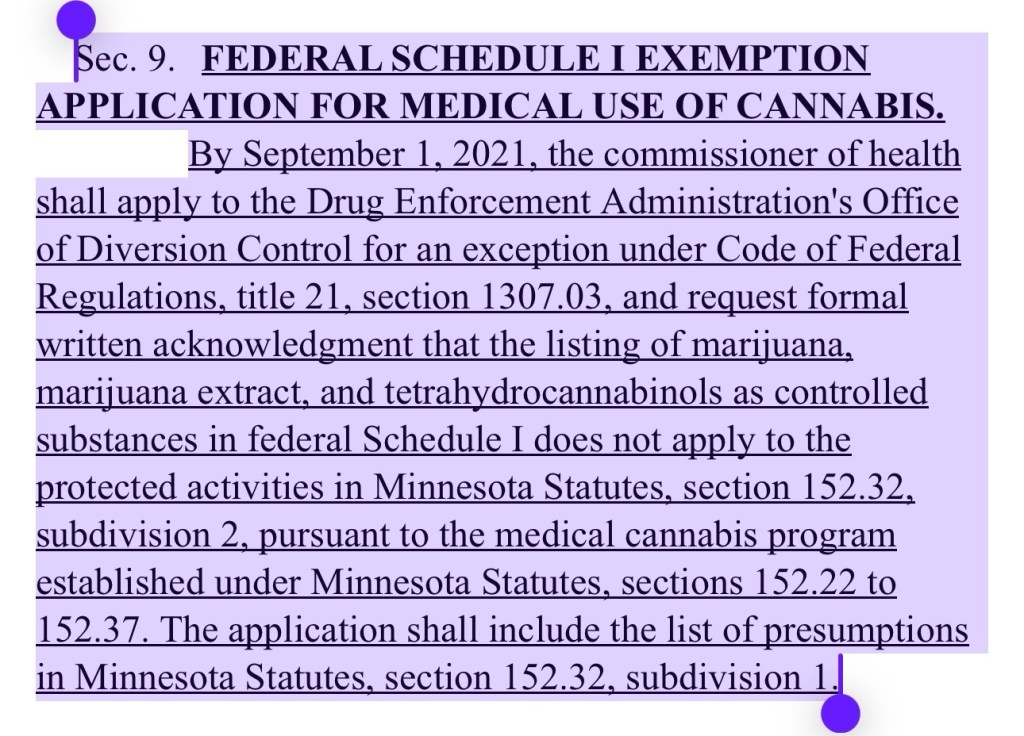
Passing state laws to entrap sick vulnerable people into federal crime isn’t without consequence. This “movement” is lucky to have WeedPress talking about this problem since 2009. Oh and that bill for federal exemption? The bill summary language was written exclusively and solely by WeedPress founder Jason Karimi. Don’t say we aren’t walking the walk.
This article posted here was sent to the South Dakota regulators of the cannabis industry via this link:
Online Comment Form via the LRC Portal
1. Start at the LRC Homepage: Visit https://mylrc.sdlegislature.gov. This is the centralized site for rulemaking and committee input.
2. Navigate to Rulemaking Comments:
• Click on “Rulemaking” in the top menu (or search for “rulemaking comments”).
• Select “Public Comments on Proposed Rules” or “Submit Comment.” This leads to the interactive form for proposed rules.
• If no active rulemaking is listed, use the general contact form under “Contact Us” and specify it’s for MMOC public input.
3. Fill Out the Form:
• Required Fields:
• Your full name.
• Contact info (email, mailing address, phone—optional for follow-up).
• Rule/Topic: Enter the specific rule (e.g., “ARSD 44:90:01 for patient certification”) or “MMOC General Comment: [Your Issue, e.g., Edibles Regulations].”
• Comment Body: Concise text (under 1,000 words) with your stance, evidence, and role (e.g., patient). Anonymous option available—check to withhold name.
• Attachments: Upload PDFs (e.g., studies) up to 5MB.
• Agency: Select or note “Department of Health (79)” for medical cannabis.
4. Submit and Confirm: Hit submit; you’ll get an email receipt. Comments are public records, viewable via the LRC search tool.
Alternative Methods (More Reliable for Immediate Submission)
• Email Directly to LRC Staff (Recommended Backup):
• Send to: lrc.comments@state.sd.us or rulemaking@lrc.sd.gov.
• CC: MMOC Chair Sen. Erin Tobin (erin.tobin@sdlegislature.gov) and Vice Chair Rep. Ernie Otten (ernie.otten@sdlegislature.gov).
• Subject: “Public Comment for MMOC Rulemaking: [Topic].”
• Include all details from the form above. This is explicitly encouraged for off-cycle input.
• Mail Submission:
• Address: Legislative Research Council, 3rd Floor, State Capitol, 500 E. Capitol Ave., Pierre, SD 57501.
• Attn: Rulemaking Comments – Medical Marijuana Oversight Committee.
• Include a cover letter with your details.
• Testimony at Meetings:
• Register via https://sdlegislature.gov/Legislative-Session/Committees/Medical-Marijuana-Oversight-Committee.
• Agendas post 1–2 weeks ahead; virtual Zoom options available. Limit: 3–5 minutes.
Additional Tips
• Track Active Rules: Check https://mylrc.sdlegislature.gov/Rulemaking/ProposedRules.aspx for open comment periods (30 days typically).
• DOH Portal: For program-specific feedback, email medcannabis@state.sd.us via https://doh.sd.gov/medical-marijuana/, but route MMOC comments through LRC.
• Recent Context: November 2025 MMOC motions highlighted limited public input—your comment could influence 2026 reforms.
If you run into issues accessing the site or need a sample comment drafted, share more details! For verification, the LRC phone is (605) 773-3251.
Read more:
 WeedPress: The Paper Trail
Leave a comment