Why Most State Drug Laws Will Collapse Without Immediate Legislative Repair
A WeedPress White Paper
Based on national Controlled Substances Act architecture documented by Vicente LLP
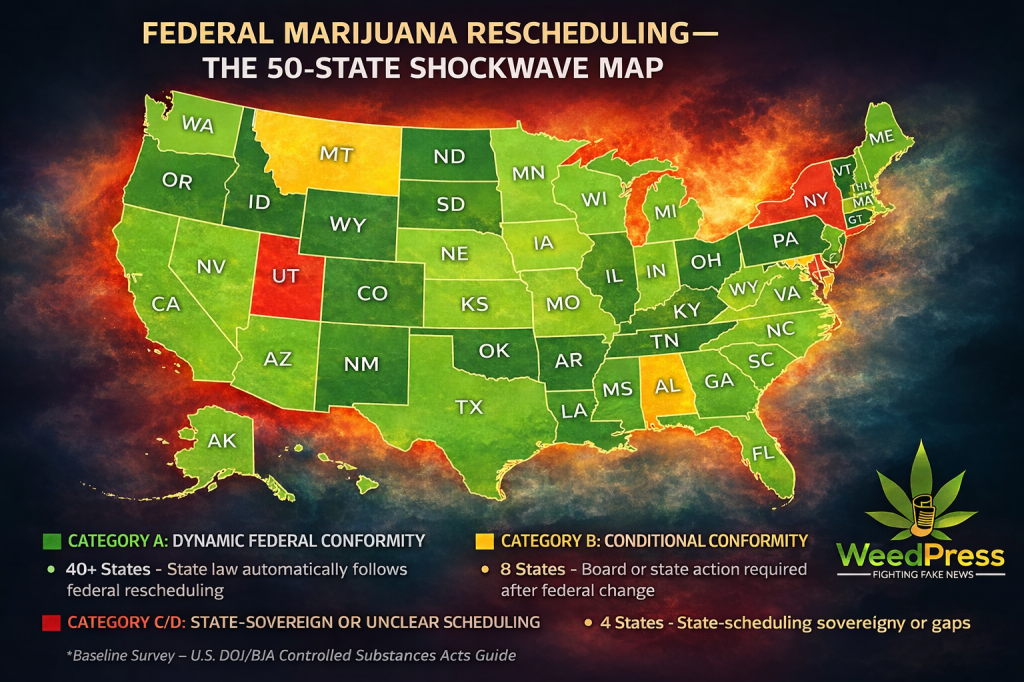
Executive Summary
The American drug-law system is not fifty independent sovereign criminal codes.
It is a federally anchored network of derivative state statutes.
Most U.S. states have written their Controlled Substances Acts (“CSAs”) so that federal scheduling decisions automatically rewrite state criminal law or trigger mandatory restructuring. This architecture means that federal marijuana rescheduling, descheduling, or exemption will immediately destabilize or collapse marijuana enforcement in a majority of states — regardless of state political intent.
This white paper documents:
• Why most states lack sovereign marijuana law
• How federal rescheduling legally rewrites state criminal codes
• Which states face automatic collapse
• Why South Dakota and Utah are confirmed structural failure states
• Why federal carve-outs trigger nationwide legal domino effects
• What states must do to prevent enforcement vacuums
I. The Hidden Architecture of U.S. Drug Law
State Controlled Substances Acts do not stand alone.
They are structurally tethered to the federal Controlled Substances Act.
A national regulatory survey by Vicente LLP documents that:
“The majority of states include in their laws a regulatory mechanism for the addition, removal, or rescheduling of a substance when a federal schedule change occurs.”
This means state criminal law is federally derivative, not sovereign.
II. Three Classes of State Dependence
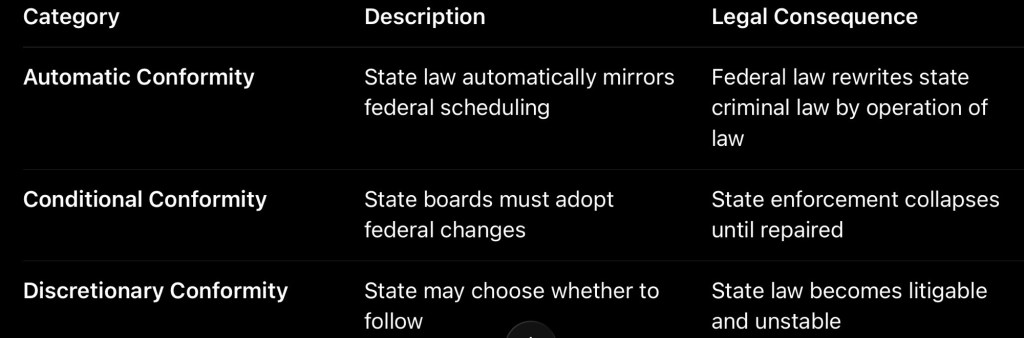
This creates a national legal reality:
Federal marijuana reform automatically alters or destabilizes most state criminal codes.
III. South Dakota & Utah — Confirmed Structural Failure States
South Dakota
Vicente LLP identifies South Dakota as a Blue-Category State:
• No independent marijuana definition
• No hemp distinction
• No internal scheduling authority
• Department of Health must recommend changes
• Legislature must repair before enforcement can resume
Federal change = enforcement vacuum
Utah
Utah is structurally worse:
• No hemp exemption
• No statutory scheduling authority
• CSA incorporates federal CSA
• No designated sovereign authority to repair scheduling
Utah has no lawful scheduling sovereign.
Federal change creates immediate due-process failure.
IV. Constitutional Consequences
Federal marijuana rescheduling triggers:
• Supremacy Clause preemption
• Void-for-vagueness failures
• Due-process notice violations
• Equal-protection conflicts
• Enforcement collapse absent legislative repair
This is not political — it is structural.
V. Why One Federal Exemption Creates a National Domino Effect
Once marijuana ceases to be uniformly scheduled at the federal level:
• State CSAs lose definitional coherence
• Prosecutions lose statutory foundation
• Courts lose enforceable standards
• Legislatures are forced into emergency repair
This makes federal exemptions de facto national legalization accelerators, even when states oppose reform.
VI. Required State Repairs
To prevent collapse, states must:
• Create independent marijuana/hemp definitions
• Establish sovereign scheduling authority
• Decouple CSA operation from automatic federal conformity
• Codify procedural rescheduling mechanisms
• Restore constitutional notice sufficiency
VII. Conclusion
The United States has unknowingly built a centralized drug-law nervous system.
Federal marijuana reform is not a policy choice — it is a structural detonation inside state criminal law.
Most states will lose marijuana enforcement authority automatically when federal scheduling changes.
This is not theory.
It is the architecture.
 WeedPress: The Paper Trail
Leave a comment