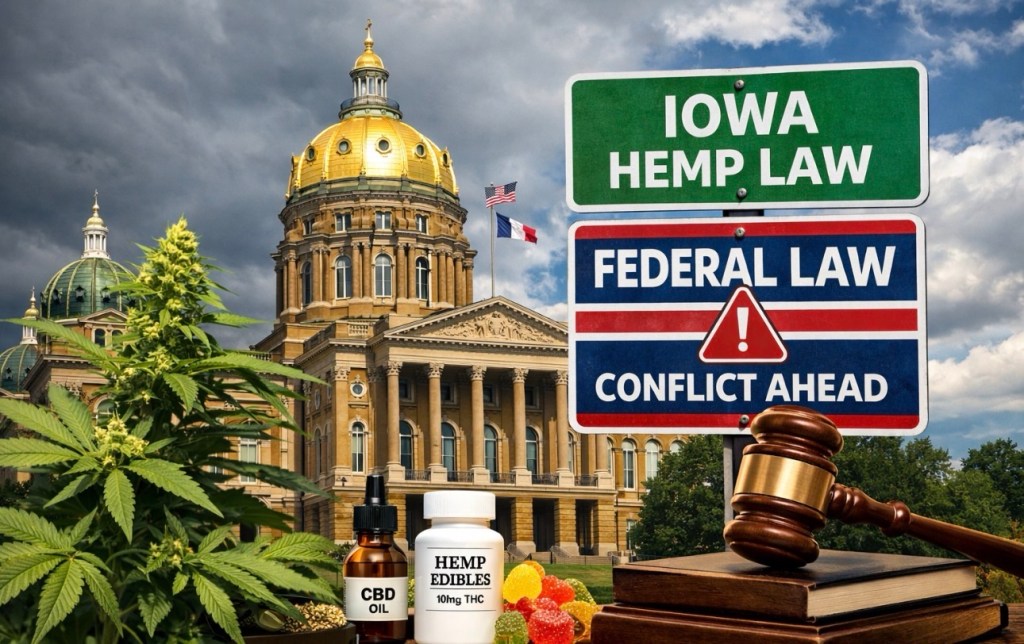
For the last few years, Iowa has tried to thread a needle: keep “hemp” legal while cracking down on the intoxicating THC marketplace that grew out of the 2018 Farm Bill’s loopholes. That’s the basic story behind Iowa’s consumable-hemp rules (embedded in Iowa’s Chapter 204 framework and enforced through state rules and HHS registration): age limits, warning labels, bans on synthetics, and hard potency caps like 4 mg THC per serving / 10 mg per container.
But Congress just moved the goalposts.
On November 12, 2025, Congress and President Trump enacted a change to the federal hemp definition (in P.L. 119-37) that reimposes federal controls over certain hemp products by tightening what counts as “hemp” under federal law.
And that creates a blunt reality for Iowa: a state can regulate within its borders, but it can’t make federally-illegal products federally legal. If Iowa’s rules keep permitting a category of “hemp” products that federal law says are actually controlled substances, the state is basically inviting a compliance and enforcement mess for farmers, retailers, and consumers.
What Iowa law currently does (in plain English)
Iowa’s recent hemp updates were designed to shrink the intoxicating market without fully banning hemp-derived products:
– Age restriction: 21+ for “consumable hemp” sales.
– Potency limits: generally 4 mg total THC per serving and 10 mg total THC per container (with serving-size definitions and labeling rules pushed into agency rules).
– Ban on “synthetic cannabinoids” (Iowa has treated delta-8-style products as prohibited).
– Total-THC concept: Iowa HHS guidance emphasizes total THC and even uses a delta-9 + THCa conversion in compliance materials.
That regime was Iowa’s attempt to say: “We’ll allow limited-dose hemp edibles/drinks, but we’re not letting this become backdoor recreational marijuana.”
What federal law changed — and why it breaks the old assumptions
The Congressional Research Service summarizes the federal change like this:
– The federal definition now targets “total THC” (not just delta-9) at < 0.3% on a dry-weight basis.
– It expressly excludes certain categories, including: intermediate hemp-derived products over the limit, and final hemp-derived cannabinoid products containing more than 0.4 mg of THC per container.
– It also excludes hemp-derived cannabinoid products with cannabinoids that are not naturally produced by the plant or that were synthesized/manufactured outside the plant (a direct shot at much of the “intoxicating hemp” industry).
– Effective date: the CRS notes this new definition takes effect November 12, 2026.
That means Iowa’s current “legal” potency caps (like 10 mg per container) can end up dramatically higher than what federal law will allow for “hemp” (0.4 mg per container) once the new federal definition kicks in.
The practical problem: Iowa’s “legal hemp” can become federally-controlled marijuana overnight
If you’re a retailer or manufacturer, here’s the risk profile Iowa creates if it doesn’t update Chapter 204:
– Products compliant in Iowa could be noncompliant federally (and treated as controlled substances) once the federal definition takes effect.
– Interstate commerce becomes a trap. You might be “legal” under Iowa’s state scheme but moving federally-illegal product through channels that banks, insurers, payment processors, and shippers won’t touch.
– Enforcement becomes arbitrary. The CRS notes uncertainty about how aggressively federal agencies will enforce, but “uncertain enforcement” is not a business plan.
Iowa can avoid that chaos by aligning state definitions now, well before November 2026.
What Iowa lawmakers need to do next
Here are the fixes Iowa’s legislature should be debating this session (not in late 2026, under panic conditions):
1) Update Iowa’s definitions to match the new federal hemp definition
The cleanest approach is to incorporate the updated federal definition directly (including total-THC treatment and the federal exclusions). That prevents Iowa from maintaining a legal category that federal law says is contraband.
2) Rebuild Iowa’s consumable limits around what federal law will recognize as “hemp”
If federal law draws a bright line at 0.4 mg THC per container for “final products,” Iowa has to choose:
– Either tighten state “hemp” allowances to stay within that line, or
– Reclassify higher-dose products into another legal regime (which, in Iowa, effectively means “not legal” unless the state creates a different cannabis framework).
3) Codify the “no synthetics” rule with the same concepts federal law uses
Iowa already moved against synthetics in practice.
Federal law now explicitly excludes synthesized/manufactured-outside-the-plant cannabinoids from the hemp definition. Iowa should mirror that language so there’s no argument about loopholes and lab tricks.
4) Create a safe off-ramp: grace periods, inventory wind-down, and clear enforcement dates
Businesses need a predictable transition:
a sell-through window for existing stock, clear testing + COA requirements, and a single statewide enforcement start date tied to the federal effective date (or earlier, if Iowa chooses).
5) Clarify what happens to Iowa’s existing 4 mg / 10 mg model
Right now, Iowa’s public-facing rule is easy to communicate: 4 mg/serving and 10 mg/container.
If federal law effectively shrinks “legal hemp” to something like “trace THC only,” Iowa lawmakers should be honest about it: that old model may not survive federal preemption in practice.
Bottom line
Iowa’s Chapter 204 hemp system was built for the old federal world: delta-9-centric definitions, a gray-market explosion, and states improvising guardrails.
But Congress has now written a new federal definition that (1) moves to total THC, (2) clamps down on final products, and (3) targets synthetic/intoxicating derivatives—with an effective date in November 2026.
So the Iowa legislature has a choice:
– Update Chapter 204 now to align with federal law and give businesses time to adapt, or
– wait until the deadline and trigger a last-minute scramble where “legal in Iowa” becomes “illegal federally” and everyone pretends they didn’t see it coming.
Either way, the fix is legislative. And the clock is already running.
Furthermore, I’m not a hemp advocate. Hemp should never have been legalized separate from cannabis. Just legalize cannabis and quit playing loophole winky wink games. It’s setting up industry and patients for a trap, and makes the unconstitutionality of cannabis prohibition more confusing for everyone.
What we need to do is roll hemp out of Chapter 204 and put it in Chapter 124E for medical use, and then get 21 USC 822(d) to make it all legal so the cost comes down.
 WeedPress: The Paper Trail
Leave a comment