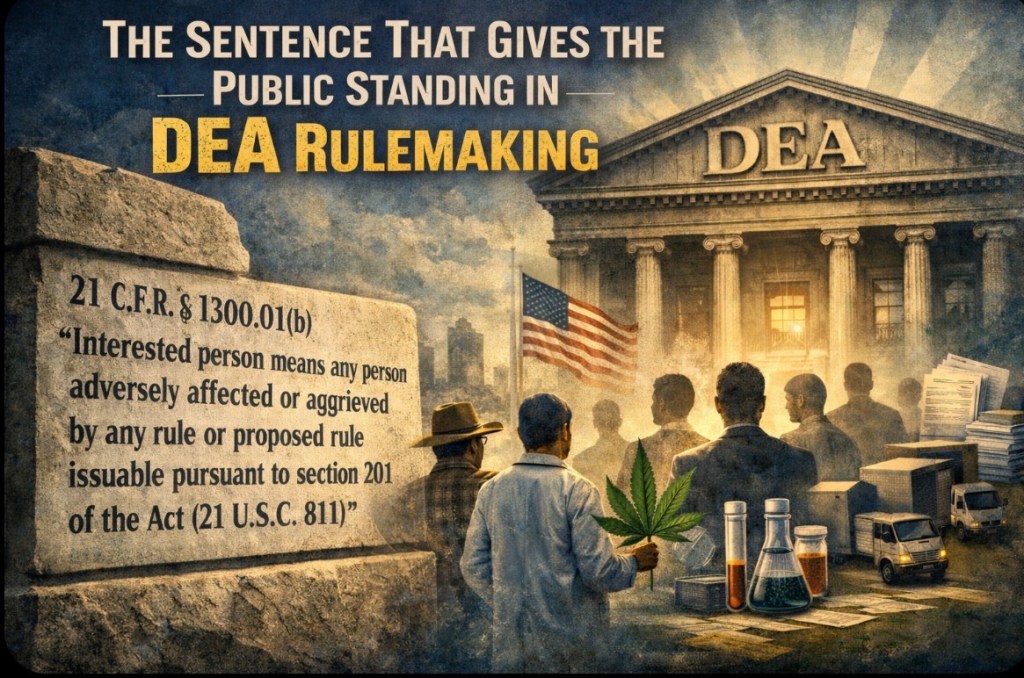
There is a single sentence inside federal regulations that quietly determines who gets legal standing in DEA drug scheduling and rescheduling proceedings.
It is not a press release.
It is not a policy memo.
It is not optional.
It is binding federal law.
And it decides who gets a seat at the table.
The Controlling Definition
The DEA’s master definition appears in 21 C.F.R. § 1300.01(b):
“Interested person means any person adversely affected or aggrieved by any rule or proposed rule issuable pursuant to section 201 of the Act (21 U.S.C. 811).”
That one sentence governs all federal scheduling, rescheduling, and descheduling of controlled substances.
Not just marijuana.
Not just opioids.
Everything.
What “Adversely Affected or Aggrieved” Really Means
This language is deliberate — and extremely broad.
You do not have to be licensed by the DEA.
You do not have to hold a federal registration.
You do not have to be a pharmaceutical company.
You only have to show that a DEA rule:
• restricts your business
• increases your compliance costs
• interferes with your livelihood
• changes what you can sell, grow, research, prescribe, or transport
• damages your economic interests
• limits your access to products or services
• alters your legal exposure
If the rule hurts you or threatens to hurt you — you qualify.
Why Cannabis and Hemp Created Millions of Interested Persons
Federal cannabis policy now exists in a collision zone:
• the Controlled Substances Act
• the Farm Bill
• state legalization programs
• federal hemp commerce protections
• pending rescheduling actions
Every time the DEA issues or proposes a rule that collides with those systems, new interested persons are created by law.
Hemp farmers.
Processors.
Retailers.
Interstate carriers.
Payment processors.
Testing labs.
Consumers.
Advocacy organizations.
Researchers.
Publishers.
All of them can be “adversely affected or aggrieved.”
Which means all of them have standing.
What This Standing Unlocks
Once you qualify as an interested person, federal law gives you:
• the right to participate in rulemaking
• the right to submit formal objections
• the right to demand hearings in scheduling proceedings
• the right to force agency records
• the right to create judicial review jurisdiction
• the right to challenge unconstitutional enforcement
This is how federal agencies are actually constrained — not by press conferences, but by procedural law.
Why This Changes Everything
DEA does not control who gets standing.
The regulation does.
And it does not say “DEA registrants.”
It says any person adversely affected or aggrieved.
That quietly turned the public into legal participants in federal drug policy.
Final Thought
The next phase of cannabis reform will not happen quietly in Congress.
It is already happening loudly inside federal rulemaking proceedings — by the people who now legally qualify as interested persons.
And the law already gave them the microphone.
 WeedPress: The Paper Trail
Leave a comment