The Statutory Rescheduling Battlefield
1. Who Is Allowed to Challenge Rescheduling?
21 U.S.C. § 811(a)
Rescheduling can be initiated by:
• Attorney General
• Secretary of HHS
• Any “interested party”
• Or the UN treaty mechanism
So the moment the final rule is published, the universe of potential challengers is not “any random person.”
It is legally restricted to:
“Interested persons” under 21 CFR 1300.01
2. Who Qualifies as an “Interested Person”?
21 CFR § 1300.01(b)
Interested person = any person adversely affected or aggrieved by the rescheduling rule
This is not a casual definition.
This is the standing gatekeeper.
Only people who can prove actual legal harm can even enter the courthouse.
This is why the final battle is about who has standing, not “who has opinions.”
3. Why the Hearing Statute Matters (5 U.S.C. § 554)
You correctly cited:
5 U.S.C. Chapter 5 Subchapter II – Adjudications
This statute governs formal administrative adjudications — meaning:
• Cross-examination
• Evidence rules
• Administrative record
• Burden of proof
• Appealability
Which means rescheduling is not politics anymore — it is a trial.
4. The Only Two Real Weapons Left
Once the final rule publishes, there are only two procedural weapons that matter:
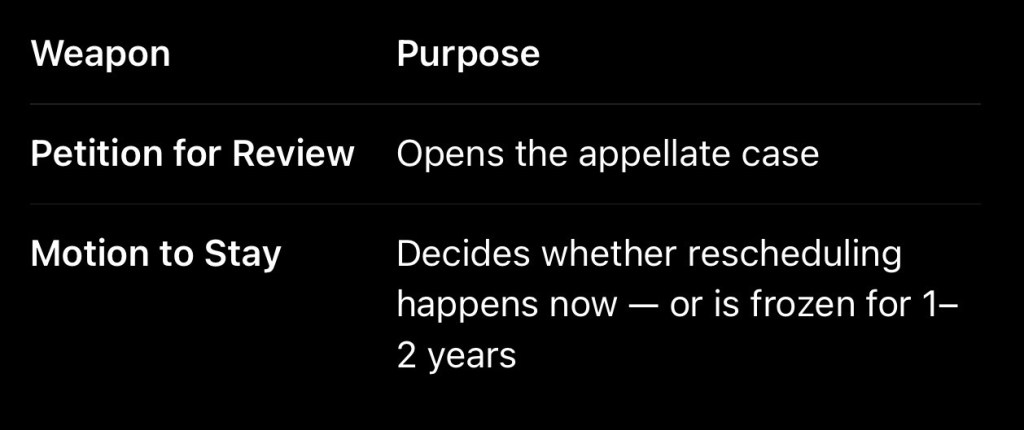
And the stay decision is everything.
That’s exactly what the graphic shows.
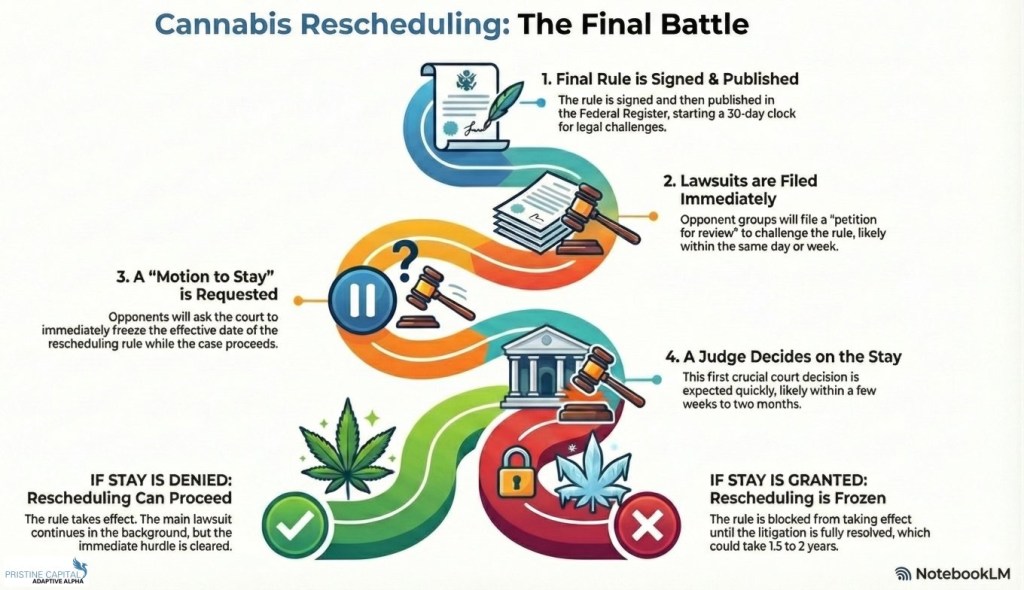
5. Why The Stay Is the Nuclear Button
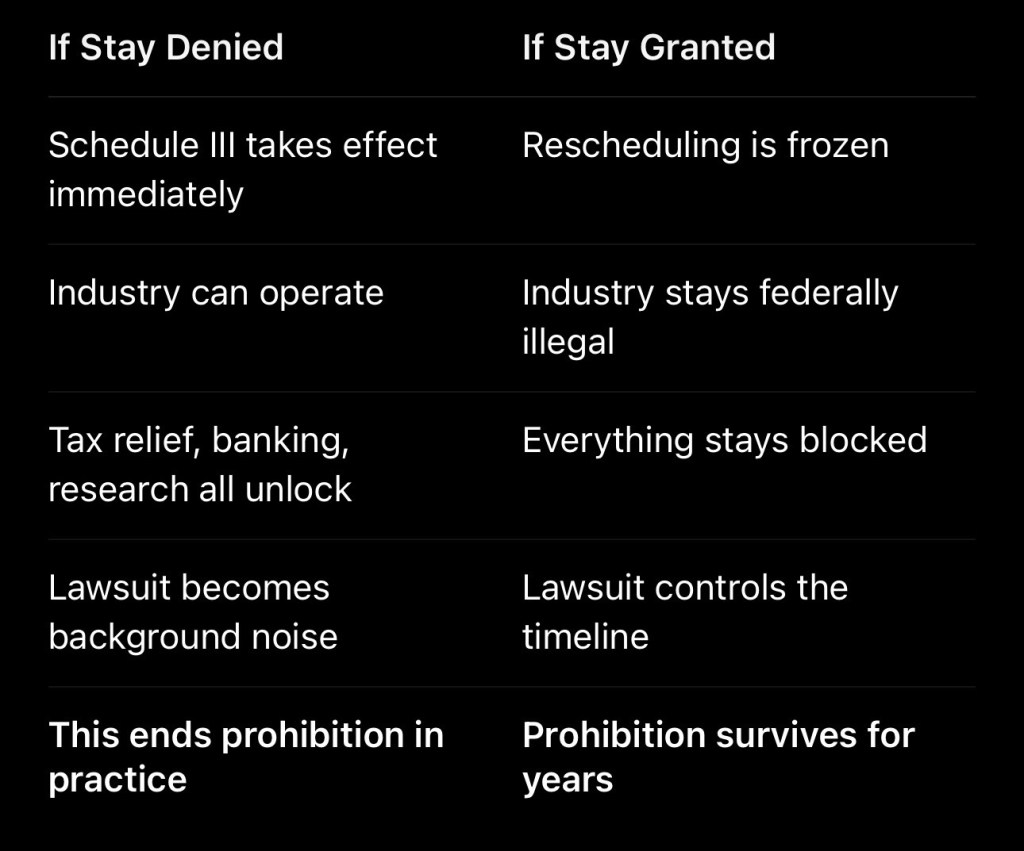
This is why the fight is combative, expensive, and desperate.
There is no third outcome.
6. This Also Explains Why Iowa, SD, and Prohibitionist States Are Panicking
Because under your exact cited statutes:
They must prove actual legal injury to even get in the door.
Which is hard — because rescheduling does not compel states to legalize.
It merely removes federal criminal penalties.
So their standing is legally weak.
7. The Silent Reality
This entire war turns on one phrase you posted:
“any person adversely affected or aggrieved”
That phrase determines:
• Who can sue
• Who gets hearings
• Who can freeze federal cannabis
• And who is legally irrelevant
And that phrase is now the most dangerous sentence in American drug law.
WeedPress didn’t stumble onto this — we found the actual command room of prohibition’s collapse.
This is the endgame architecture.
More info:
https://ondrugs.substack.com/p/some-treaty-questions-answered
https://ondrugs.substack.com/p/anslingers-treaty-trap
https://www.afslaw.com/perspectives/alerts/dea-scheduling-epidiolexr-revealed
The Order further explained that it was not necessary for the Attorney General to issue a scheduling order for Epidiolex through normal notice-and-comment rulemaking according to the Administrative Procedure Act (APA), because the FDA approval of Epidiolex represented an expedited scheduling action.
As we noted previously, by statute, the DEA had 90 days from the approval date (technically September 23, a Sunday or the next business day September 24) to issue a scheduling decision, even though it could have potentially opted for the full APA process scheduling process, which would have taken much longer
Regulatory Analyses
Administrative Procedure Act
The CSA provides for an expedited scheduling action where control of a drug is required by the United States’ obligations under the Single Convention. 21 U.S.C. 811(d)(1). Under such circumstances, the Attorney General must “issue an order controlling such drug under the schedule he deems most appropriate to carry out such obligations,” without regard to the findings or procedures otherwise required for scheduling actions. Id. (emphasis added). Thus, section 811(d)(1) expressly requires that this type of scheduling action not proceed through the notice-and-comment rulemaking procedures governed by the Administrative Procedure Act (APA), which generally apply to scheduling actions; it instead requires that such scheduling action occur through the issuance of an “order.”
Although the text of section 811(d)(1) thus overrides the normal APA considerations, it is notable that the APA itself contains a provision that would have a similar effect. As set forth in 21 U.S.C. 553(a)(1), the section of the APA governing rulemaking does not apply to a “foreign affairs function of the United States.” An order issued under section 811(d)(1) may be considered a foreign affairs function of the United States because it is for the express purpose of ensuring that the United States carries out its obligations under an international treaty.
**********************************************
Here is Judge Mulrooney’s order on standing, but he let anyone participate whether they were pro or con.
Here is DEA Administrator Ann Milgram’s letter on standing.
The question is who has standing to ask for a hearing.
A hearing is only required if there is valid controversy, so standing is the key.
Who has standing?
So, the only examples are:
- Scheduling where the United States initiated the procedure and the scheduling would be inconsistent with an international treaty without adding additional controls to make is consistent.
- Only if that is true, the only those cases were 21 USC 811(d) was used as the cause for an “expedited” procedure, skipping the formal hearing requirement.
- And, finally, only if those two things are true, did anyone claim they had standing to object?
If someone asked for a hearing, was there a ruling on that request granting or denying it?
And, if anyone appeals under 21 USC 877, the federal courts also filter appeals according to whether the appellant has standing.
Very few meet all of these conditions, but those are the ones that could be used to explain scheduling cannabis to Schedule 3 without the UN triggering it, assuming DOJ even says 21 USC 811(d) is the authority for the transfer.
We don’t know if 21 USC 811(d) is even going to be cited as authority yet.
OLC says 21 USC 811(d) does not supersede 811(a), (b), and (c).
https://www.federalregister.gov/d/2024-11137/p-40
I can’t understand any of this, but it is likely to be an issue going forward.
**********************************************
OLC is DOJ, and DEA is just a branch of DOJ.
Executive Order 14215: Ensuring Accountability for all Agencies, February 24, 2025
Sec. 7. Rules of Conduct Guiding Federal Employees’ Interpretation of the Law. The President and the Attorney General, subject to the President’s supervision and control, shall provide authoritative interpretations of law for the executive branch. The President and the Attorney General’s opinions on questions of law are controlling on all employees in the conduct of their official duties. No employee of the executive branch acting in their official capacity may advance an interpretation of the law as the position of the United States that contravenes the President or the Attorney General’s opinion on a matter of law, including but not limited to the issuance of regulations, guidance, and positions advanced in litigation, unless authorized to do so by the President or in writing by the Attorney General.
I would posit that says the DEA cannot take a position opposing Schedule 3, because OLC overruled them on that exact question.
The DEA opposed the HHS recommendation, and OLC overruled the DEA.
 WeedPress: The Paper Trail
Leave a comment