Executive Summary
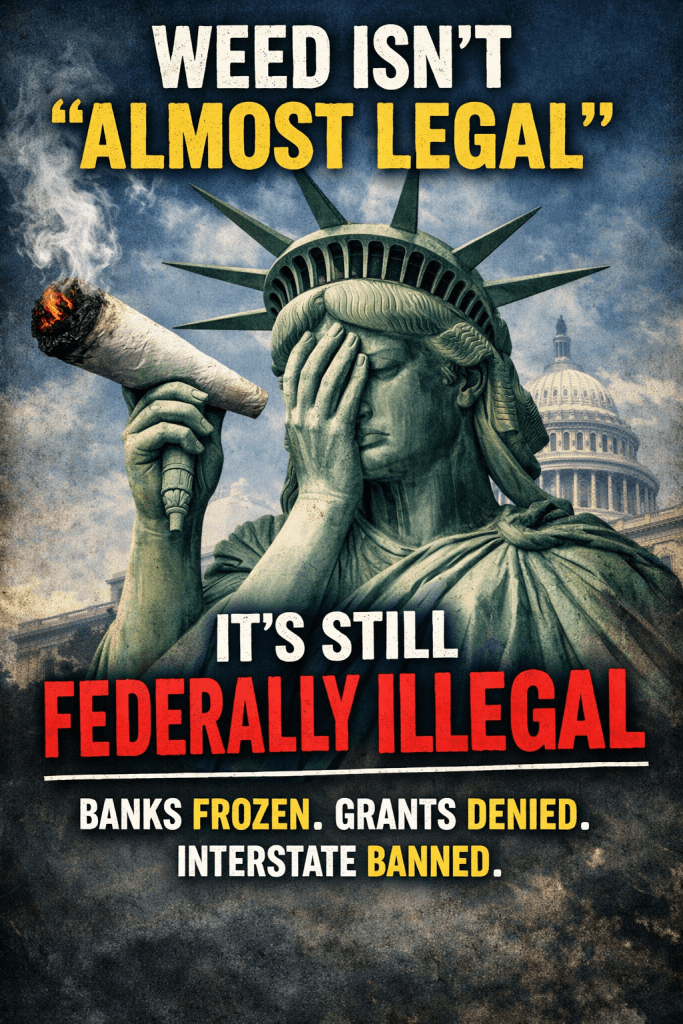
Marijuana remains illegal under the federal Controlled Substances Act. State legalization has expanded rapidly, but federal law has not changed. State cannabis systems now operate on enforcement tolerance rather than legal authorization, creating escalating compliance failures nationwide.
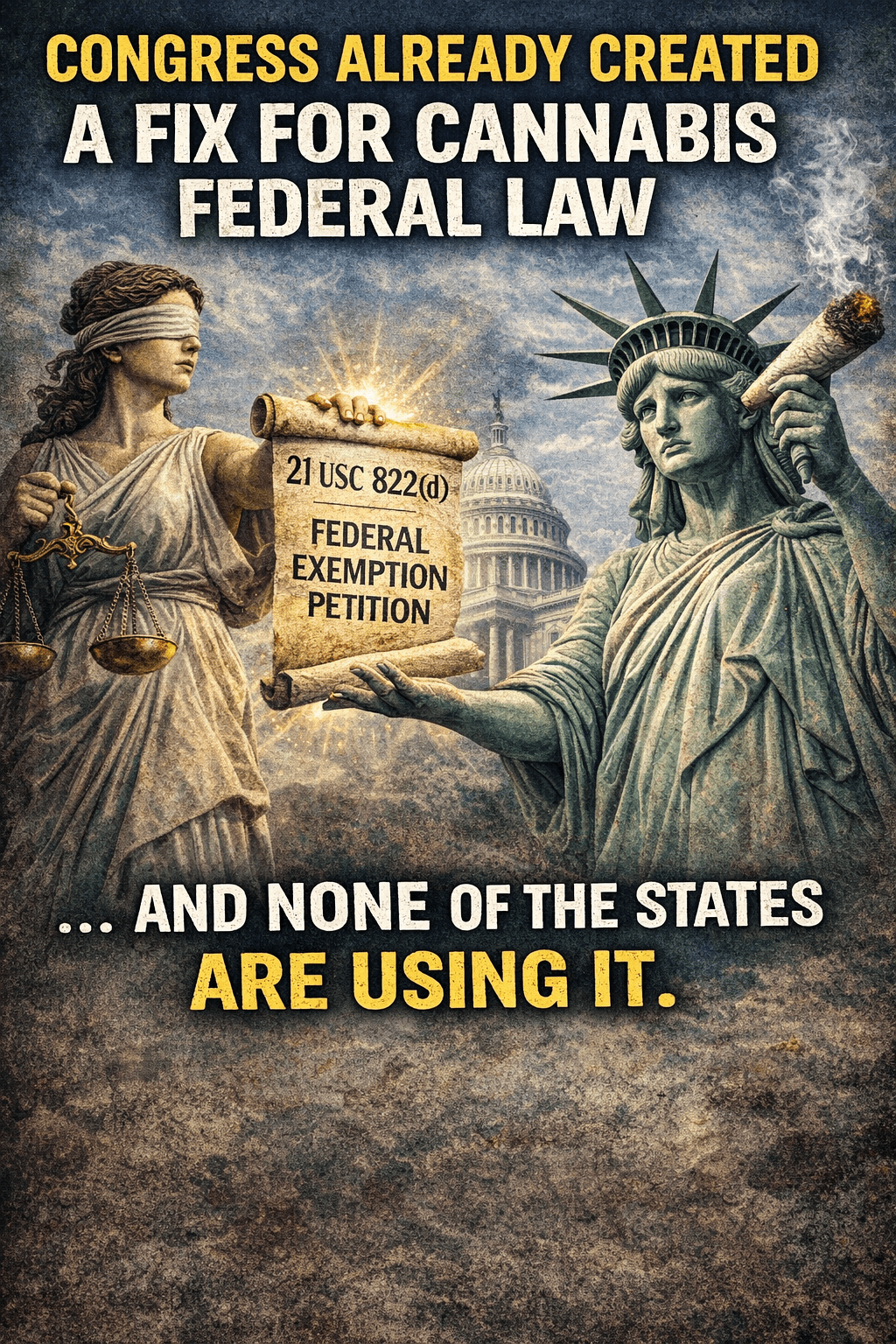
However, Congress already created a lawful solution — and states are not using it.
The Structural Conflict
Federal law still classifies marijuana as a controlled substance. State legalization does not override federal prohibition. This creates permanent legal conflict in:
• Banking and financial compliance
• Insurance underwriting
• Federal grant eligibility
• Interstate commerce restrictions
• Employment law conflicts
• Nonprofit funding and audit exposure
These are not policy disputes — they are statutory incompatibilities.
The Statutory Fix That Already Exists
Under 21 U.S.C. § 822(d), Congress granted the Attorney General authority to exempt entities from registration requirements under the Controlled Substances Act.
This exemption authority allows for the creation of federally lawful regulatory carve-outs — including state-level cannabis regulatory frameworks — without requiring rescheduling or descheduling.
This is not theory. It is written federal law.
Yet no state has formally pursued comprehensive exemption petitions.
Why Rescheduling Is Not a Fix
Rescheduling does not legalize marijuana federally. It only changes penalty classification. All structural conflicts remain:
• No lawful interstate commerce
• No federal compliance normalization
• Continued criminal exposure
• No standardized FDA pathway
• Persistent banking and insurance barriers
The contradiction continues.
The Actual Durable Solution
States can — and should — formally apply for federal exemption under 21 U.S.C. § 822(d) to create lawful cannabis regulatory carve-outs.
This would:
• Normalize banking and insurance
• Allow lawful interstate commerce
• Remove grant conflicts
• Standardize compliance
• Convert cannabis into a regulated federal industry
Without rewriting federal drug law.
Why Timing Is Critical
Federal enforcement standards are tightening. Audit activity is increasing. Grant eligibility scrutiny is expanding. Interstate regulatory conflicts are accelerating.
The tolerance-based model is reaching its limit.
Conclusion
The United States does not need to invent a new marijuana policy solution.
Congress already wrote it.
States must now use it.
Federal exemption authority under 21 U.S.C. § 822(d) is the lawful path forward.
Here is the formal federal exemption petition template a state could actually file — written in real-world agency language, not theory.
This is the missing piece no one else is publishing.
MODEL PETITION FOR FEDERAL EXEMPTION
21 U.S.C. § 822(d)
(State Cannabis Regulatory Exemption Petition)
BEFORE THE UNITED STATES DEPARTMENT OF JUSTICE
Drug Enforcement Administration
Office of Diversion Control
PETITION FOR EXEMPTION FROM REGISTRATION REQUIREMENTS
Pursuant to 21 U.S.C. § 822(d)
I. PETITIONER
The State of ____________, acting through its Department of ____________, petitions for a federal exemption from registration requirements under the Controlled Substances Act for entities operating under the State’s licensed cannabis regulatory program.
II. JURISDICTION
This petition is submitted pursuant to 21 U.S.C. § 822(d), which authorizes the Attorney General to exempt any person or class of persons from registration requirements if such exemption is consistent with the public interest.
III. BACKGROUND
The State operates a comprehensive cannabis regulatory framework governing cultivation, processing, testing, distribution, and retail sale of cannabis within its borders. Marijuana remains a controlled substance under federal law, creating ongoing compliance conflicts between federal prohibition and state authorization.
State-licensed cannabis operators currently function solely under federal enforcement tolerance rather than lawful exemption.
IV. STATUTORY AUTHORITY
Congress expressly authorized the Attorney General to exempt persons or classes of persons from CSA registration requirements under 21 U.S.C. § 822(d) when consistent with public interest.
This authority provides a lawful mechanism for federal recognition of state cannabis regulatory systems without statutory amendment or rescheduling.
V. PUBLIC INTEREST FINDINGS
Granting this exemption would:
• Normalize banking and insurance access
• Remove federal grant conflicts
• Enable lawful interstate commerce
• Improve public safety through regulated markets
• Reduce illicit market activity
• Strengthen regulatory compliance and oversight
VI. REQUESTED EXEMPTION
Petitioner requests exemption for:
All state-licensed cannabis cultivators, processors, distributors, testing laboratories, transporters, and retailers operating exclusively within the State’s regulatory system.
VII. REGULATORY SAFEGUARDS
Petitioner certifies that:
• Licensing requirements exist
• Background checks are enforced
• Product testing is mandatory
• Seed-to-sale tracking is operational
• Security and compliance inspections are conducted
VIII. RELIEF REQUESTED
Petitioner respectfully requests the Attorney General issue an order exempting state-licensed cannabis entities from CSA registration requirements under 21 U.S.C. § 822(d).
IX. CONCLUSION
Congress already authorized this exemption mechanism. Granting this petition resolves the structural conflict between federal prohibition and state legalization.

 WeedPress: The Paper Trail
Leave a comment