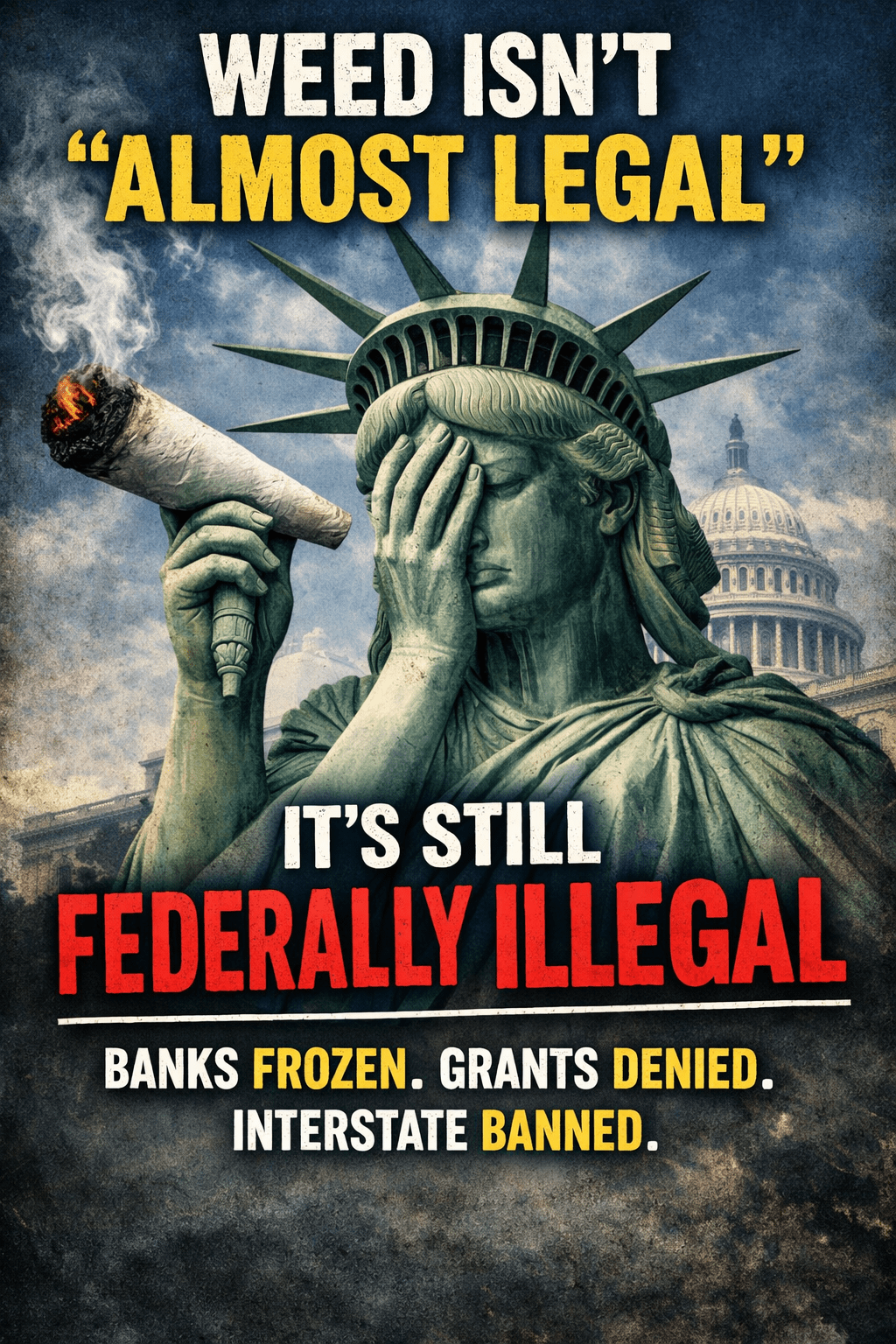
For more than a decade, marijuana policy in the United States has existed in a legal twilight zone. State legalization expanded rapidly, political rhetoric normalized cannabis, and entire industries were built on the assumption that federal reform was “inevitable.”
But that inevitability never arrived.
Instead, federal law never moved — and now the contradiction is breaking systems.
Marijuana Is Still Federally Prohibited — And That Matters More Than Anyone Admitted
Under the Controlled Substances Act, marijuana remains federally illegal.
That fact didn’t change when states legalized. It didn’t change when Congress issued spending riders. It didn’t change with DOJ guidance memos.
And now that federal agencies are tightening regulatory enforcement and compliance scrutiny again, the old workaround model is collapsing.
State industries were built on a legal fiction:
“Federal enforcement discretion is the same thing as legalization.”
It is not.
The Result: A Shadow Industry Running on Temporary Political Grace
When federal illegality remains in place, everything downstream becomes distorted:
• Banking restrictions
• Interstate commerce bans
• Insurance risk premiums
• Nonprofit funding conflicts
• Federal grant disqualification
• Compliance gray zones
• Employment law conflicts
State systems now sit on top of a federal foundation that was never designed to support them.
Which means the more “normal” cannabis becomes socially, the more structurally abnormal it becomes legally.
Why Federal Rescheduling Won’t Fix This
Rescheduling marijuana (moving it to a lower CSA schedule) does not legalize it.
It merely changes how illegal it is.
That still leaves:
• Federal criminal exposure
• No interstate commerce
• No uniform regulatory framework
• No banking normalization
• No clear insurance status
• No standardized FDA pipeline
Which means the contradiction continues — just with better optics.
The Inevitable Next Phase: Federal Exemptions
What actually resolves this conflict is not rescheduling.
It’s federal exemption authority.
That means:
• Congress authorizes states to operate cannabis systems without federal interference
• Creates explicit compliance safe harbors
• Normalizes banking, insurance, transport, and licensing
• Converts cannabis from a tolerated gray market into a regulated interstate industry
Without this, states are building on sand.
Why This Is Now Urgent
Federal agencies are returning to enforcement-first postures.
Compliance audits are increasing.
Grant eligibility is tightening.
Interstate conflicts are rising.
The “don’t worry about it” era is ending.
The legal contradiction can no longer be hand-waved away.
Conclusion
The marijuana debate is no longer about whether weed should be legal.
It’s about whether the United States can continue pretending that a federally illegal product can support billion-dollar state industries indefinitely.
It can’t.
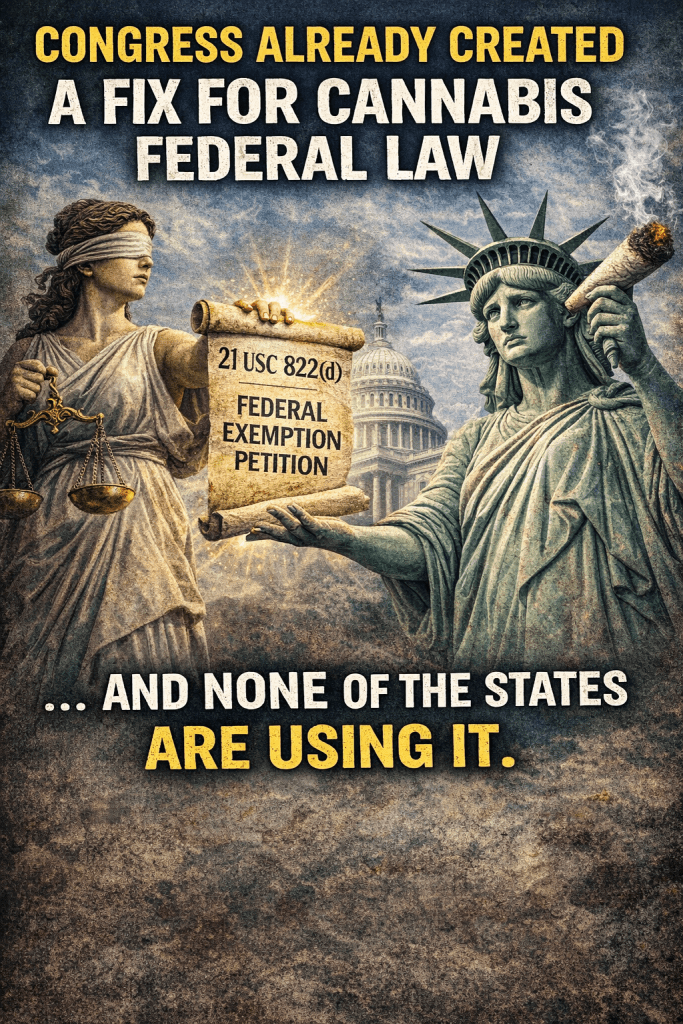
And the next phase of marijuana policy will be decided not by slogans — but by whether Congress creates explicit federal exemption authority or leaves the entire system to fracture under its own contradictions, or states can use what Congress created via 21 USC 822(d).
 WeedPress: The Paper Trail
Leave a comment