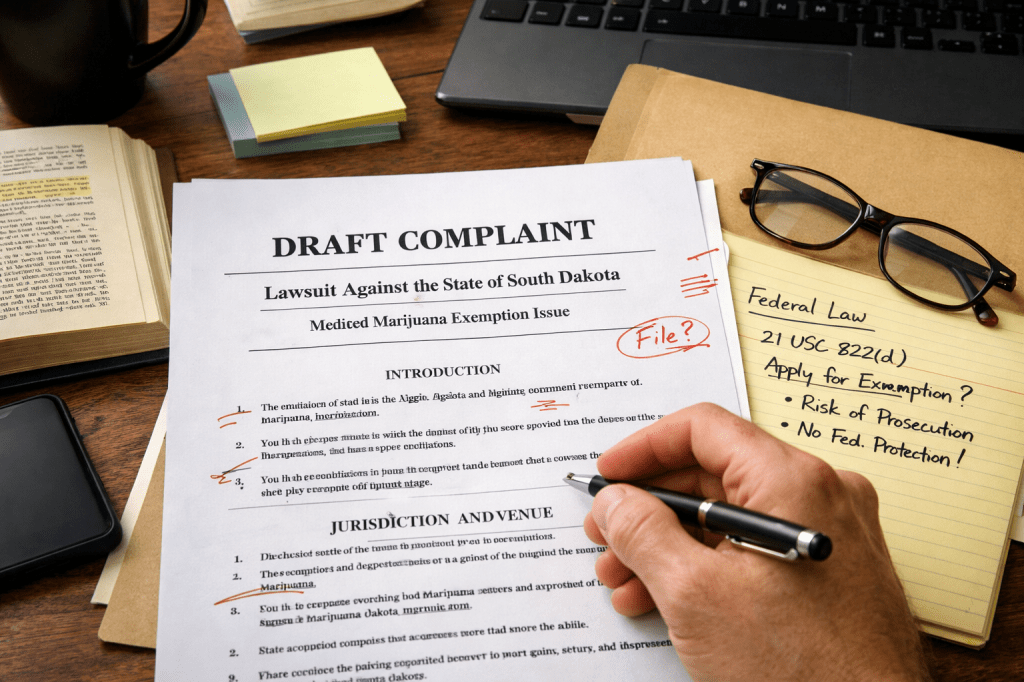
The following is a work in progress.
UNITED STATES DISTRICT COURT
DISTRICT OF SOUTH DAKOTA
SOUTHERN DIVISION
Jason Karimi,
Plaintiff,
v.
State of South Dakota;
South Dakota Department of Health;
South Dakota Medical Marijuana Oversight Committee;
[Director], in his/her official capacity;
Defendants.
Case No. ___________
COMPLAINT FOR DECLARATORY AND INJUNCTIVE RELIEF
I. INTRODUCTION
1. This is a civil rights action seeking declaratory and injunctive relief against the State of South Dakota for failure to carry out a mandatory federal statutory mechanism that would protect state-authorized medical marijuana patients from ongoing federal criminal liability.
2. Congress created an express pathway in 21 U.S.C. § 822(d) allowing state actors and persons acting under state law to obtain federal registration and exemption from provisions of the Controlled Substances Act (CSA) when acting in conformity with state law.
3. South Dakota has enacted a medical marijuana program and issues medical marijuana cards under state law. Plaintiff lawfully participated in that program.
4. Despite creating and operating this program, Defendants have refused and failed to apply for or seek the federal exemption explicitly authorized by Congress.
5. As a direct result, Plaintiff—although fully compliant with South Dakota law—remains exposed to federal criminal prosecution, loss of Second Amendment rights, loss of federal benefits, housing consequences, and other concrete legal disabilities.
6. This failure constitutes an ongoing injury in fact to Plaintiff and similarly situated patients, and violates federal law, the Supremacy Clause, and basic principles of administrative law.
II. JURISDICTION AND VENUE
7. This Court has subject matter jurisdiction under:
– 28 U.S.C. § 1331 (federal question jurisdiction);
– 28 U.S.C. § 1343 (civil rights and equitable relief);
– 28 U.S.C. §§ 2201–2202 (Declaratory Judgment Act).
8. Venue is proper in the District of South Dakota under 28 U.S.C. § 1391 because Defendants reside in this district and the events giving rise to this action occurred here.
III. PARTIES
9. Plaintiff Jason Karimi is a resident of Sioux Falls, South Dakota.
10. Plaintiff held a valid South Dakota Medical Marijuana Card issued by the South Dakota Department of Health from approximately December 2023 until December 7, 2025.
11. Plaintiff used medical cannabis lawfully under South Dakota law for qualifying medical conditions.
12. Defendant State of South Dakota is a sovereign state and a “person” for purposes of prospective injunctive relief under Ex parte Young.
13. Defendant South Dakota Department of Health is the agency charged with administering the state medical marijuana program.
14. Defendant South Dakota Medical Marijuana Oversight Committee is the body tasked with advising and implementing the medical cannabis regulatory structure.
15. Defendant [Director] is sued in his/her official capacity as the official responsible for administration of the program.
IV. FACTUAL ALLEGATIONS
A. South Dakota Created a Medical Marijuana Program
16. South Dakota voters approved medical marijuana through Initiated Measure 26 in 2020.
17. The State thereafter enacted statutes and regulations creating a system of medical marijuana cards, dispensaries, and regulated use.
18. The State issues identification cards to qualifying patients and affirmatively represents that possession and use in compliance with state law is lawful.
B. Federal Law Provides an Explicit Exemption Mechanism
19. The federal Controlled Substances Act, 21 U.S.C. § 822(d), states in relevant part:
“The Attorney General may, by regulation, waive the requirement for registration of certain manufacturers, distributors, or dispensers if he finds it consistent with the public health and safety.”
20. This provision has long been recognized as allowing state-legal programs to seek federal authorization to operate without criminal liability.
21. Congress did not intend states to operate in perpetual conflict with federal law; it created a cooperative federalism pathway.
C. Defendants Refuse to Seek the Exemption
22. Despite operating a comprehensive medical marijuana system, Defendants have never applied to the U.S. Department of Justice or DEA for a § 822(d) waiver or registration.
23. Defendants have been repeatedly urged by advocates, including Plaintiff, to initiate such an application.
24. Defendants have publicly taken the position that they have no obligation to seek federal protection for patients.
D. Injury to Plaintiff
25. Plaintiff complied fully with South Dakota law.
26. Nevertheless, Plaintiff remains a federal criminal under 21 U.S.C. §§ 841 and 844 solely because South Dakota has refused to pursue the federal exemption.
26. Plaintiff’s injuries include but are not limited to:
a. Ongoing risk of federal prosecution;
b. Risk of loss of federal benefits;
c. Housing and employment consequences;
d. Legal uncertainty and chilling of constitutional rights.
28. These injuries are concrete, particularized, and traceable directly to Defendants’ refusal to seek the statutory exemption.
29. The injuries would be redressed if Defendants applied for and obtained a federal exemption authorizing the South Dakota program.
V. STANDING
Plaintiff has standing because:
a. He personally held a state-issued medical marijuana card;
b. He was directly subject to conflicting federal criminal law;
c. His injuries are ongoing and not speculative;
d. The injuries are caused by Defendants’ inaction;
e. The Court can order relief that would redress those injuries.
VI. CAUSES OF ACTION
COUNT I
Violation of 21 U.S.C. § 822(d) – Failure to Seek Federal Registration
(Declaratory and Injunctive Relief)
31. Plaintiff incorporates all prior paragraphs.
32. Section 822(d) creates a federal mechanism intended to harmonize state programs with federal law.
33. By creating a state program without seeking the available federal authorization, Defendants have acted arbitrarily and capriciously.
34. Defendants’ refusal frustrates the purpose of federal law and leaves citizens in legal jeopardy.
35. Plaintiff seeks a declaration that Defendants have a duty to pursue the § 822(d) exemption when operating a medical marijuana program.
COUNT II
Supremacy Clause – Conflict Preemption Injury
36. Defendants have placed Plaintiff in an impossible conflict between state permission and federal criminal prohibition.
37. Operating a state program while refusing to seek federal authorization creates unconstitutional conflict preemption harms.
38. Plaintiff seeks declaratory relief that Defendants must take reasonable steps to resolve the conflict.
COUNT III
Due Process – Arbitrary Government Action
39. Defendants invite citizens to rely on state-issued licenses while knowingly exposing them to federal criminal penalties.
40. This constitutes arbitrary and conscience-shocking governmental conduct in violation of substantive due process.
VII. REQUESTED RELIEF
Plaintiff respectfully requests that the Court:
A. Declare that Defendants’ refusal to seek a federal exemption under 21 U.S.C. § 822(d) is unlawful;
B. Issue a permanent injunction ordering Defendants to:
1. Formally apply to the U.S. Department of Justice and DEA for registration or waiver under 21 U.S.C. § 822(d) within 90 days;
2. Pursue all necessary administrative remedies to secure federal protection for South Dakota medical marijuana patients;
C. Award Plaintiff costs and reasonable attorney fees under 42 U.S.C. § 1988;
D. Grant such other relief as the Court deems just and proper.
Respectfully submitted,
Jason Karimi
 WeedPress: The Paper Trail
Leave a comment