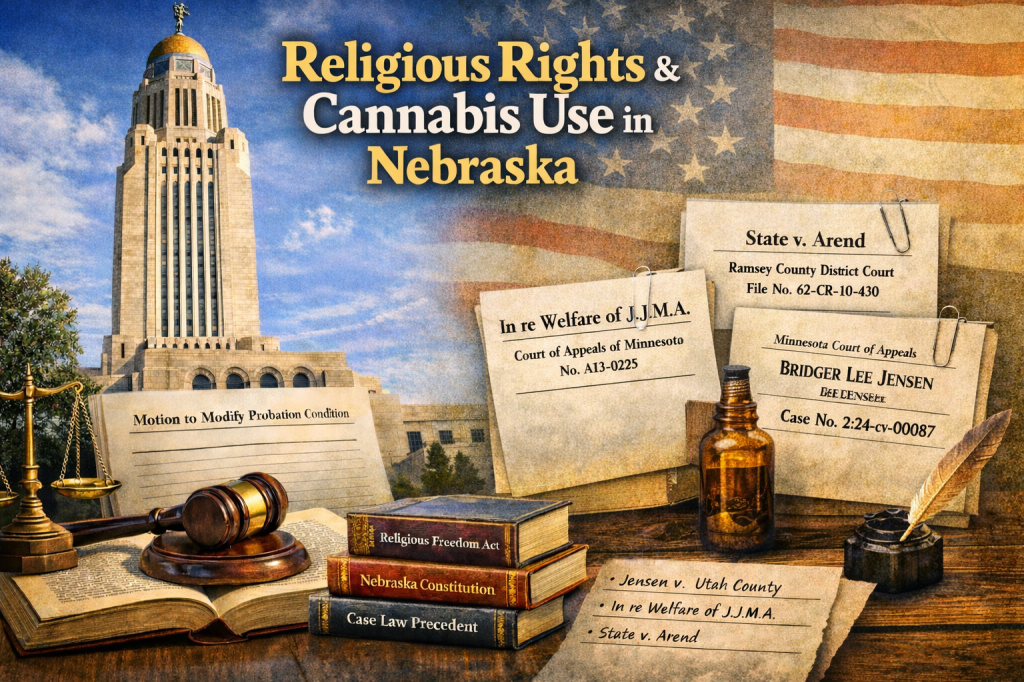
IN THE DISTRICT COURT OF THURSTON COUNTY, NEBRASKA
STATE OF NEBRASKA,
Plaintiff,
v.
JASON KARIMI,
Defendant.
Case No:
DEFENDANT’S PRO SE MOTION TO MODIFY PROBATION CONDITION
PURSUANT TO THE NEBRASKA FIRST FREEDOM ACT
(NEB. REV. STAT. §§ 20-701 – 20-705)
COMES NOW the Defendant, appearing pro se, and respectfully moves this Court to modify Probation Condition #11, which currently prohibits all THC use, and states as follows:
I. Jurisdiction and Authority
- This Court possesses continuing jurisdiction to modify probation conditions under Nebraska law.
- This motion is brought under the Nebraska First Freedom Act, Neb. Rev. Stat. §§ 20-701 to 20-705, which expressly applies to all actions of state and local government, including judicially imposed probation conditions.
- The First Freedom Act provides that government may not substantially burden a person’s exercise of religion unless it demonstrates that the burden:
a. Furthers a compelling governmental interest, and
b. Is the least restrictive means of furthering that interest.
(Neb. Rev. Stat. § 20-703)
- Probation conditions constitute state action and therefore must comply with the First Freedom Act and the Free Exercise Clause.
II. Background and Identification of Challenged Condition
- Defendant Jason Karimi is currently on supervised probation in Thurston County, Nebraska under Case No. .
- The probation order at issue was imposed by Judge Zachary L. Blackman.
- As a condition of probation, Defendant is subject to Probation Condition 11, which states:
“Shall not use, consume or have in his/her personal possession any alcoholic beverages or controlled substances. Exceptions may be made for controlled substances prescribed by a duly licensed physician or dentist but Defendant shall immediately notify the probation officer of the prescribed controlled substances, and also provide him/her with a copy of the prescription. When consulting with the physician or dentist, Defendant shall notify the physician or dentist (i) that he/she is on probation, the terms of which subject him/her to random drug tests; and, (ii) that if medically possible and the health of the Defendant would allow, no controlled substance shall be prescribed which is of a kind or nature that would cause the Defendant’s body fluids to test positive for: … Marijuana.”
- This condition operates as a total and categorical prohibition on all marijuana use, including religious sacramental use, and affirmatively pressures medical providers to avoid any treatment that could allow THC presence.
- The condition contains no mechanism for individualized accommodation of sincere religious exercise.
III. Defendant’s Sincerely Held Religious Beliefs
- Defendant is a sincere practitioner of the Rastafari faith, a recognized religious tradition in which cannabis (referred to as “ganja”) is a sacred sacrament used in prayer, meditation, and spiritual observance.
- For Defendant, cannabis is not recreational. It is a religious instrument used for communion with the divine, scriptural contemplation, and ritual worship.
- Defendant’s beliefs are genuine, longstanding, and deeply held.
- The Nebraska First Freedom Act defines “exercise of religion” broadly as:
“Exercise of religion means the practice or observance of religion and includes any action that is motivated by a sincerely held religious belief, whether or not the exercise is compulsory or central to a larger system of religious belief.” Neb. Rev. Stat. § 20-702
- Defendant’s sacramental use of cannabis is therefore fully protected religious exercise within the meaning of Nebraska law.
IV. Probation Condition 11 Imposes a Substantial Burden
- A law or government action imposes a substantial burden when it places substantial pressure on a person to modify behavior and violate religious beliefs.
- Condition 11 forces Defendant to choose between:
a. Adhering to probation and abandoning central religious practice, or
b. Exercising religion and risking incarceration.
- This is the precise form of coercion that RFRA and the First Freedom Act were enacted to prohibit.
- The burden is categorical, ongoing, and absolute. No accommodation process exists.
- Therefore, Defendant has clearly demonstrated a substantial burden on sincere religious exercise, triggering strict scrutiny under Nebraska law.
V. The State Cannot Satisfy Strict Scrutiny
- The State undoubtedly has legitimate interests in:
- Public safety
- Rehabilitation
- Preventing impaired driving
- Ensuring compliance with probation
- However, strict scrutiny requires more than legitimate interests. The State must show:
- A compelling interest in denying THIS defendant a religious exemption, and
- That a total prohibition is the least restrictive means.
- Generalized concerns about drug use are legally insufficient. The government must present particularized evidence that accommodating Defendant would endanger probation goals.
- Numerous less restrictive alternatives exist, including:
- Location restrictions
- Time restrictions
- Impairment-based prohibitions
- Testing requirements
- Revocation for misuse
- Because such alternatives are available, a categorical ban cannot satisfy the least-restrictive-means requirement.
VI. Nebraska Probation Case Law Requires Individualized Tailoring
- Nebraska appellate courts consistently require that probation conditions be individually tailored rather than imposed as blanket prohibitions.
- In State v. Morgan, 301 Neb. 102 (2018), the Nebraska Supreme Court held that probation conditions must be reasonably related to rehabilitation and may not be broader than necessary to achieve legitimate goals.
- In State v. Spang, 302 Neb. 285 (2019), the Court emphasized that sentencing conditions must be based on the individual circumstances of the defendant, not imposed categorically without consideration of personal factors.
- In State v. Garcia, 302 Neb. 406 (2019), the Court confirmed that trial courts retain continuing jurisdiction to modify probation conditions when constitutional concerns arise.
- These cases establish that Nebraska law disfavors rigid, one-size-fits-all probation restrictions and instead requires proportional, individualized conditions.
- A blanket prohibition on religious sacramental cannabis use, without any individualized assessment, is inconsistent with these principles.
VII. Nebraska Statutory Policy Favors Religious Accommodation
- Nebraska statutes repeatedly demonstrate legislative intent to accommodate religious conscience even in highly regulated areas:
- Neb. Rev. Stat. § 79-221 – religious exemptions to immunization requirements
- Neb. Rev. Stat. § 71-1913.01 – written religious opt-outs in childcare contexts
- Neb. Rev. Stat. § 48-239 – religious exemptions from employment vaccine mandates
- These statutes show that Nebraska does not treat public safety regulations as absolute when they conflict with sincere religious belief.
- Probation conditions should be construed in harmony with this longstanding policy of accommodation.
VIII. Governing Federal RFRA and Free Exercise Authority
- In Gonzales v. O Centro Espírita Beneficente União do Vegetal, 546 U.S. 418 (2006), the Supreme Court held that once a claimant demonstrates a substantial burden on religious exercise, the government must prove that denying an exemption is the least restrictive means of furthering a compelling interest. General appeals to drug control are insufficient.
- In Church of the Lukumi Babalu Aye v. City of Hialeah, 508 U.S. 520 (1993), the Court ruled that when a law contains secular exceptions but denies comparable religious ones, it is not neutral and must undergo strict scrutiny.
- In Oklevueha Native American Church v. Holder, 676 F.3d 829 (9th Cir. 2012), the court confirmed that RFRA expressly contemplates judicially ordered exemptions to drug laws.
- Sherbert v. Verner and Wisconsin v. Yoder establish that government cannot condition liberty on abandonment of religious practice.
- These authorities collectively require individualized, exemption-based analysis rather than categorical prohibitions.
IX. Federal RFRA Authority – Jensen v. Utah County
- In Jensen v. Utah County, Case No. 2:24-cv-00887 (D. Utah), a federal court addressed nearly identical issues involving entheogenic sacramental use.
- Provo police executed a search warrant in 2024, seizing psilocybin and religious texts from a sincere religious group. Criminal charges followed.
- The plaintiffs sued under RFRA. On February 20, 2025, Judge Jill Parrish issued a preliminary injunction ordering the return of sacramental substances and halting interference with religious practice.
- In August 2025, the court denied a motion to dismiss and enjoined criminal proceedings, finding a substantial burden and evidence of bad-faith prosecution.
- The court specifically emphasized that Utah’s medical psilocybin exemptions undermined claims of neutrality and compelling interest.
- Jensen demonstrates that when a state permits secular medical use of a substance, it becomes exceedingly difficult to justify prohibiting sincere religious use of the same substance.
- Nebraska’s medical cannabis statute creates the same problem for the State here: it authorizes non-religious cannabis use while prohibiting Defendant’s religious use.
X. Nebraska Medical Cannabis Regulation Act
- Nebraska has enacted the Nebraska Medical Cannabis Regulation Act, codified at Neb. Rev. Stat. §§ 71-24,103 to 71-24,111.
- This Act authorizes lawful possession and use of cannabis for medical purposes pursuant to state regulation.
- The existence of this statutory scheme proves that Nebraska has already determined cannabis use can be permitted safely under regulated conditions.
- Because the State allows cannabis use for secular medical reasons, a categorical ban on sacramental religious use cannot be considered neutral, generally applicable, or the least restrictive means. Fulton v. City of Philadelphia, 593 U.S. 522 (2021) affirmed that when a government policy isn’t neutral or generally applicable, allowing for secular exceptions while burdening religious practice, it triggers strict scrutiny, requiring the government to show a compelling interest and narrow tailoring.
XI. Equal Protection and Peyote Parity
- The Equal Protection Clause prohibits selective disfavoring of one religion over another.
- Federal law recognizes exemptions for sacramental peyote use by the Native American Church.
- Denying comparable accommodation to Rastafari sacramental cannabis use—while allowing medical cannabis use—constitutes unequal treatment of similarly situated religious practitioners.
- This disparate treatment further undermines any claim that the prohibition is neutral or necessary.
XII. Proposed Accommodation
- Defendant proposes a narrowly tailored accommodation permitting THC use only under the following conditions:
a. Solely for bona fide religious purposes;
b. Only within a private residence;
c. No use within 24 hours of operating a vehicle;
d. No use prior to probation meetings;
e. Subject to random testing;
f. No possession outside permitted locations.
- These conditions fully protect public safety while respecting religious liberty.
ADDITIONAL AUTHORITIES AND ARGUMENTS
XIII. Minnesota Rastafari Case Authority
- In re Welfare of J.J.M.A., No. A13-0295 (Minn. Ct. App. Sept. 23, 2013) (unpublished) reversed a juvenile adjudication for possession of drug paraphernalia, holding that enforcement of Minn. Stat. §152.092 violated the Minnesota Constitution’s freedom-of-conscience clause as applied to a Rastafarian minor who possessed a ceremonial cannabis pipe (chalice).
- The Court of Appeals held that Rastafari is a true religion, that the appellant held a sincere religious belief regarding possession of his chalice, and that possession of the chalice was protected religious exercise. The court applied strict scrutiny and ruled that the State failed to show that enforcing the paraphernalia statute was the least restrictive means of achieving a compelling public-safety interest.
- The court emphasized that Minnesota’s Constitution provides broader free-exercise protection than the federal constitution, and that generalized public-safety assertions are insufficient to defeat sincerely held Rastafarian sacramental practices involving ceremonial pipes.
XIV. Minnesota Probation Exemption
- The court granted a state exemption in State v. Arend, Ramsey County Dist. Ct. File No. 62-CR-10-430 (Mar. 24, 2010), where the court recognized a colorable Rastafarian religious right to ceremonial cannabis use and expressly declined to impose marijuana abstention or urinalysis testing as probation conditions. The court found that imposing marijuana testing would create an unconstitutional risk of incarceration for sincere religious practice. It therefore: (1) declined to order marijuana abstention; (2) prohibited urinalysis testing for marijuana; and (3) modified probation conditions to avoid burdening Rastafarian ceremonial cannabis use. This case establishes that Minnesota courts have already approved religious exemptions from probation drug-testing and abstention conditions for Rastafarians, directly supporting RFRA and free-exercise modification of probation conditions.
XV. Nebraska Constitutional Protection
- Article I, §4 of the Nebraska Constitution provides that all persons have a natural and indefeasible right to worship Almighty God according to the dictates of their own consciences, and that no person shall be compelled to attend, erect, or support any place of worship, or to maintain any ministry against their consent.
- Nebraska courts recognize that Article I, §4 provides independent state constitutional protection for religious liberty that may be more protective than the federal Free Exercise Clause. State action burdening religious practice must therefore be narrowly tailored and justified by a compelling interest.
- Probation conditions imposed by Nebraska courts constitute state action subject to Article I, §4. Where such conditions burden sincere religious exercise, courts must consider accommodation and less restrictive alternatives consistent with Nebraska’s constitutional tradition of protecting conscience and worship.
XVI. First Freedom Act – Floor Debate Intent
- During legislative debate on the Nebraska First Freedom Act (LB), sponsors and supporters repeatedly emphasized that the Act was intended to restore strict scrutiny for all state and local government actions burdening religious exercise, regardless of whether the religious practice was traditional, institutional, or widely shared.
- Floor debate reflects legislative intent that courts must order exemptions and accommodations whenever government can achieve its objectives through less restrictive means, and that categorical prohibitions were expressly disfavored.
- Legislators noted that the Act was designed to protect minority and unconventional faith practices that are often burdened by generally applicable criminal and regulatory laws.
- This legislative history confirms that the Act applies to probation and criminal justice contexts and mandates individualized religious accommodation when sincere religious exercise is burdened.
XVII. Federal Constitutional Argument
- The First Amendment to the United States Constitution provides that Congress shall make no law respecting an establishment of religion or prohibiting the free exercise thereof. This protection is incorporated against the states through the Fourteenth Amendment.
- Government actions that are not neutral or generally applicable and that burden sincere religious exercise must satisfy strict scrutiny, requiring a compelling governmental interest and the least restrictive means. Church of the Lukumi Babalu Aye, Inc. v. City of Hialeah, 508 U.S. 520 (1993); Fulton v. City of Philadelphia, 593 U.S. 522 (2021).
- The Equal Protection Clause of the Fourteenth Amendmentto the United States Contitution prohibits selective enforcement and unequal treatment of similarly situated religious practitioners, and requires heightened scrutiny where religious classifications or exemptions are selectively granted.
- Probation conditions constitute state action subject to the First and Fourteenth Amendments, and categorical THC abstention or testing requirements that burden sincere religious exercise must be narrowly tailored.
WHEREFORE, Defendant respectfully requests that the Court:
A. Set this motion for hearing;
B. Modify Probation Condition #11 consistent with the Nebraska First Freedom Act; and
C. Grant such other relief as justice requires.
Respectfully submitted,
Jason Karimi, Pro Se
Jahkingdomcome23@ gmail
Date: ___________
AFFIDAVIT OF SINCERE RELIGIOUS BELIEF
IN THE DISTRICT COURT OF THURSTON COUNTY, NEBRASKA
STATE OF NEBRASKA,
Plaintiff,
v.
JASON KARIMI,
Defendant.
Case No:
⸻
AFFIDAVIT OF JASON KARIMI
IN SUPPORT OF MOTION TO MODIFY PROBATION CONDITION
STATE OF NEBRASKA )
) ss.
COUNTY OF THURSTON )
I, Jason Karimi, being first duly sworn upon oath, depose and state as follows:
1. My name is Jason Karimi. I am the Defendant in the above-captioned matter and I make this affidavit in support of my Motion to Modify Probation Condition pursuant to the Nebraska First Freedom Act.
2. I am over the age of 18 and competent to testify to the matters stated herein.
3. I am a sincere practitioner of the Rastafari faith.
4. Within the Rastafari religious tradition, cannabis (also known as ganja) is regarded as a sacred sacrament and a central element of religious worship and spiritual practice.
5. My use of cannabis is not recreational. It is undertaken solely as part of religious prayer, meditation, scriptural reflection, and spiritual observance.
6. My religious beliefs concerning the sacramental use of cannabis are genuine, longstanding, and deeply held.
7. I have practiced the Rastafari faith for many years, and my beliefs regarding cannabis are integral to my religious conscience.
8. Probation Condition #11, which categorically prohibits any use of marijuana or THC, directly conflicts with and substantially burdens my sincere religious exercise.
9. Because of this condition, I am forced to choose between compliance with probation and adherence to my sincerely held religious beliefs.
10. I seek only a narrowly tailored religious accommodation that would allow me to practice my faith while still complying with all legitimate public-safety and probationary requirements.
11. I do not seek permission to use cannabis in public, to drive while impaired, or to violate any other lawful conditions of supervision.
12. I am willing to comply with reasonable restrictions and safeguards designed to protect public safety, including limitations on location, timing, impairment, and testing, so long as my core religious practice is not categorically prohibited.
13. All statements made in my Motion to Modify Probation Condition regarding my religious beliefs and practices are true and correct to the best of my knowledge.
FURTHER AFFIANT SAYETH NAUGHT.
⸻
Jason Karimi, Affiant
Subscribed and sworn to before me this _ day of , 20.
⸻
Notary Public
My Commission Expires: _
CERTIFICATE OF SERVICE
IN THE DISTRICT COURT OF THURSTON COUNTY, NEBRASKA
STATE OF NEBRASKA,
Plaintiff,
v.
JASON KARIMI,
Defendant.
Case No:
CERTIFICATE OF SERVICE
I, Jason Karimi, hereby certify that on this _____ day of ________, 20, I caused a true and correct copy of the following documents:
Defendant’s Motion to Modify Probation Condition Pursuant to the Nebraska First Freedom Act Affidavit of Sincere Religious Belief
to be served upon the following parties by depositing the same in the United States Mail, first-class postage prepaid, addressed as follows, or by electronic filing/service where applicable:
Thurston County Attorney’s Office
[Insert current mailing address or email of County Attorney]
Thurston County Courthouse
Court Clerk(s)
Gina Roth
Phone402-385-3318
Fax402-385-2762
Address
P.O. Box 216
Pender, NE 68047
Pender, Nebraska
and upon any other parties entitled to service under Nebraska law.
I declare under penalty of perjury under the laws of the State of Nebraska that the foregoing is true and correct.
Dated this _____ day of ________, 20.
Jason Karimi, Pro Se
[Address]
[Phone]
[Email]
 WeedPress: The Paper Trail
Leave a comment