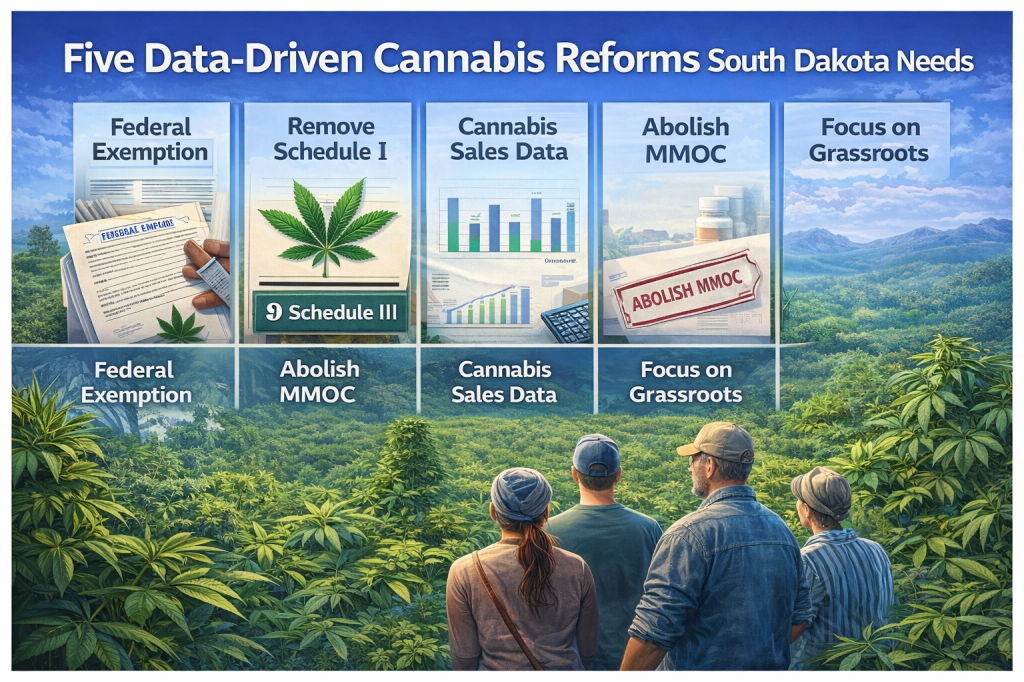
Five Data-Driven Cannabis Reforms South Dakota Needs Now
By Jason Karimi
South Dakota’s cannabis program is stuck in neutral.
Years after legalization, we still lack clarity, transparency, and a coherent path forward. Instead of endless meetings and political posturing, the state needs concrete reforms grounded in data and law.
Here are five changes that would immediately improve the system.
1. Seek a Federal Exemption Under 21 U.S.C. §822(d)
The most overlooked tool in American cannabis law is hiding in plain sight.
21 U.S.C. §822(d) allows the federal government to authorize controlled-substance activities that would otherwise be illegal if they serve the public interest.
South Dakota should formally request such an exemption for:
State-licensed businesses Patients Testing laboratories Transportation and banking partners
This single action would do more for stability than any number of state-level rule tweaks.
Other states are exploring it. South Dakota should lead.
2. Remove Cannabis From Schedule I Under State Law
It is absurd that South Dakota still treats cannabis as Schedule I while the federal government moves toward Schedule III.
Schedule I means:
“No accepted medical use” “High potential for abuse”
Neither claim is scientifically defensible anymore.
The Legislature and MMOC should recommend immediate rescheduling to align with federal findings. Keeping cannabis in Schedule I is not policy—it’s denial.
3. Mandate Public Reporting of Cannabis Sales Figures
Data drives good policy. Secrecy drives bad policy.
South Dakota should publish quarterly reports showing:
Total statewide sales Product categories Number of active licenses Tax revenue generated
This is standard practice in states like Colorado, Michigan, and Illinois.
Right now the public has no idea whether the industry is thriving, struggling, or consolidating into a few hands. That information belongs to the voters, not locked in agency filing cabinets.
4. Abolish the MMOC or Give It Real Authority
The MMOC currently functions as a discussion forum with little practical power.
Either:
give the board actual binding authority, or eliminate it entirely and move oversight to professional regulators
What South Dakota does not need is a perpetual advisory committee that consumes time and oxygen while accomplishing nothing.
Regulation should be efficient, not theatrical.
5. Rebuild the Grassroots Movement Instead of Corporate-Centered Advocacy
One uncomfortable truth needs to be said out loud.
Much of South Dakota’s cannabis advocacy infrastructure has drifted away from patients and ordinary voters and toward the narrow interests of a few businesses.
Advocates who once built broad grassroots networks have increasingly focused on protecting their own commercial interests. That shift has consequences:
Fewer volunteers Less community engagement Weak legislative pressure Declining public trust
The movement that won legalization was built on everyday South Dakotans. Reforms will only succeed if advocates return to that model and admit where organizing has been neglected.
The Path Forward
South Dakota doesn’t need more slogans. It needs structural reforms grounded in law and data.
Federal exemption Rescheduling Transparency Real oversight Genuine grassroots organizing
Those five steps would transform the program from a fragile experiment into a stable, patient-focused system.
Everything else is just noise.
 WeedPress: The Paper Trail
Leave a comment