What the MMOC Actually Recommended in 2025 — and Why It Still Doesn’t Control Policy
By Jason Karimi
Every year the South Dakota Medical Marijuana Oversight Committee (MMOC) meets, debates, hears testimony, and votes on recommendations about the state’s medical cannabis program.
And every year many patients and businesses assume those votes actually do something.
They don’t.
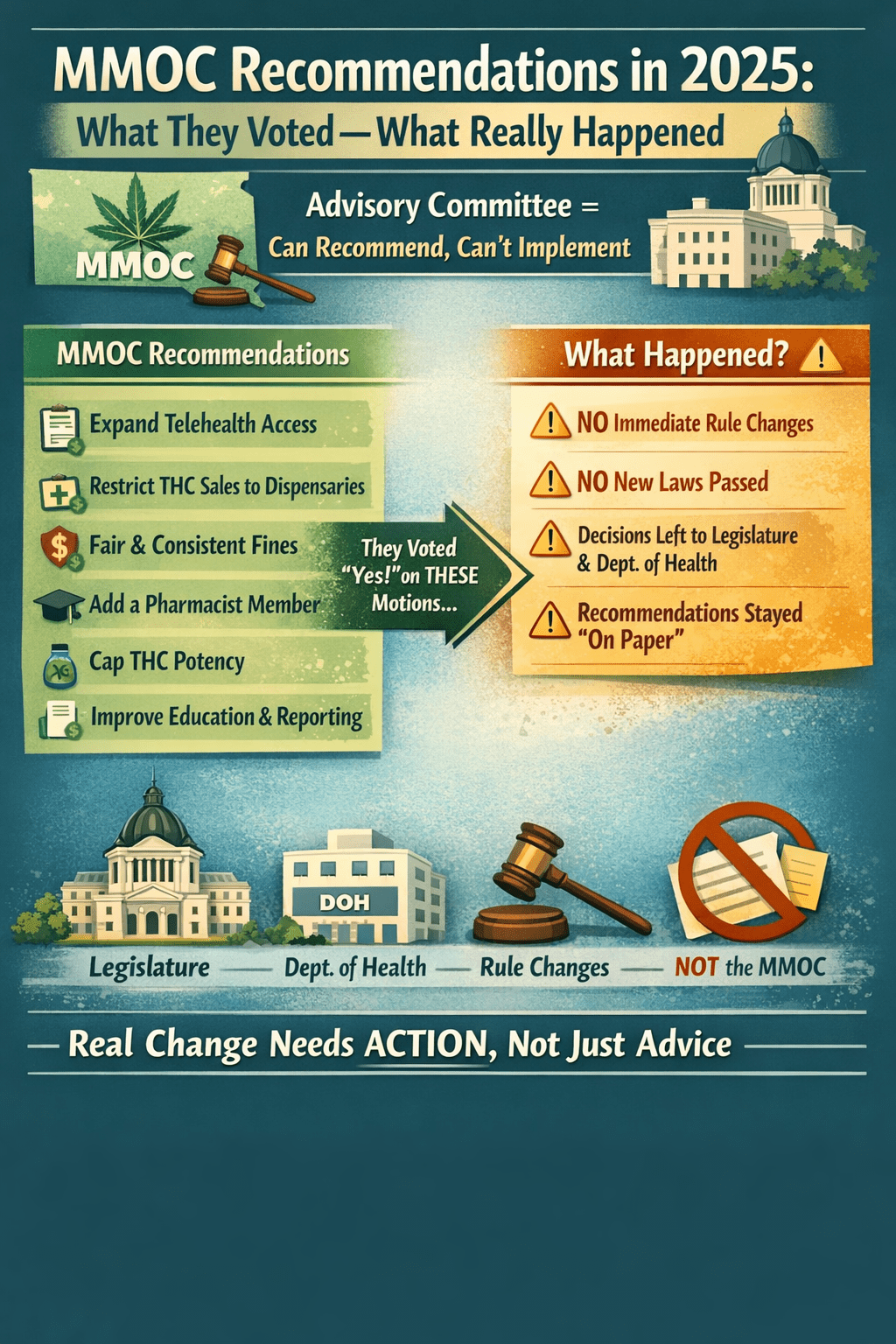
The MMOC is an advisory committee. It can suggest changes. It cannot implement them. Real authority remains with the Legislature and the Department of Health.
Understanding that distinction is essential to understanding why South Dakota cannabis policy often feels stuck in place.
What the MMOC Is — and Isn’t
By statute, the MMOC’s job is to:
* Evaluate the medical cannabis program
* Gather input from patients, providers, and industry
* Make recommendations to lawmakers and regulators
That’s it.
The committee cannot:
* Change state law Issue binding regulations
* Require the Department of Health to act Grant or revoke licenses
It votes. Others decide.
What the MMOC Actually Recommended in 2025
Here are the real, documented recommendations the MMOC formally adopted in its 2025 report.
These are not rumors or interpretations — they are the committee’s own official motions.
1. Expand Telehealth Access After Initial Visits
The MMOC recommended that:
“Telehealth services be provided to patients receiving medical marijuana after their initial physical examination.”
This proposal was aimed at improving access for rural patients who struggle with travel and provider availability.
What happened:
Nothing automatically. For this to occur, either the Department of Health would need to change rules, or the Legislature would need to update statutes.
2. Create Fair and Consistent Fines and Inspections
The committee recommended that the Department of Health:
* Ensure fines are fair and equitable
* Establish clearer policies for how fines are assessed
* Continue working on consistency in inspections
This came directly from industry complaints about unpredictable enforcement.
What happened:
The MMOC can urge fairness, but it cannot force the Department of Health to change its enforcement practices.
3. Restrict Intoxicating THC Products to Licensed Medical Facilities
One of the most controversial votes of 2025 was the recommendation that:
“The sale of THC products be prohibited in stores and permitted only in licensed medical marijuana facilities.”
This was aimed at intoxicating hemp-derived products being sold in gas stations and smoke shops.
What happened:
Only the Legislature can actually ban or restrict those products. The MMOC vote itself has no legal effect.
4. Require Verification of Patient Status for Law Enforcement
The MMOC recommended either:
* Giving law enforcement access to the Prescription Drug Monitoring Program, or
* Requiring patients to produce their medical cannabis card on request
What happened:
This would require statutory or administrative changes. A committee vote cannot create new police powers.
5. Strengthen the Patient–Provider Relationship
The committee recommended efforts to improve and formalize the relationship between certifying medical providers and patients.
What happened:
Again, this is advisory guidance. Implementation would require action by regulators or lawmakers.
6. Consider a Cap on THC Potency
The MMOC recommended that:
“A cap be placed on the THC percentage in medical marijuana products.”
What happened:
A potency cap would require formal rulemaking or legislation. The recommendation alone changes nothing.
7. Change MMOC Membership to Include a Pharmacist
The committee voted to recommend that:
A licensed pharmacist be added as a member of the MMOC
What happened:
Only the Legislature can change the committee’s composition. No such change has yet been enacted.
8. Create an Interim Committee on Illegal THC Sales
The MMOC recommended formation of a separate interim legislative committee to study:
* Illegal THC product sales
* Distribution at smoke shops and similar outlets
What happened:
Whether such a committee is created is entirely up to legislative leadership, not the MMOC.
9. Improve Public Education and Data Reporting
Finally, the MMOC recommended that the Department of Health:
* Provide better public education on marijuana and medical marijuana
* Report statistics on hospitalizations, impaired driving, and poison control calls related to cannabis
What happened:
These would require agency action. The MMOC cannot compel reporting standards.
The Pattern Is Clear
Look at every single item above and you’ll notice the same structure:
The MMOC identifies an issue It votes on a recommendation And then… it waits
Implementation depends entirely on:
1. The South Dakota Legislature
2. The Department of Health
3. Formal administrative rulemaking
A recommendation without follow-through is just a suggestion on paper.
Even the MMOC Knows Its Limits
The committee’s own 2024 report openly acknowledged this reality. That year the MMOC did not propose any legislation at all, concluding that most problems were “regulatory” and encouraging the Department of Health to keep meeting with stakeholders instead.
In other words: the MMOC can talk about problems, but it cannot fix them.
Why This Matters for Real Reform
Too many advocates treat MMOC votes as victories.
They are not.
Real change in South Dakota cannabis policy requires:
* Bills introduced and passed by the Legislature
* Rules adopted through the formal administrative process
* Direct action by the Department of Health
Attending MMOC meetings is useful for discussion. It is not a substitute for lawmaking.
Bottom Line
The MMOC plays a role — but it is an advisory role.
If South Dakota wants meaningful reforms like:
Federal exemption strategies
Rescheduling cannabis
Transparency in sales data
Modernized patient access
…those changes will not come from a committee vote.
They will come from organized grassroots pressure and legislative action.
Everything else is just political theater.
 WeedPress: The Paper Trail
Leave a comment