How Federal Cannabis Rescheduling Is Being Mischaracterized in South Dakota Media Coverage
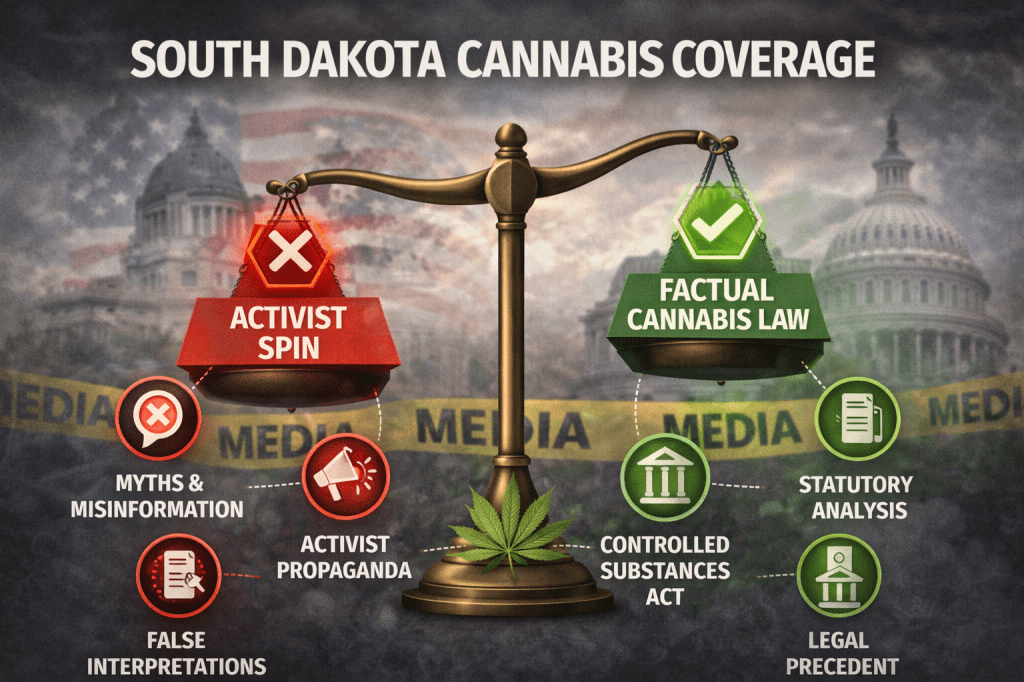
Federal cannabis rescheduling is not symbolism, and it does not work the way activists and local media keep claiming.

South Dakota news coverage of federal cannabis rescheduling has become a feedback loop of activist talking points, repeated by reporters who never stop to ask what the law actually says.
Instead of explaining the real legal consequences of federal rescheduling under the Controlled Substances Act, local media has leaned on advocacy voices that confuse political optimism with legal reality. The result is coverage that reassures readers while quietly getting the law wrong.
Federal cannabis rescheduling is not a press release, not a vibe shift, and not a symbolic nod to reform. It is a concrete legal change with specific statutory consequences — consequences that activists routinely misstate and reporters fail to challenge.
This article explains what South Dakota reporters are missing, why activist explanations are misleading, and what federal cannabis law actually does when schedules change.
⸻
- The News Coverage Is Misleading on What Rescheduling Does
In Dakota News Now’s article “Marijuana Reclassification: What It Means for South Dakotans,” reporters describe President Trump’s executive order to move marijuana from Schedule I to Schedule III and frame it largely as a positive recognition of medical use while implying that the change is straightforward and mostly symbolic in South Dakota.
They quoted advocates saying the rescheduling won’t change much overnight and may take a year to implement.
That narrative — that rescheduling is a slow, symbolic shift — is common among activists. But it misses the deeper legal impact of such a federal shift, especially under the Supremacy Clause and the way South Dakota’s law is structured.
Rather than explaining how the Controlled Substances Act interacts with state law, the article substitutes activist interpretation for legal reality. Readers are told what advocates hope rescheduling means, not what Congress actually wrote or how courts are likely to treat a change in federal drug schedules.
That distinction matters — especially in a state like South Dakota, where cannabis law is structurally tied to federal definitions.
⸻
- Activists Are Confusing Policy Talk With Legal Reality
Activist voices often frame federal rescheduling like a “permission slip” that simply makes things easier at the state level. But that’s not how federal scheduling works.
In an earlier WeedPress piece, “Request for South Dakota to Petition U.S. Attorney General for Waiver Under 21 U.S.C. § 822(d),” we explained that rescheduling alone does not automatically create federal legality for South Dakota’s medical cannabis program — and why petitioning for a federal waiver under § 822(d) could offer a real exemption from DEA registration that matters for banking and enforcement.
That’s a nuance most local coverage, including the Dakota News Now article, completely overlooks.
⸻
- Even the Best Written Local Report Doesn’t Explain the Structural Legal Consequences
In a separate, more technically detailed WeedPress article, “Marijuana Rescheduling: What It Really Means for South Dakotans,” I broke down the structural weaknesses in South Dakota’s own controlled-substances architecture — how state law depends on federal definitions and what that means if federal marijuana law changes.
Key points from that analysis include:
• South Dakota’s marijuana statute incorporates the federal Controlled Substances Act by reference.
• If federal law changes the definition or classification of marijuana, South Dakota’s statute can become unclear, unenforceable, or unconstitutional without legislative action.
• This isn’t academic — it can directly affect prosecutions, due process, and the validity of the state program itself.
These structural legal realities go far beyond what reporters are currently communicating.
- What Reporters Think “Rescheduling Means” Isn’t What the Law Actually Does
Local news and activist commentary often emphasize:
• rescheduling means more research
• rescheduling is “recognition” of medical use
• rescheduling won’t change much here
But none of those statements capture the actual legal mechanics:
• Federal scheduling changes do not instantly legalize state activities.
• They don’t automatically change how state law defines controlled substances.
• They don’t eliminate federal enforcement risk without an explicit exemption or waiver.
• They risk destabilizing state criminal statutes unless the legislature updates definitions.
I explained all this in depth in “Marijuana Rescheduling: What It Really Means.”
This is why activists who say “rescheduling solves everything” are offering policy opinion, not constitutional analysis — and why reporters repeating that narrative are not giving readers the full picture.
⸻
- Why This Matters Right Now in South Dakota
South Dakota voters legalized medical cannabis, but our statutory framework is tethered to federal definitions. That means:
• Federal changes have real legal consequences for the enforceability of our own laws.
• Judges could be asked to dismiss charges based on preemption or vagueness.
• Legislators may need to act urgently to redefine marijuana independently of federal law.
• Banking, research, and commercial activity remain in legal limbo without formal federal waivers.
That’s not speculation — it’s constitutional law and preemption doctrine, as fully detailed in the WeedPress legal analysis.
⸻
- The Bottom Line: Reporters Should Report Law, Not Opinions
As long as local reporting frames rescheduling as merely “good news” without explaining the legal mechanics, South Dakotans will remain misinformed about what federal change actually means.
I’ve laid the real legal foundations out clearly in WeedPress:
• The federal waiver pathway under 21 U.S.C. § 822(d) matters more than activists realize.
• Rescheduling interacts with state law in destabilizing ways unless statutory definitions are fixed.
And that’s why I understand the legal impact better than most reporters or activists currently covering this issue.
This debate isn’t abstract for me—it’s the difference between being treated as a criminal and understanding the law well enough to push back against it.
When activists and reporters get the law wrong, people like me pay the price.
⸻

Call to Action
If you want better coverage of cannabis law that goes beyond headlines and into real legal analysis:
• Read our full legal breakdown here: Marijuana Rescheduling: What It Really Means for South Dakotans (and why state laws may collapse without legislative action)
• Consider why federal waivers and state legislative fixes are necessary to protect patients and businesses once federal law evolves.
South Dakotans deserve more than sound bites — they deserve accurate legal context.
Federal cannabis law is not governed by press releases, advocacy talking points, or optimistic interviews. It is governed by statutes, regulations, and preemption doctrine — none of which bend to activist enthusiasm or media framing.
When reporters repeat activist spin without interrogating the law itself, they don’t just oversimplify the issue. They misinform the public about the legal risks, limits, and consequences facing patients, businesses, and the state itself.
South Dakotans deserve reporting that explains what federal law does, not what advocates wish it did. Until that happens, readers will continue to misunderstand rescheduling — and policymakers will continue making decisions based on incomplete information.
Cannabis reform will not succeed on vibes alone. It requires legal clarity. And that clarity starts with telling the truth about the law.
 WeedPress: The Paper Trail
Leave a comment