How South Dakota Cannabis Businesses Actually Interact With Federal Law: A Plain-English Guide for Patients, Owners, and Lawmakers
By WeedPress Staff
South Dakota has legal medical cannabis.
The federal government still lists cannabis as Schedule I.
Both of those statements are true at the same time—and that contradiction sits at the heart of nearly every problem patients and businesses face in this state.
This article explains, in plain English, how South Dakota’s cannabis program really operates inside a federal legal system that technically still calls marijuana an illegal drug.
No slogans. No spin. Just the mechanics.
The Big Picture Problem
South Dakota voters approved medical cannabis in 2020. The Legislature implemented a state program. Patients get cards. Dispensaries open. Products are sold.
Under South Dakota law, all of that is legal.
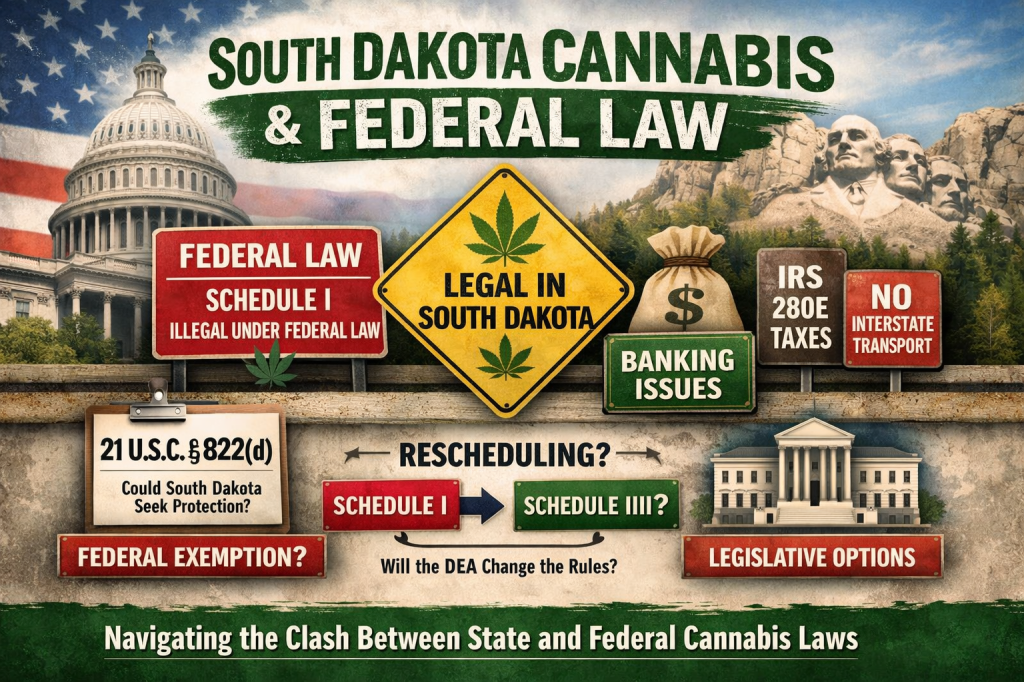
But under federal law, cannabis is still classified as a Schedule I controlled substance under the Controlled Substances Act (21 U.S.C. §812).
Schedule I is supposed to mean:
“no currently accepted medical use,” and “high potential for abuse.”
That is the same category as heroin.
So how can South Dakota run an entire medical program when the federal government says the substance itself is illegal?
The answer is: carefully—and with a lot of legal gray area.
What Federal Law Actually Says
Most people think the federal government simply “allows” state cannabis programs.
That isn’t technically true.
Federal law does not contain any blanket permission for states to legalize marijuana. Instead, states operate under a kind of uneasy truce created by:
federal enforcement discretion, Department of Justice guidance, and Congress refusing to fund federal crackdowns on state medical programs.
In other words: South Dakota cannabis exists because the federal government is choosing, for now, not to aggressively interfere.
That is not the same thing as true federal legality.
The Overlooked Exemption: 21 U.S.C. §822(d)
One part of federal law almost nobody in South Dakota talks about is 21 U.S.C. §822(d).
This section of the Controlled Substances Act allows the U.S. Attorney General to grant exemptions from certain federal drug laws if doing so is “consistent with the public health and safety.”
In theory, a state like South Dakota could formally request a federal exemption for its medical cannabis program so that:
dispensaries could operate with clearer federal authority, doctors could work without fear, and businesses could access banking more easily.
To date, South Dakota has never seriously pursued this path.
Instead, the state runs a program that technically conflicts with federal scheduling while hoping federal enforcement never changes.
That is a policy choice—not a legal necessity.
Why Rescheduling to Schedule III Would Change Everything
Right now, the federal government is actively considering moving cannabis from Schedule I to Schedule III.
If that happens, it would be the biggest legal change in cannabis law in half a century.
Here’s what would immediately shift:
Taxes
Dispensaries are currently hit with IRS Code Section 280E, which prevents them from taking normal business deductions.
Schedule III cannabis would likely eliminate that burden overnight.
Banking
Most banks refuse to work with cannabis businesses because of federal drug laws and money-laundering rules.
Rescheduling would make traditional banking far easier.
Medical Legitimacy
Schedule III would formally recognize cannabis as having accepted medical use—something federal law currently denies.
Research and Prescribing
Doctors and universities would have far more freedom to study and recommend cannabis products without DEA fears.
What This Means Day-to-Day in South Dakota
Because of the federal conflict, South Dakota cannabis businesses must operate in a strange hybrid world:
Many cannot get normal business loans Credit card processing is limited Interstate transport of products is illegal Insurance options are restricted Federal agencies still treat cannabis as contraband
Patients face their own complications:
Medical cards do not protect gun ownership rights under federal law
Federal housing can still prohibit use
Crossing state lines with cannabis remains illegal
VA doctors cannot formally “prescribe” marijuana
None of these problems are caused by South Dakota law. They are the direct result of the unresolved federal contradiction.
What the MMOC Board Can—and Cannot—Do
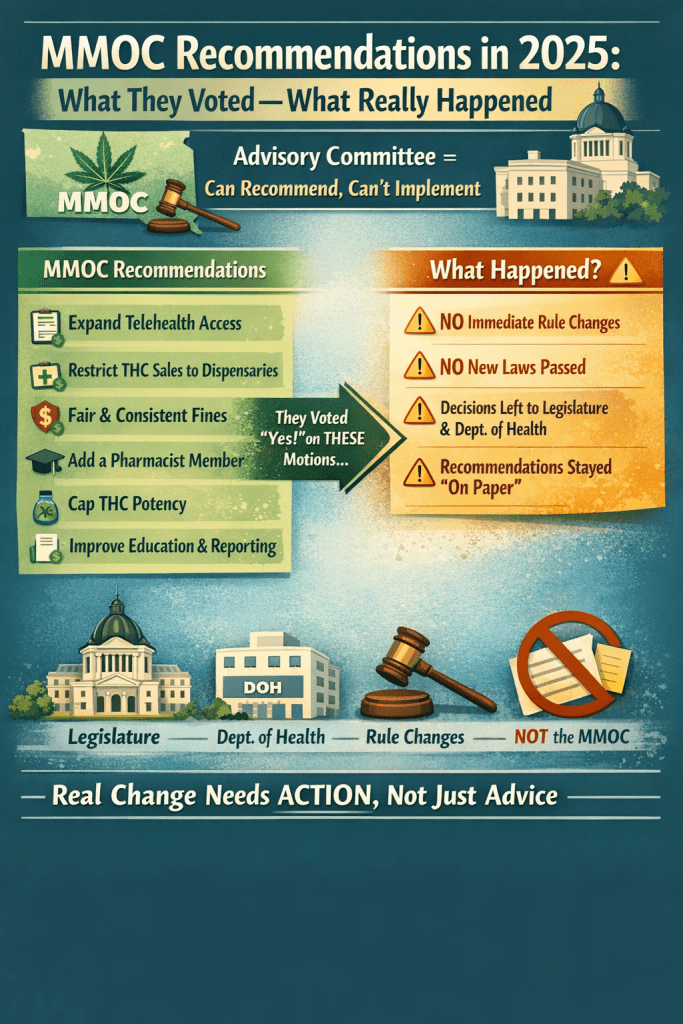
The Medical Marijuana Oversight Committee (MMOC) in South Dakota is advisory only.
It can recommend:
program changes regulatory tweaks patient access improvements
But it cannot:
change federal law
reschedule cannabis
grant federal exemptions
force banks to work with dispensaries
Many frustrations aimed at the MMOC are really frustrations with federal policy that the board has no authority to fix.
What the South Dakota Legislature Actually Could Do
There are realistic, constructive steps state lawmakers could take instead of pretending the conflict doesn’t exist:
Formally request a federal exemption under 21 U.S.C. §822(d) Update state scheduling laws to reflect likely federal Schedule III changes Increase transparency by publishing statewide cannabis sales figures Align state regulations with anticipated federal reforms Protect patients from unnecessary state-level barriers
These are concrete actions that would help businesses and patients without waiting for Washington, D.C. to act first.
Bottom Line
South Dakota’s medical cannabis program operates in a narrow legal channel carved out by politics, not by clear federal permission.
For now, that channel is open.
But long-term stability requires either:
federal rescheduling, or a formal exemption process, or congressional reform.
Until one of those happens, every dispensary in South Dakota is effectively driving with one foot on the gas and one foot on the brake.
Patients deserve better clarity.
Businesses deserve better certainty.
Lawmakers deserve better information.
And South Dakota deserves a cannabis policy grounded in law instead of wishful thinking.
About WeedPress
WeedPress covers cannabis policy, law, and reform in the Midwest with a focus on practical impacts rather than politics
 WeedPress: The Paper Trail
Leave a comment