Who Actually Holds Power?
Another hit master piece by
Jason Karimi, WeedPress News
Scroll social media for five minutes and you’ll see the same illusion repeated in different forms: whoever controls the narrative controls the system. Influencers, viral posts, cultural momentum — these are presented as the new centers of power. The message is simple: attention equals authority.
It doesn’t.
Cultural influence can shift perception. It cannot rewrite federal code. It cannot override court orders. It cannot nullify agency authority. And it cannot substitute for statutory change.
Power in the United States is not held by whoever trends hardest. It is held by institutions designed to be boring, procedural, and resistant to pressure.
Attention Is Not Authority
Modern politics is dominated by visibility. Engagement metrics are mistaken for leverage. When a post goes viral, it feels like something has happened. In reality, nothing legally binding has occurred.
A million views does not amend a statute.
A trending hashtag does not vacate a conviction.
A popular personality does not supersede federal jurisdiction.
Attention can create noise. Authority creates consequences.

The Real Centers of Power
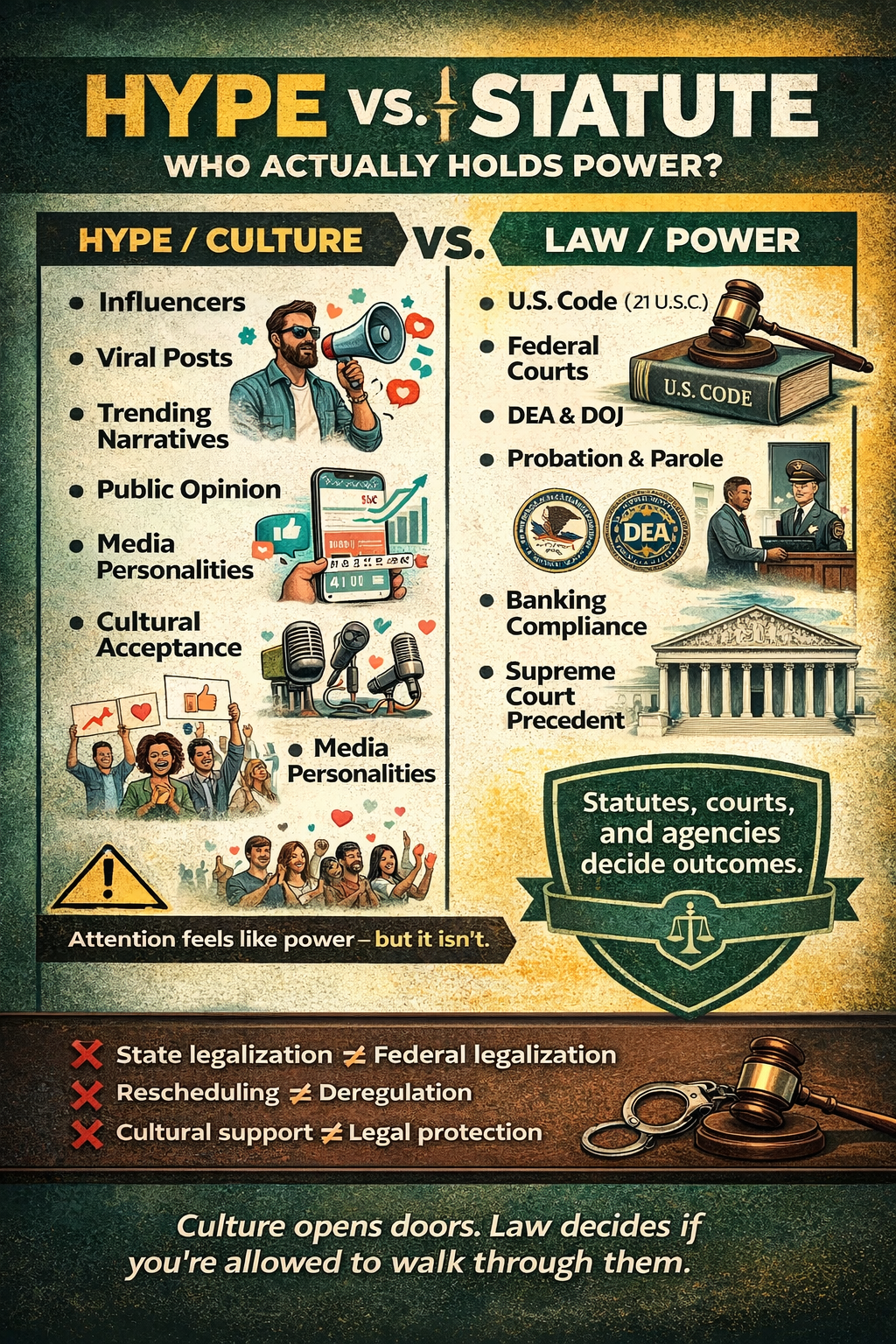
The infographic below contrasts culture with the structures that actually decide outcomes. On the right side are the actors and systems that matter when freedom, money, and compliance are on the line:
– U.S. Code — Federal statutes define what is legal and illegal.
– Federal courts — Judges interpret and enforce those statutes.
– DEA & DOJ — Agencies execute and prioritize enforcement.
– Probation & parole systems — Supervision rules override cultural norms.
– Banking compliance — Financial access is governed by federal risk rules.
– Supreme Court precedent — Binding law outlives any news cycle.
These systems do not care who is trending. They care what is written, what is ordered, and what is enforced.
Cannabis Shows the Illusion Perfectly
Cannabis policy exposes the gap between hype and power more clearly than almost any other issue.
Culturally, cannabis is mainstream. Politically, it is popular. Economically, it is a multibillion-dollar industry. Legally, it remains federally illegal.
That contradiction exists because institutions — not influencers — decide outcomes.
Federal law still controls:
– Scheduling under the Controlled Substances Act
– Federal prosecution authority Interstate commerce restrictions
– Banking and financial compliance
– Probation and supervised release conditions
This is why people are shocked when they are violated for conduct they believed was “basically legal.” Culture told them one thing. Law enforced another.
The False Comfort of Cultural Victory
One of the most dangerous narratives is that once public opinion flips, protection automatically follows.
It doesn’t.
History is full of examples where public sentiment outpaced legal reform by years or decades. During that gap, people pay the price. Arrests still happen. Violations are still charged. Licenses are still denied. Banks still refuse service. Courts still enforce old frameworks.
Believing culture equals protection creates false confidence — and false confidence leads to real consequences.
Why Institutions Move Slowly (On Purpose)
The same structures that frustrate reformers also prevent chaotic swings of power. Courts, agencies, and statutes are intentionally slow to change. That inertia protects rights in some cases and preserves injustice in others.
But it also means:
Power does not shift because a narrative changes.
Power shifts when law changes.
Anything else is performance.
What Real Power Looks Like
If you want to measure power, don’t look at who has the loudest platform. Look at who can:
File charges
Issue binding orders
Deny or grant licenses
Freeze or allow financial access
Interpret statutes
Set regulatory rules
Enforce compliance
That is power.
Everything else is commentary.
Why This Distinction Matters
Confusing hype for power is not just an intellectual error. It is a practical one. It causes people to:
– Take legal risks they shouldn’t
– Assume protections that don’t exist
– Underestimate institutional authority
– Overestimate cultural leverage
For people in regulated, criminalized, or gray-market spaces, that mistake is expensive.
Sometimes life-altering.
Conclusion: Follow the Statute, Not the Narrative
This infographic makes a simple point that modern media tries to hide: the system does not run on vibes.
Culture can open doors.
Law decides whether you’re allowed to walk through them.
If you want to understand who actually holds power, stop watching trends. Start reading statutes. Start tracking court decisions. Start paying attention to agencies and enforcement priorities.
Because when things go wrong, you don’t answer to bloggers podcasters and influencers.
You answer to institutions on different timelines than you.
 WeedPress: The Paper Trail
Leave a comment