Legal Memorandum: Common Misconceptions in Cannabis Activism Regarding Federal Drug Law
Jason Karimi
Weedpress | January 2026
Executive Summary
Public discourse surrounding cannabis reform continues to reflect widespread misunderstanding of federal drug law. In particular, cannabis advocacy frequently conflates administrative scheduling changes with legalization, underestimates the role of international treaty obligations, and overlooks existing statutory mechanisms for targeted federal-state reconciliation. This memorandum identifies common legal errors and cites controlling statutory, constitutional, and treaty authorities, with relevant legislative history and agency practice.
⸻
I. Rescheduling Under the Controlled Substances Act Does Not Constitute Federal Legalization
A. Statutory Framework
The Controlled Substances Act (“CSA”) establishes five schedules of controlled substances. 21 U.S.C. §§ 801–971 (2022).
Schedule I substances are defined as having “no currently accepted medical use in treatment in the United States.” 21 U.S.C. § 812(b)(1)(B) (2022). Schedule III substances are defined as having accepted medical use and a lower potential for abuse relative to Schedules I and II. 21 U.S.C. § 812(b)(3) (2022).
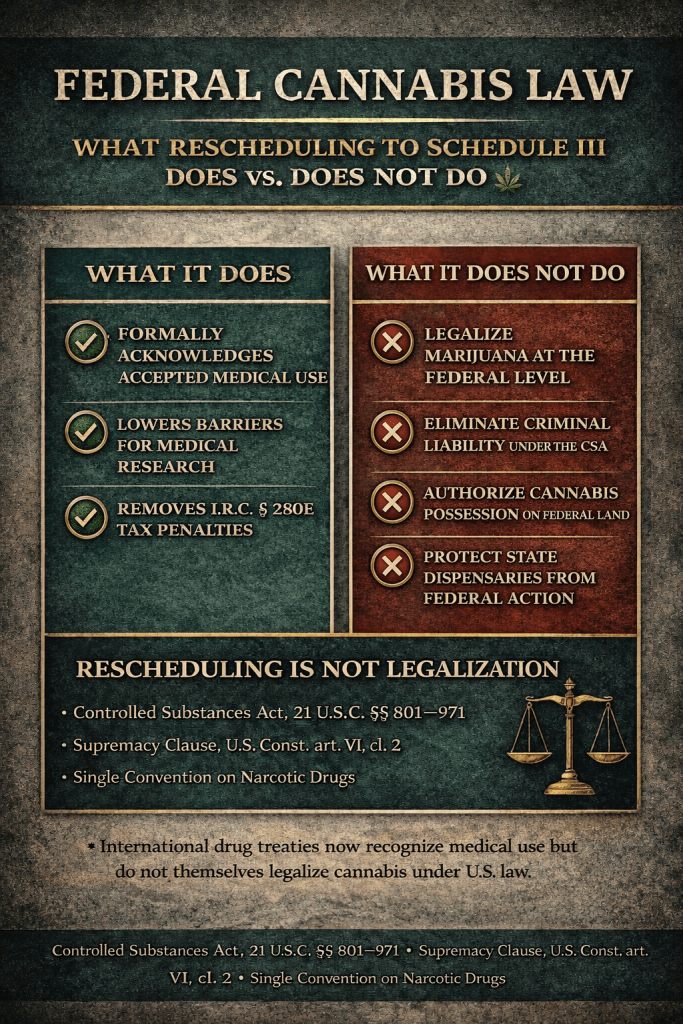
Placement in Schedule III does not remove a substance from federal control.
B. Continued Federal Control of Schedule III Substances
Schedule III substances remain subject to federal registration, manufacturing, and distribution controls. 21 U.S.C. §§ 822–824 (2022).
Unauthorized manufacture or distribution of Schedule III substances remains a federal felony. 21 U.S.C. § 841(a) (2022).
Examples of Schedule III substances include ketamine and anabolic steroids. 21 C.F.R. § 1308.13 (2024).
⸻
II. Federal–State Conflict and Congressional Intent
A. Federal Supremacy
The Supremacy Clause establishes federal law as supreme over conflicting state law. U.S. Const. art. VI, cl. 2.
Congress enacted the CSA pursuant to its Commerce Clause authority. See Gonzales v. Raich, 545 U.S. 1, 22–33 (2005).
B. Legislative History of the CSA
The CSA was enacted as Title II of the Comprehensive Drug Abuse Prevention and Control Act of 1970. Pub. L. No. 91-513, 84 Stat. 1236 (1970).
Congressional findings emphasized the need for a uniform national framework to control controlled substances and prevent diversion into illicit markets. See H.R. Rep. No. 91-1444, pt. 1, at 1–3 (1970).
The legislative history reflects Congress’s intent to establish federal primacy over drug control policy, even where states adopt differing approaches.
⸻
International Drug Control Treaties and Medical Cannabis
International drug control treaties, including the Single Convention on Narcotic Drugs of 1961, recognize and permit the use of cannabis for accepted medical and scientific purposes, subject to strict governmental controls.
In December 2020, the United Nations Commission on Narcotic Drugs (CND) voted to remove cannabis and cannabis resin from Schedule IV of the Single Convention, a category reserved for substances considered particularly dangerous with limited or no therapeutic value. This action formally acknowledged the medical utility of cannabis and reduced international legal barriers to medical research and therapeutic use.
Cannabis remains listed in Schedule I of the Convention, which permits medical and scientific use while requiring continued regulatory controls to prevent abuse. Single Convention, sched. I (as amended 2020).
Under the Convention and International Narcotics Control Board (INCB) guidance, signatory nations permitting medical cannabis must establish government systems for:
• Licensing of cultivation and manufacture
• Control of distribution and dispensing
• Monitoring and reporting to international bodies
• Limiting production to medical and scientific needs
See Single Convention on Narcotic Drugs arts. 23, 28, 34; Int’l Narcotics Control Bd., Report of the International Narcotics Control Board for 2021.
The treaty framework does not authorize non-medical (recreational or adult-use) cannabis. The INCB has repeatedly expressed concern that national recreational legalization regimes and certain practices, such as non-medical self-cultivation, may be inconsistent with treaty obligations.
Accordingly, the international treaty system now affirmatively permits medical cannabis programs under strict governmental oversight but continues to prohibit legalization for non-medical purposes.
B. Legislative Incorporation of Treaty Obligations
Congress expressly incorporated treaty compliance into domestic scheduling authority. 21 U.S.C. § 811(d)(1) (2022) requires that if control is required by international treaty, the Attorney General must place the substance in the appropriate schedule.
Legislative history confirms that Congress intended U.S. drug scheduling to remain consistent with international obligations. See S. Rep. No. 91-613, at 5–6 (1969).
⸻
IV. Waiver Authority Under 21 U.S.C. § 822(d): Legislative Intent and Agency Practice
A. Statutory Text and Purpose
Section 822(d) authorizes the Attorney General to waive registration requirements when consistent with public health and safety. 21 U.S.C. § 822(d) (2022).
This provision was included to provide administrative flexibility in exceptional or specialized circumstances. See H.R. Rep. No. 91-1444, pt. 1, at 47–48 (1970) (discussing registration framework and discretionary authorities).
B. Agency Practice
Historically, DOJ and DEA have exercised waiver and exemption authorities narrowly, primarily in research, government, or specialized distribution contexts.
There is no indication in public legislative history that Congress specifically contemplated broad state cannabis program waivers under § 822(d). However, the statutory text does not preclude state-initiated waiver petitions, provided the Attorney General makes required public health and safety findings.
Accordingly, § 822(d) represents a legally plausible—though politically underutilized—mechanism for targeted federal-state accommodation.
⸻
V. Section 280E: Legislative Purpose and Limits
Internal Revenue Code § 280E was enacted as part of the Tax Equity and Fiscal Responsibility Act of 1982. Pub. L. No. 97-248, § 351, 96 Stat. 324, 640 (1982).
Congress enacted § 280E in response to Edmondson v. Comm’r, T.C. Memo 1981-623, to prevent drug traffickers from deducting ordinary business expenses.
Section 280E applies only to Schedule I and II substances. 26 U.S.C. § 280E (2022). Removal of marijuana from Schedule I would eliminate § 280E’s application to cannabis businesses but would not legalize cannabis or remove CSA criminal liability.
⸻
VI. Administrative Practice and Enforcement Discretion
DOJ enforcement priorities have historically fluctuated based on internal guidance memoranda, including:
• The Ogden Memorandum (2009)
• The Cole Memorandum (2013)
• The Sessions Memorandum (2018) (rescinding prior guidance)
These memoranda reflect enforcement discretion, not changes in substantive law. They do not create legal rights or immunities and may be rescinded at any time.
⸻
VII. Common Advocacy Errors
Cannabis advocacy frequently advances claims inconsistent with statutory text, case law, treaty obligations, and legislative history, including:
1. That rescheduling equals legalization
2. That federal enforcement authority ceases upon Schedule III placement
3. That state legalization overrides federal law
4. That treaty obligations are irrelevant
5. That no statutory mechanisms exist for targeted federal relief
⸻
Conclusion
Congress enacted the CSA to establish a uniform national drug control framework, expressly incorporating international treaty obligations and maintaining federal supremacy. Rescheduling constitutes an administrative classification change, not legalization. Legislative history and agency practice confirm that meaningful reform requires congressional action, treaty modification, or careful use of limited statutory waiver authorities—not reliance on slogans or mischaracterizations of federal law.
***********************************************

Executive Policy Brief for Lawmakers
Federal Cannabis Reform: Legal Realities, Misconceptions, and Strategic Options
Prepared by: Jason Karimi, Weedpress | January 2026
⸻
Purpose
This brief provides lawmakers with a concise, legally grounded overview of common misconceptions surrounding federal cannabis reform and identifies strategic policy options consistent with existing statutory and treaty frameworks. It is intended to assist legislators, executive officials, and staff in evaluating cannabis policy proposals with an accurate understanding of federal law.
⸻
Key Legal Realities
- Rescheduling Is Not Legalization
Administrative rescheduling of marijuana under the Controlled Substances Act (CSA) does not legalize cannabis at the federal level. Schedule III placement would:
• Acknowledge accepted medical use
• Reduce certain research barriers
• Remove Internal Revenue Code § 280E tax penalties
However, Schedule III substances remain federally controlled. Unauthorized manufacture, distribution, and possession remain federal crimes. Rescheduling does not preempt federal enforcement authority or override federal supremacy.
⸻
- Federal Supremacy Remains Controlling
Federal law preempts conflicting state law under the Supremacy Clause. The Supreme Court has affirmed Congress’s authority to prohibit marijuana even where states permit it. State legalization does not displace federal criminal law.
Accordingly, state-legal cannabis programs continue to operate in tension with federal law absent congressional authorization.
⸻
- International Treaty Obligations Constrain Policy
The United States is bound by international drug control treaties requiring continued control over cannabis. These treaty obligations are incorporated into U.S. law and limit unilateral domestic descheduling. Significant federal legalization would require:
• Treaty modification
• Treaty reservation
• Or formal withdrawal
Absent such actions, administrative changes alone cannot fully resolve treaty constraints.
⸻
Strategic Options Available Under Existing Law
- Targeted Federal Waivers (21 U.S.C. § 822(d))
The CSA authorizes the Attorney General to waive registration requirements for certain manufacturers, distributors, or dispensers if consistent with public health and safety.
This authority could be explored as a mechanism for:
• Targeted federal-state accommodation
• Pilot programs for state medical cannabis systems
• Reduced conflict for narrowly defined programs
This option does not require congressional action but would require executive branch initiative and formal findings.
⸻
- Congressional Legislative Pathways
Durable federal cannabis reform ultimately requires congressional action, including:
• Amendments to the Controlled Substances Act
• Creation of federal regulatory frameworks
• Preemption or safe harbor provisions for state programs
• Statutory accommodation of international treaty obligations
Without congressional action, administrative reforms remain limited in scope and vulnerable to reversal.
⸻
Common Policy Errors to Avoid
Lawmakers should be cautious of policy narratives that:
• Conflate rescheduling with legalization
• Assume federal enforcement authority disappears after Schedule III placement
• Treat state legalization as controlling over federal law
• Ignore treaty obligations
• Overstate the legal impact of executive branch guidance
These misconceptions create unrealistic expectations and undermine effective policy design.
⸻
Recommendations for Lawmakers
1. Educate staff and constituents on the legal limits of rescheduling.
2. Evaluate targeted waiver authorities for narrowly tailored medical programs.
3. Develop treaty-compliant legislative proposals for long-term reform.
4. Pursue statutory clarity rather than reliance on enforcement discretion.
5. Distinguish tax reform from legalization when communicating policy impacts.
⸻
Conclusion
Federal cannabis reform requires statutory precision, treaty awareness, and realistic policy design. Rescheduling represents a regulatory adjustment, not legalization. Lawmakers seeking durable reform should prioritize legislative solutions and consider targeted administrative tools as interim measures. Clear communication of legal realities will improve policymaking and public understanding.
WeedPress Policy Series
No. 1 — Legal Memorandum: Common Misconceptions in Cannabis Activism Regarding Federal Drug Law (January 25, 2026)
No. 2 — The Path to a Religious Cannabis Exemption: How Medical Cannabis Systems Change the RFRA Equation (January 27, 2026)
No. 3 — Structural Contradictions and Prospective Litigation Risk in Post-Rescheduling Cannabis Policy (February 6, 2026)
No. 4 — The Controlled Substances Act Is Not a Blunt Instrument — It Is an Architecture of Exceptions (February 13, 2026)
No. 5 — The Limits of § 822(d): What It Does — and Does Not — Authorize (February 13, 2026)
No. 6 — The Major Questions Doctrine and Cannabis Reform: Delegation, Scale, and Judicial Review (February 14, 2026)
No. 7 — Chevron’s Collapse and Cannabis Regulation: Judicial Review After Loper Bright (February 17, 2026)
No. 8 — Administrative Procedure Act Vulnerabilities in DEA Rescheduling (February 20, 2026)
No. 9 – No. 9 — Dormant Commerce Clause, Circuit Splits, and Cannabis Federalism (February 23, 2026)
No. 10 — Federal Preemption After Rescheduling: Conflict, Obstacle, and Cannabis Federalism (February 27, 2026)
No. 11 — Equal Protection and Economic Protectionism in Cannabis Licensing: Classification, Remedial Design, and Constitutional Limits (March 3, 2026)
No. 12 — Federal Rescheduling as a Preemption Trigger: Rational Basis, Conflict, and State Schedule I Exposure (March 6, 2026).
No. 13 — Criminal Prosecution After Federal Medical Recognition: Motions Practice, Rational Basis, and Schedule I Litigation Exposure (March 10, 2026).
No. 14 — The South Dakota Controlled Substances Act: Legislative Architecture, Intent, and Institutional Design in a Potential Federal Rescheduling Context (March 24, 2026).
About Weedpress Policy Series
The Weedpress Policy Series publishes in-depth, citation-supported analysis of federal cannabis law, regulatory policy, and enforcement practices. The series is designed to provide lawmakers, attorneys, journalists, and stakeholders with legally grounded, non-activist, non-promotional analysis focused on statutory reality and institutional accountability.
Weedpress Policy Series emphasizes:
• Federal statutory interpretation
• Congressional intent and legislative history
• Treaty and international law implications
• Administrative law and agency authority
• Oversight of enforcement discretion and regulatory gaps

WeedPress is a policy analysis publication focused on statutory interpretation, administrative procedure, and publicly available records. Our commentary addresses systems, laws, and institutional structures — not private individuals. WeedPress does not encourage harassment, direct contact, or targeting of any person. All analysis is intended for informational and educational purposes.
 WeedPress: The Paper Trail
Leave a comment