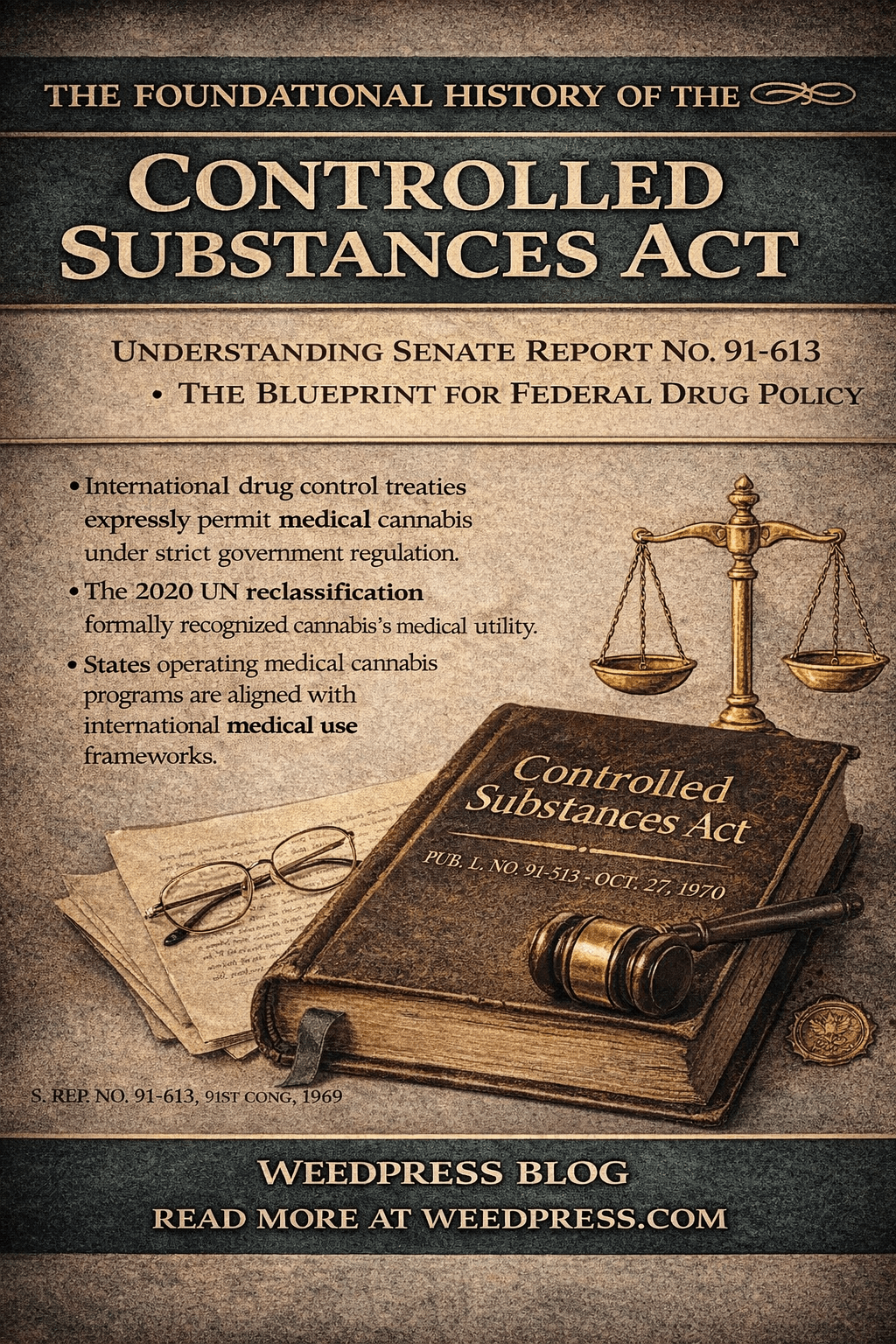
S. Rep. No. 91-613 (1969) is the Senate Judiciary Committee report accompanying S. 3246, the bill that became Title II and III of the Comprehensive Drug Abuse Prevention and Control Act of 1970 (Public Law 91-513), also known as the Controlled Substances Act (CSA). This is the foundational federal law classifying drugs into schedules and establishing the modern framework for controlled substances regulation in the US.
The report was submitted to the Senate on December 16, 1969 (with some references to it being presented or acted on around late December 1969/early 1970).
Unfortunately, the full text of Senate Report 91-613 does not appear to be freely available online in digitized form through standard government sources like Congress.gov, GovInfo, or the GPO. Many older congressional reports from the pre-digital era (especially from the 91st Congress) have not been fully scanned and uploaded as searchable PDFs for direct access.
Overview and Purpose (from multiple sources quoting pp. 1–4, 2–3, etc.)
The report explains the need for comprehensive reform of federal drug laws:
• “The United States has international commitments to help control the worldwide drug traffic. To honor those commitments, and to meet the responsibilities imposed by the Constitution in matters of interstate and foreign commerce, the Federal Government has a basic and continuing responsibility to control the drug traffic.” (Quoted in multiple Federal Register notices and DOJ opinions, e.g., S. Rep. No. 91-613, at 4 (1969)).
• The bill aimed to “prevent both the trafficking in these substances for unauthorized purposes and drug abuse.” It consolidated prior fragmented laws into a single framework with uniform scheduling, registration, and penalties (quoted in H. Rept. 105-683 and various academic analyses).
• It sought to balance enforcement against abuse while reducing penalties for simple possession (shifting many from felonies to misdemeanors) and focusing severe penalties on trafficking and profit-driven distribution.
Key Provisions on Scheduling and Classification
The report describes the five schedules (I–V) based on potential for abuse, medical use, and dependence liability:
• Schedule I: High abuse potential, no accepted medical use, lack of accepted safety for use under medical supervision (e.g., heroin, LSD, marijuana at the time).
• Schedules II–V: Graduated based on decreasing abuse risk and increasing medical utility.
• The Attorney General (now delegated to DEA) has authority to add, delete, or reschedule substances after considering factors like abuse potential, scientific evidence, and international treaties (21 U.S.C. § 811; legislative history in the report emphasizes treaty compliance under the Single Convention on Narcotic Drugs).
Excerpts often cite: “The report discusses the criteria for scheduling and the intent to align with international obligations” (paraphrased across sources like the OLC memo on marijuana cultivation and Federal Register scheduling rules).
Penalties and Enforcement
• The report imposes “severe criminal penalties” on unauthorized manufacture, distribution, and trafficking, especially for profit (“primarily for the profits to be derived therefrom” – referenced in United States v. Moore, 423 U.S. 122 (1975), and related quotes from pp. 2, 116).
• For conspiracies and attempts: Identical penalties to substantive offenses (cited in Bifulco v. United States, 447 U.S. 381 (1980), referencing p. 116).
• Reduced penalties for personal use/possession in many cases, reflecting a rehabilitative approach over purely punitive for users.
International and Treaty Aspects
A recurring theme: The U.S. must comply with treaties like the 1961 Single Convention on Narcotic Drugs. The report stresses that federal law fulfills these obligations by controlling production, distribution, and possession to limit drugs to medical/scientific purposes.
Additional Details from Legislative History Compilations
• The report includes sections on registration of manufacturers/distributors/practitioners, record-keeping, inspections, administrative subpoenas, and forfeiture provisions.
• It addresses the shift from prior mandatory minimums in some drug laws to more flexible sentencing, with emphasis on treatment and research.
If you’re publishing this on your blog, you can use these excerpts with proper attribution (e.g., “As quoted in , citing S. Rep. No. 91-613, at [page]”). For example:
• Federal Register documents (public domain) frequently quote pp. 4 and others.
• Supreme Court cases like Gonzales v. Raich (545 U.S. 1, 2005) and others reference the report’s intent on comprehensive control.
• CRS reports (e.g., on marijuana) paraphrase the history.
To get closer to “complete”:
• Check HeinOnline (if you have access via a library) for the full scanned report in their Federal Legislative Histories or U.S. Congressional Serial Set.
• Request a copy from a federal depository library in Omaha (e.g., University of Nebraska at Omaha’s Dr. C.C. and Mabel L. Criss Library is a depository; they may have it in microfiche or can ILL it quickly).
• Some legislative history compilations (like U.S. Code Congressional & Administrative News) reprint large portions.
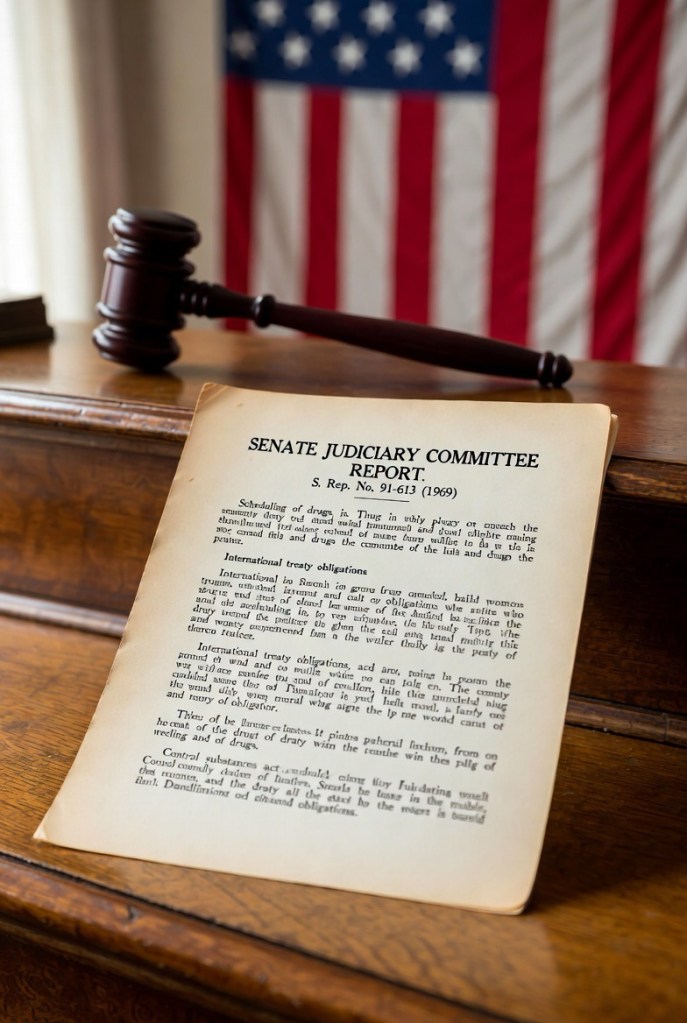
Where to Access The Full Report
• Physical/Microfiche Copies: It was printed by the U.S. Government Printing Office in 1969 as “91st Congress, 1st Session, Senate Report No. 91-613” (likely around 165 pages based on archival references). You can request it through:
• A federal depository library (find one near Omaha via https://www.fdlp.gov/ — the University of Nebraska-Omaha or Creighton University libraries may have it in microfiche or bound collections).
• Interlibrary loan from the Library of Congress or a major research library.
• Paid/Archival Sources: Some databases like HeinOnline (https://home.heinonline.org/), ProQuest Congressional, or Lexis/Westlaw have historical congressional reports digitized (including legislative history volumes for the 1970 Controlled Substances Act that compile S. Rep. 91-613 and related materials). These require institutional or subscription access — check if your local library/university provides access.
• Congress.gov: The report is referenced in legislative history (e.g., in the bill status for H.R. 18583 or S. 3246 equivalents), but no full PDF is linked. See: https://www.congress.gov/bill/91st-congress/house-bill/18583 (the enacted version).
• GovInfo: Scanned Congressional Records from 1969 mention the report (e.g., https://www.govinfo.gov/content/pkg/GPO-CRECB-1969-pt29/pdf/GPO-CRECB-1969-pt29-3-1.pdf has Judiciary Committee discussion on drug abuse bills around the report date), but not the report text itself.
If You Want to Publish It on Your Blog
Since it’s a U.S. government document, the full report is in the public domain (no copyright restrictions under 17 U.S.C. § 105). You can reproduce or excerpt it freely. However, you’d need to obtain a copy first (via the options above) to scan/transcribe/publish it accurately. Partial excerpts appear in court cases, CRS reports, and academic papers (e.g., discussions of sentencing, subpoenas, or scheduling), but not the complete document.
 WeedPress: The Paper Trail
Leave a comment