The Path to a Religious Cannabis Exemption: Why Medical Cannabis Systems Change the RFRA Equation
By Jason Karimi | WeedPress Policy Series No. 2 January 27, 2026
For decades, U.S. courts have uniformly rejected claims that marijuana is protected as a religious sacrament under the First Amendment or the Religious Freedom Restoration Act (RFRA). Ethiopian Zion Coptic Church cases, Rastafarian challenges, and other sacramental-cannabis claims have all failed at the federal level.
But that uniformity was built on a factual and regulatory landscape that is now rapidly changing.
Medical cannabis systems, rescheduling, and the existence of tightly regulated distribution infrastructure fundamentally alter the RFRA strict-scrutiny analysis that doomed earlier cases. The next generation of religious-cannabis litigation will not be decided on the same facts — and courts will be forced to confront arguments they have never squarely addressed.
The RFRA Framework: Why Cannabis Has Always Lost
Under RFRA, the government must show that burdening religious exercise serves:
– A compelling governmental interest, and
– Is the least restrictive means of furthering that interest.
Courts have consistently ruled that marijuana prohibition satisfies both prongs.
In United States v. Rush, 738 F.2d 497 (1st Cir. 1984), involving the Ethiopian Zion Coptic Church, the First Circuit rejected a sacramental cannabis defense, accepting the government’s position that strict enforcement of federal drug laws constituted a compelling interest.
Similarly, in Olsen v. DEA, 878 F.2d 1458 (D.C. Cir. 1989), the court denied a RFRA-style challenge (pre-RFRA but applying similar scrutiny), holding that marijuana’s illegality and abuse potential justified denying religious exemptions.
Post-RFRA, courts have continued to rely on the same reasoning. In United States v. Meyers, 906 F. Supp. 1494 (D. Wyo. 1995), aff’d, the court explicitly rejected a religious marijuana claim, emphasizing diversion risk and enforcement burdens.
The theme is consistent: courts accept the government’s assertion that categorical prohibition is necessary, and that no narrower alternative can adequately protect public safety or prevent abuse.
The Supreme Court’s Template: O Centro and Least Restrictive Means
The turning point in religious-drug law did not involve marijuana. It involved ayahuasca.
In Gonzales v. O Centro Espírita Beneficente União do Vegetal, 546 U.S. 418 (2006), the U.S. Supreme Court unanimously held that the federal government failed RFRA’s strict-scrutiny test when it tried to ban sacramental use of ayahuasca (containing DMT).
The Court rejected broad, categorical claims and required case-specific proof, emphasizing that:
RFRA requires the government to demonstrate that applying the burden to the particular claimant is the least restrictive means of furthering a compelling interest.
The Court also emphasized that the existence of regulatory exemptions (such as peyote for the Native American Church) undermined the government’s claim that uniform enforcement was necessary.
O Centro is the controlling RFRA framework — and it is the case religious cannabis litigants have never been able to fully leverage.
Why Medical Cannabis Systems Change the RFRA Analysis
This is the core shift courts have not yet fully confronted:
In medical cannabis states, governments already operate tightly regulated dispensary systems that track, limit, and control cannabis distribution. Under RFRA, this undermines the claim that total prohibition is the least restrictive means of furthering governmental interests. A religious-use registry tied to licensed medical dispensaries would directly mirror the regulatory structure courts approved for ayahuasca — raising serious questions about why sacramental cannabis remains categorically excluded.
This argument goes directly to RFRA’s weakest point for the government: least restrictive means.
Once a state has conceded — through medical cannabis law — that cannabis can be:
Safely distributed – Tracked and limited – Audited and regulated – Integrated into public health frameworks
It becomes much harder to argue that categorical denial of religious access is the least restrictive way to serve public safety or diversion concerns.
This is the RFRA pressure point.

The Minnesota Court of Appeals: A Rare Religious Cannabis Win (Narrow but Important)
While no appellate court has granted a broad religious exemption to possess marijuana itself, the Minnesota Court of Appeals has issued one of the most important religious-cannabis rulings in the country — recognizing Rastafarian religious rights involving cannabis ritual objects.
In In re Welfare of J.J.M.A., No. A13-0295 (Minn. Ct. App. Sept. 23, 2013) (unpublished), the court reversed a juvenile adjudication for possession of a cannabis pipe, holding that Minnesota’s Constitution provides stronger protection for religious exercise.
The court held:
“Rastafari is a true religion and that J.J.M.A. has a sincerely held belief in the tenets of that religion.”
And applied strict scrutiny under Minnesota’s freedom-of-conscience clause, emphasizing that:
“Once an individual has demonstrated a sincerely held religious belief intended to be protected…, the burden shifts to the state to demonstrate that public safety cannot be achieved by proposed alternative means.”
Critically, the court ruled that the state failed to show that enforcing paraphernalia laws against a Rastafarian’s prayer chalice was the least restrictive means of protecting public safety. The conviction was reversed.
While narrow — limited to paraphernalia, not cannabis possession — this case shows how stronger state constitutional protections + strict scrutiny can produce real religious accommodations related to cannabis practice.
The Dispensary-Based Religious Registry Model
A future religious-cannabis exemption that could survive RFRA scrutiny would likely need to look like this:
1. No Home Grow
Eliminates diversion risk.
2. Licensed Dispensary Distribution
Uses existing medical cannabis infrastructure.
3. Clergy Verification + Religious Registry
Prevents sham claims.
4. Quantified Sacramental Limits
Mirrors peyote and ayahuasca models.
5. Narrow Ceremonial Scope
Prevents lifestyle-use claims.
Under RFRA, this structure allows religious claimants to argue:
– The state already has a regulatory system
– The system already controls diversion
– Denying religious access through that same system is not the least restrictive means
This is exactly the logic the Supreme Court accepted in O Centro.
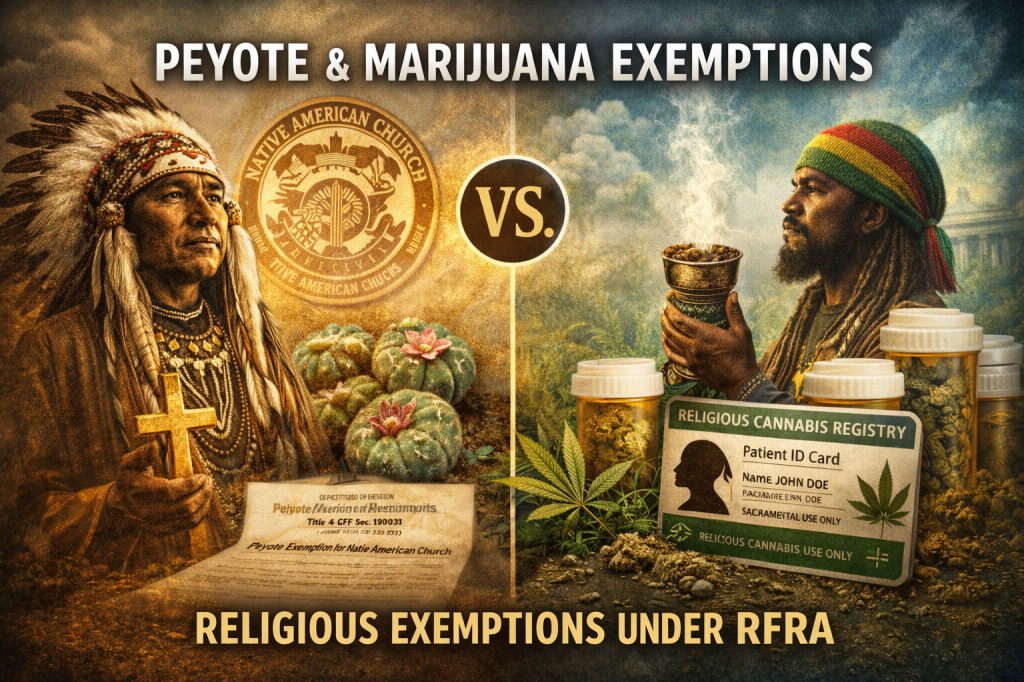
Equal Treatment: Cannabis vs. Ayahuasca and Peyote
Another underused RFRA argument is disparate treatment.
The federal government allows Peyote for Native American Church Ayahuasca (DMT) for UDV Church, yet denies cannabis — even in medical states — despite:
– Lower toxicity
– Broader accepted use
– Extensive regulatory frameworks
Post-rescheduling, this unequal treatment becomes harder to justify under RFRA’s neutrality principles.
Why Earlier Cannabis Cases Will Be Vulnerable Post-Rescheduling
Most earlier religious-cannabis losses rely on facts that are changing:
– Schedule I classification “No accepted medical use”
A Lack of regulatory frameworks
– Uncontrolled diversion risk
Rescheduling + medical systems directly undercut those premises.
Future courts will be forced to ask whether old precedent still applies to new facts.
The Strategic Path Forward
A realistic test case would involve:
– A medical cannabis state
A A state RFRA or strong state constitution
A Dispensary-based sacramental access
A Narrow ceremonial doctrine
A Full regulatory compliance
This is how religious cannabis moves from theoretical to legally plausible.
Conclusion
Religious cannabis claims have failed not because RFRA is weak, but because marijuana’s legal status and lack of regulatory structure allowed courts to accept categorical prohibition as the least restrictive means.
That is no longer true in many states.
Medical cannabis systems, rescheduling, and tightly regulated dispensary infrastructure fundamentally weaken the government’s RFRA position. The next generation of religious-cannabis litigation will not be decided on the same record — and courts will eventually have to explain why cannabis remains excluded from religious accommodation frameworks that already exist for other controlled substances.
Disclaimer:
This article and accompanying materials are provided for informational and policy-analysis purposes only and do not constitute legal advice. Nothing herein creates an attorney-client relationship. Laws and interpretations vary by jurisdiction and are subject to change. Readers should consult a qualified attorney licensed in their jurisdiction before relying on or acting upon any legal analysis or strategy discussed in this publication.
WEEDPRESS POLICY SERIES™ — LITIGATION STRATEGY MEMO
Roadmap to a Viable Religious Cannabis Exemption Case
Purpose:
This memo outlines a realistic, legally defensible litigation strategy to pursue a religious cannabis exemption under RFRA and state constitutional law in the post-medical/post-rescheduling landscape.
This is not a theoretical exercise. It is designed to build a record capable of surviving strict scrutiny.
⸻
I. Strategic Premise
Past religious cannabis cases failed because courts accepted two government claims:
1. Cannabis prohibition serves a compelling interest
2. Total prohibition is the least restrictive means
Medical cannabis systems, regulatory infrastructure, and evolving federal policy now directly undermine the least restrictive means prong.
The litigation goal is not to argue cannabis is harmless.
The goal is to prove that categorical denial of religious access is no longer the least restrictive means.
⸻
II. Jurisdictional Targeting (Where to File)
Priority 1 — State RFRA + Medical Cannabis
Best test case environment:
• State with:
• Medical cannabis
• State RFRA statute OR strong free exercise clause
• History of strict scrutiny (e.g., Minnesota, Texas, Florida, Arizona, New Mexico)
Why:
State courts are more willing to recognize accommodations and are less constrained by federal drug enforcement narratives.
⸻
Priority 2 — Federal RFRA (Post-Rescheduling)
Federal court strategy becomes viable after:
• Formal rescheduling
• HHS/FDA recognition of accepted medical use
• DOJ enforcement guidance softening
Until then, federal courts will default to CSA uniformity arguments.
⸻
III. Plaintiff Selection (Critical)
The wrong plaintiff kills the case.
Required Plaintiff Profile:
• Long-standing, organized religious group
• Clear doctrine predating litigation
• Clergy structure
• Written theology tying cannabis to ritual
• No criminal trafficking history
• No recreational branding
Avoid:
• Individual-only claims
• Lifestyle-use religions
• New churches formed for litigation
• Public cannabis activism branding
Courts look for sincerity + institutional structure.
⸻
IV. Regulatory Design (The Heart of the Case)
Your strongest weapon is a prebuilt regulatory accommodation.
Proposed Accommodation Model:
• No home grow
• No private distribution
• No cash church sales
• Access only through:
• Licensed medical dispensaries
• Religious registry card
• Clergy verification
• Limited ceremonial quantities
This allows you to argue:
The government already operates a regulatory system capable of safely distributing cannabis. Denying religious access through that same system is not the least restrictive means.
This mirrors Gonzales v. O Centro.
⸻
V. Framing the RFRA Burden
Plaintiffs must clearly show:
• Cannabis is a sacrament
• Cannabis is required for specific religious rites
• Prohibition substantially burdens religious exercise
This must be documented with:
• Written doctrine
• Clergy affidavits
• Longstanding practice
• Expert religious testimony
⸻
VI. Attacking Least Restrictive Means
This is the litigation battlefield.
Key Arguments:
1. Medical dispensaries already prevent diversion
2. Track-and-trace already exists
3. Quantity limits already exist
4. Identity verification already exists
Therefore:
• Total denial is overinclusive
• Religious registry through dispensaries is a narrower alternative
Quote RFRA language constantly:
The government must use the least restrictive means.
Force DOJ/state AG to explain why an existing regulated channel is insufficient.
⸻
VII. Equal Treatment Argument (Powerful)
Use peyote + ayahuasca as comparators:
• Peyote: Statutory exemption
• Ayahuasca: RFRA judicial exemption
Argue:
• Cannabis is less toxic
• Cannabis has broader accepted use
• Cannabis has more regulation
Therefore:
• Selective denial violates RFRA neutrality principles
• Government must justify disparate treatment
⸻
VIII. Record Building (How You Win Later)
Even if you lose at trial:
Your goal is to create a record showing:
• Government refused narrower alternatives
• Government relied on outdated assumptions
• Regulatory systems already exist
• Courts relied on pre-medical era precedent
This sets up:
• Circuit split potential
• Post-rescheduling reconsideration
• Legislative pressure
⸻
IX. Minnesota-Style State Constitutional Hook
Use state constitutional freedom-of-conscience clauses.
Minnesota precedent shows:
• Courts may apply stricter scrutiny than federal courts
• State courts can recognize narrow religious accommodations
Argue for:
• Paraphernalia + sacrament access
• Narrow religious carveouts
State courts are the best place to notch the first real win.
⸻
X. Litigation Sequencing
Phase 1 — Declaratory + Injunctive Relief
• Challenge denial of religious registry
• Seek injunction for limited sacramental access
Phase 2 — Build Appellate Record
• Force state/feds to argue why medical system can’t be used
• Lock in testimony on diversion, safety, tracking
Phase 3 — Leverage for Legislative Fix
• Use litigation to support narrow statutory exemption
• Peyote model for cannabis
⸻
XI. What Not to Do (Common Failures)
• Do not argue lifestyle religious use
• Do not rely on sincerity alone
• Do not argue broad personal autonomy
• Do not attack CSA abstractly
• Do not use home-grow models
Courts want narrow, controlled accommodation.
⸻
XII. Strategic Bottom Line
Religious cannabis has failed because plaintiffs argued against prohibition.
The winning strategy is to argue against categorical denial in the presence of existing regulatory systems.
Medical cannabis + RFRA creates the first plausible pathway to a narrow, defensible religious accommodation.
⸻
WeedPress Strategic Framing:
“The future of religious cannabis litigation will not turn on whether courts believe cannabis is harmless, but on whether governments can still justify categorical denial when tightly regulated medical cannabis systems already exist. RFRA does not require perfect enforcement — it requires the least restrictive means.”
——
COUNT __
Violation of [State RFRA] and/or [State Constitution, Art. , § ]
Failure to Employ Least Restrictive Means
(State Law Claim)
A. Substantial Burden on Religious Exercise
1. Plaintiff incorporates all prior allegations by reference.
2. Defendants’ enforcement of [State Controlled Substances Act / state cannabis law / state criminal code] against Plaintiff’s sacramental use of cannabis substantially burdens Plaintiff’s sincere exercise of religion in violation of [State RFRA] and/or [State Constitution, Art. , § ].
3. Plaintiff’s religious doctrine requires the sacramental use of cannabis in defined religious ceremonies and rites.
4. By prohibiting Plaintiff from obtaining and using cannabis for sacramental purposes, Defendants place Plaintiff in the position of choosing between compliance with state law and adherence to sincerely held religious beliefs.
⸻
B. Strict Scrutiny Under State Law
5. Under [State RFRA] and/or [State Constitution], once a substantial burden on religious exercise is shown, Defendants must prove that application of the challenged law to Plaintiff:
a. Furthers a compelling governmental interest; and
b. Is the least restrictive means of furthering that interest.
6. State courts interpreting [State RFRA] and/or [State Constitution] apply strict scrutiny and require narrow tailoring where religious exercise is burdened.
⸻
C. Defendants Cannot Establish Least Restrictive Means
7. Even if Defendants can articulate a compelling governmental interest, Defendants cannot demonstrate that categorical prohibition of Plaintiff’s sacramental cannabis use is the least restrictive means of furthering that interest.
8. [State] already operates a comprehensive, tightly regulated medical cannabis program that:
a. Licenses and audits cannabis cultivators and dispensaries;
b. Tracks cannabis products through seed-to-sale systems;
c. Limits quantities and potency;
d. Requires identity verification; and
e. Implements diversion-prevention and compliance controls.
9. Through this regulatory framework, Defendants have already determined that cannabis can be safely distributed and controlled through narrow, regulated channels.
10. The existence of this medical cannabis system fatally undermines any claim that total prohibition is necessary to serve Defendants’ asserted interests.
⸻
D. Narrow Religious Accommodation Is a Less Restrictive Alternative
11. Plaintiff has proposed a narrowly tailored religious accommodation, including:
a. Access only through licensed medical cannabis dispensaries;
b. A religious registry card issued upon clergy verification;
c. Strict quantity limits tied to ceremonial use;
d. No home cultivation;
e. No public or commercial sales; and
f. Compliance and audit requirements equivalent to those imposed on medical cannabis patients.
12. This proposed accommodation directly utilizes existing state regulatory infrastructure and addresses the same public safety, diversion, and enforcement concerns Defendants assert as justification for categorical prohibition.
13. Because Defendants already administer this regulatory system, Defendants cannot plausibly contend that regulated religious access is unworkable or insufficient.
⸻
E. Categorical Denial Is Overinclusive and Not Narrowly Tailored
14. Defendants’ blanket denial of sacramental cannabis use is overinclusive because it burdens sincere religious exercise even where less restrictive, equally effective regulatory mechanisms are readily available.
15. State strict-scrutiny standards require Defendants to adopt narrower alternatives when they can achieve governmental objectives without completely burdening religious exercise.
16. Defendants’ refusal to permit any religious accommodation through existing regulated channels violates the narrow tailoring required by [State RFRA] and/or [State Constitution].
⸻
F. Disparate Treatment Undermines Least Restrictive Means
17. Defendants permit regulated access to cannabis for medical purposes under state law.
18. Defendants’ decision to categorically deny regulated access for sincere religious purposes—while permitting access for medical purposes—demonstrates that total prohibition is not the least restrictive means of furthering Defendants’ asserted interests.
19. This disparate treatment further confirms that Defendants’ policy fails strict scrutiny under state law.
⸻
G. Defendants Bear the Burden and Cannot Meet It
20. Under [State RFRA] and/or [State Constitution], Defendants bear the burden of proving that no less restrictive alternative exists.
21. Defendants cannot meet that burden because:
a. A regulated medical cannabis system already exists;
b. Plaintiff’s proposed accommodation directly addresses diversion and enforcement concerns; and
c. Defendants have failed to show why regulated religious access is insufficient.
22. Accordingly, Defendants’ application of [law] to Plaintiff’s sacramental cannabis use violates [State RFRA] and/or [State Constitution].
⸻
Prayer for Relief (State Least Restrictive Means)
WHEREFORE, Plaintiff respectfully requests that this Court:
a. Declare that Defendants’ application of [law] to Plaintiff’s sacramental cannabis use violates [State RFRA] and/or [State Constitution];
b. Enjoin Defendants from enforcing [law] against Plaintiff’s religious exercise where Plaintiff complies with a narrowly tailored, regulated accommodation; and
c. Order Defendants to permit sacramental access through regulated channels consistent with state strict-scrutiny and least restrictive means requirements.
WeedPress Policy Series
No. 1 — Legal Memorandum: Common Misconceptions in Cannabis Activism Regarding Federal Drug Law (January 25, 2026)
No. 2 — The Path to a Religious Cannabis Exemption: How Medical Cannabis Systems Change the RFRA Equation (January 27, 2026)
No. 3 — Structural Contradictions and Prospective Litigation Risk in Post-Rescheduling Cannabis Policy (February 6, 2026)
No. 4 — The Controlled Substances Act Is Not a Blunt Instrument — It Is an Architecture of Exceptions (February 13, 2026)
No. 5 — The Limits of § 822(d): What It Does — and Does Not — Authorize (February 13, 2026)
No. 6 — The Major Questions Doctrine and Cannabis Reform: Delegation, Scale, and Judicial Review (February 14, 2026)
No. 7 — Chevron’s Collapse and Cannabis Regulation: Judicial Review After Loper Bright (February 17, 2026)
No. 8 — Administrative Procedure Act Vulnerabilities in DEA Rescheduling(February 20, 2026)
No. 9 – No. 9 — Dormant Commerce Clause, Circuit Splits, and Cannabis Federalism (February 23, 2026)
No. 10 — Federal Preemption After Rescheduling: Conflict, Obstacle, and Cannabis Federalism (February 27, 2026)
No. 11 — Equal Protection and Economic Protectionism in Cannabis Licensing: Classification, Remedial Design, and Constitutional Limits (March 3, 2026)
No. 12 — Federal Rescheduling as a Preemption Trigger: Rational Basis, Conflict, and State Schedule I Exposure(March 6, 2026).
No. 13 — Criminal Prosecution After Federal Medical Recognition: Motions Practice, Rational Basis, and Schedule I Litigation Exposure (March 10, 2026).
No. 14 — The South Dakota Controlled Substances Act: Legislative Architecture, Intent, and Institutional Design in a Potential Federal Rescheduling Context(March 24, 2026).
About Weedpress Policy Series
The Weedpress Policy Series publishes in-depth, citation-supported analysis of federal cannabis law, regulatory policy, and enforcement practices. The series is designed to provide lawmakers, attorneys, journalists, and stakeholders with legally grounded, non-activist, non-promotional analysis focused on statutory reality and institutional accountability.
Weedpress Policy Series emphasizes:
• Federal statutory interpretation
• Congressional intent and legislative history
• Treaty and international law implications
• Administrative law and agency authority
• Oversight of enforcement discretion and regulatory gaps
 WeedPress: The Paper Trail
Leave a comment