Judges Signal Skepticism as Court Considers Forcing DEA to Act on Long-Delayed Exemption for Iowa Church
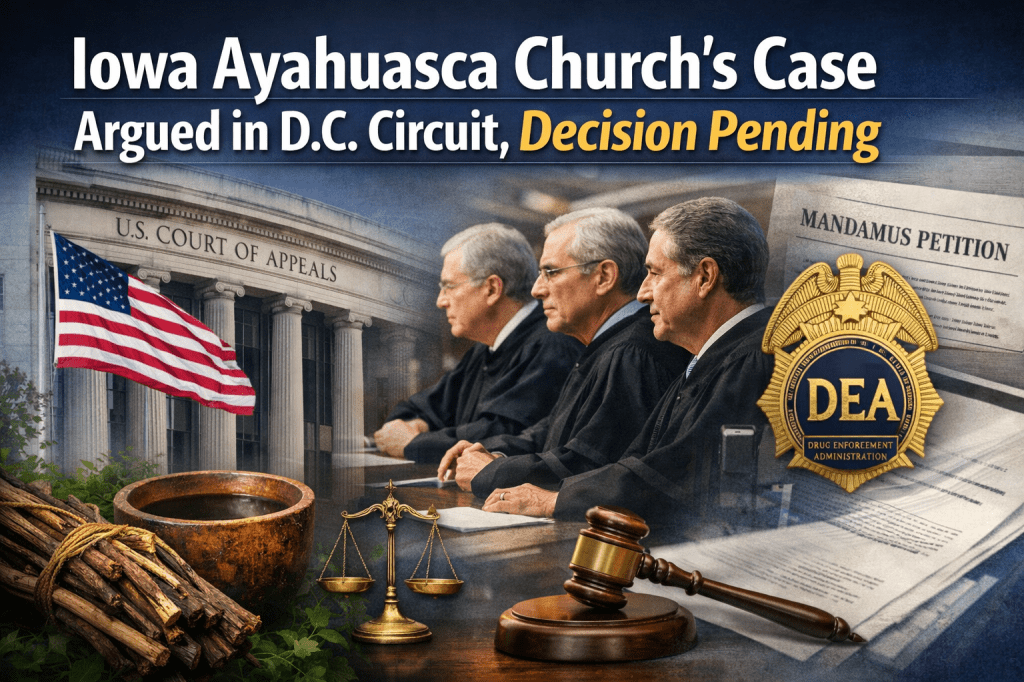
Iowa Ayahuasca Church’s Bid to Force DEA Action Argued in D.C. Circuit, Decision Pending
By Jason Karimi | WeedPress | January 39, 2026
An Iowa-based religious group has asked the U.S. Court of Appeals for the District of Columbia Circuit to intervene after the Drug Enforcement Administration allegedly failed for years to act on the church’s request for a religious exemption to use ayahuasca in its ceremonies.
The Iowaska Church of Healing filed a petition asking the D.C. Circuit to compel the DEA to process its application under the Religious Freedom Restoration Act (RFRA), arguing that the agency’s prolonged inaction effectively blocks the church’s religious exercise.
Years-Long Delay at Center of Petition
According to public court filings and reporting, the church submitted its request for a religious exemption to the DEA several years ago and has received no final determination.
The church argues that the delay itself constitutes an unlawful agency action under the Administrative Procedure Act, which requires federal agencies to conclude matters within a “reasonable time.”
In its petition, the church is asking the appeals court to issue a writ of mandamus — a rare form of relief that can be used to force a federal agency to act when it has unreasonably delayed a decision.
D.C. Circuit Signals Frustration With DEA Inaction
The Iowa case comes amid a broader pattern of D.C. Circuit judges expressing skepticism over the DEA’s handling of long-pending applications involving Schedule I substances.
In recent hearings involving both religious groups and pharmaceutical manufacturers, appellate judges have questioned why certain DEA applications have remained unresolved for years, raising concerns about whether the agency is complying with its obligations under federal administrative law.
Independent reporting has documented instances where the court pressed the DEA to explain multi-year delays and indicated that prolonged inaction may violate the Administrative Procedure Act’s requirement for timely agency decision-making.
The case, which asks the court to compel the DEA to process the church’s application under the Religious Freedom Restoration Act (RFRA), is now under advisement, with a written decision expected in the coming weeks or months.
Judges Question Years-Long DEA Delay
During oral argument in November 2025, a three-judge panel of the D.C. Circuit openly questioned the DEA about the length of time the agency has taken to process the church’s exemption request.
Public reporting and summaries of the hearing indicate that judges expressed frustration with what they characterized as multi-year inaction, with members of the panel noting that regulatory delays are typically measured in months, not years.
The church argues that the DEA’s prolonged failure to issue a final determination effectively blocks its ability to engage in protected religious exercise and violates the Administrative Procedure Act’s requirement that agencies conclude matters within a “reasonable time.”
Mandamus Petition Seeks to Compel Agency Action
Rather than challenging a final denial, the church filed a petition for a writ of mandamus — a procedural mechanism that allows courts to order a federal agency to act when it has unlawfully withheld or unreasonably delayed a decision.
In its filings, the church contends that:
• The DEA has failed to process its application for several years
• The delay itself substantially burdens religious exercise
• There is no adequate alternative remedy to force agency action
• The court has authority to compel the DEA to issue a decision
According to reporting, the government has conceded key jurisdictional points, including that the D.C. Circuit has authority to hear the case and that the church lacks an alternative forum to obtain relief.
Case Referred to Merits Panel
Earlier in the proceedings, the D.C. Circuit referred the mandamus petition to a full merits panel and ordered supplemental briefing on jurisdiction and procedural issues.
That referral indicates the court viewed the petition as raising serious questions about agency delay and administrative law compliance, rather than dismissing it at a preliminary stage.
The court has not yet issued a written opinion resolving whether the DEA must act within a specific timeframe.
Relationship to Prior Iowaska Litigation
The church has previously been involved in federal litigation related to ayahuasca use and regulatory status.
In 2024, the D.C. Circuit ruled against the church in a separate case involving tax-exempt status, holding that the church lacked standing to bring certain RFRA claims related to IRS determinations. The court emphasized that use of ayahuasca remains unlawful without a Controlled Substances Act exemption and that tax authorities could not grant such an exemption.
That ruling did not resolve the church’s separate application for a DEA religious exemption, which remains pending and is the subject of the current delay petition.
Broader Implications for Religious Entheogen Claims
The Iowa petition is part of a growing body of litigation testing how federal agencies handle RFRA-based claims involving controlled substances.
Courts have increasingly been asked to evaluate:
• Whether prolonged agency delay can itself burden religious exercise
• When mandamus relief is appropriate to compel agency action
• How RFRA interacts with the Controlled Substances Act in practice
• Whether the DEA’s exemption process complies with administrative law requirements
The outcome of the Iowa church’s petition could affect not only religious groups seeking exemptions, but also researchers and manufacturers whose Schedule I applications have remained unresolved for extended periods.
The D.C. Circuit has not yet issued a ruling on the church’s mandamus request.
⸻
Sources:
• D.C. Circuit opinion in Iowaska Church of Healing v. Werfel (2024) via Justia and FindLaw
• Independent coverage of D.C. Circuit criticism of DEA delays (Helm News, Nov. 2025)
• PharmiWeb / ACCESS Newswire reporting on D.C. Circuit scrutiny of DEA inaction (Nov. 2025
 WeedPress: The Paper Trail
Leave a comment