
The following 8,580 word book is ten chapters long and written for future advocates.
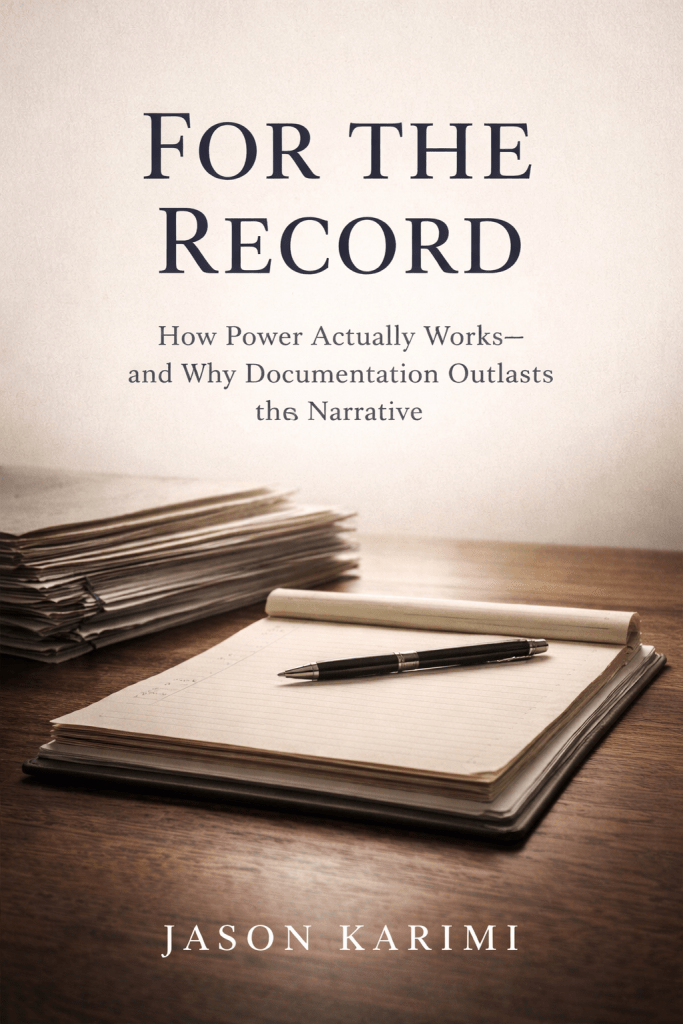
FOR THE RECORD
How Power Actually Works—and Why Documentation Outlasts the Narrative
By Jason Karimi
Table of Contents
Chapter 1 — The First Arrest
Early rupture, authority, and the beginning of resistance
Chapter 2 — Before the File Was Opened
Gifted education, faith, discipline, and early legitimacy
Chapter 3 — Becoming a Problem
Work, exhaustion, collapse, and the cost of visibility
Chapter 4 — Learning the Language of Power
Courts, probation, jail, campaigns, and proximity to decision-makers
Chapter 5 — The Apprenticeship
Training, mentorship, restraint, and learning how power actually works
Chapter 6 — Staying Power
Policy victories, documentation, long-term impact, and avoiding burnout
Chapter 7 — Why I Never Left
Containment, bad actors, ethical boundaries, and knowing when to walk away
Chapter 8 — What the Media Gets Wrong
Narratives, incentives, misinformation, and pretrial risk
Legal Note: Pretrial Publicity, Jury Pools, and Media Risk
Chapter 9 — The Record vs. the Narrative
Why documentation wins when attention fades
Chapter 10 (Epilogue): — What Remains
Author’s Note
Principles — Staying Effective Without Burning Out

Preface
This book is not an argument.
It is not a manifesto, a confession, or a demand to be understood. It is a record of how a person learned—slowly and often painfully—how power actually works, and how to operate within that reality without becoming reckless, corrupt, or disposable.
Some readers will approach this book looking for heroes and villains. They will be disappointed. Others will expect a political screed, a redemption arc, or a justification for past conflicts. They will also be disappointed.
What follows is neither vindication nor revenge.
It is documentation.
The events described here unfolded over many years, across courtrooms, classrooms, campaigns, newsrooms, halfway houses, and bureaucratic back offices. Some of those events were public. Many were not. Where details have been generalized or names omitted, it is not to obscure truth but to avoid granting attention to people or institutions whose behavior does not benefit from amplification.
This book assumes the reader is capable of holding complexity.
It does not reduce systems to good and evil. It does not pretend that intentions matter more than incentives. It does not assume that passion produces results, or that outrage equals courage.
Instead, it traces a different path: restraint over reaction, record over narrative, legality over bravado, and durability over applause.
If you are looking for reassurance that your side is right, this book will not give it to you. If you are looking for shortcuts, hacks, or easy victories, you will not find them here.
But if you want to understand why most movements fail, why institutions resist change even when they appear to concede it, and how lasting influence is built quietly by people willing to be boring, careful, and patient—then this book may be useful to you.
Read it not as a story about one person, but as a case study in method.
The work described here was never about being seen.
It was about making sure the truth survived long enough to matter.

Chapter 1: The First Arrest
I was nineteen years old when I learned how quickly a life can be reduced to paperwork.
There were no sirens screaming through the night, no dramatic showdown. Just fluorescent lights, a metal bench, and the faint smell of disinfectant that never quite covers what it’s meant to hide. Someone told me to sit. Someone else told me to stand. I did both. Compliance still felt useful then.
I believed misunderstandings could be cleared up if you explained yourself carefully enough.
I believed adults intervened when things went too far.
I believed wrong.
The arrest wasn’t about violence. It wasn’t about theft. It wasn’t about hurting anyone. It was about a belief—one I didn’t yet have the language to defend, and didn’t yet understand would follow me for decades.
At some point, they let me make a phone call.
I called my mother.
I didn’t ask for money. I didn’t ask for a lawyer. I didn’t even ask her to agree with me. I asked her to help me understand what to do next.
She told me to rot in jail.
Then she hung up.
There was no argument. No shouting. Just a clean disconnect—the sound of a decision being finalized.
That was the moment something broke.
Not loudly. Not in a way anyone else noticed. Just a quiet internal recalibration, the kind that happens when you realize a relationship you thought was permanent was actually conditional all along.
I didn’t become angry right away. I became alert.
I noticed how cold the room was. Government buildings always are. Cold enough to remind you who controls the temperature. Cold enough to train compliance without ever saying the word.
I noticed how efficiently the system moved once it had your name. How little curiosity it showed about context. How smoothly it converted a human being into a case number.
The most unsettling part wasn’t the arrest. It was the realization that the story of who I was would now be told by people who had never met me and didn’t need to.
That understanding didn’t radicalize me overnight. It disciplined me.
I learned how to read paperwork closely. How to meet deadlines. How to speak carefully and write precisely. I learned that institutions speak politely while doing permanent damage, and that moral certainty often comes wrapped in procedure.
I went to school. Paid my own way. Failed. Retried. Worked jobs that didn’t care about my past as long as I showed up. I watched who got protected and who got processed.
Politics stopped looking abstract. Law stopped looking noble. They started looking mechanical—power applied through forms, enforcement discretion, and selective attention.
Once you see that, you can’t unsee it.
This book isn’t about redemption. It’s not about revenge. It’s about proximity—what happens when you spend enough time close enough to systems of authority that you stop believing the stories they tell about themselves.
The arrest at nineteen wasn’t the worst thing that happened to me.
It was the first moment the truth stopped being theoretical.
 WeedPress: The Paper Trail
Leave a comment