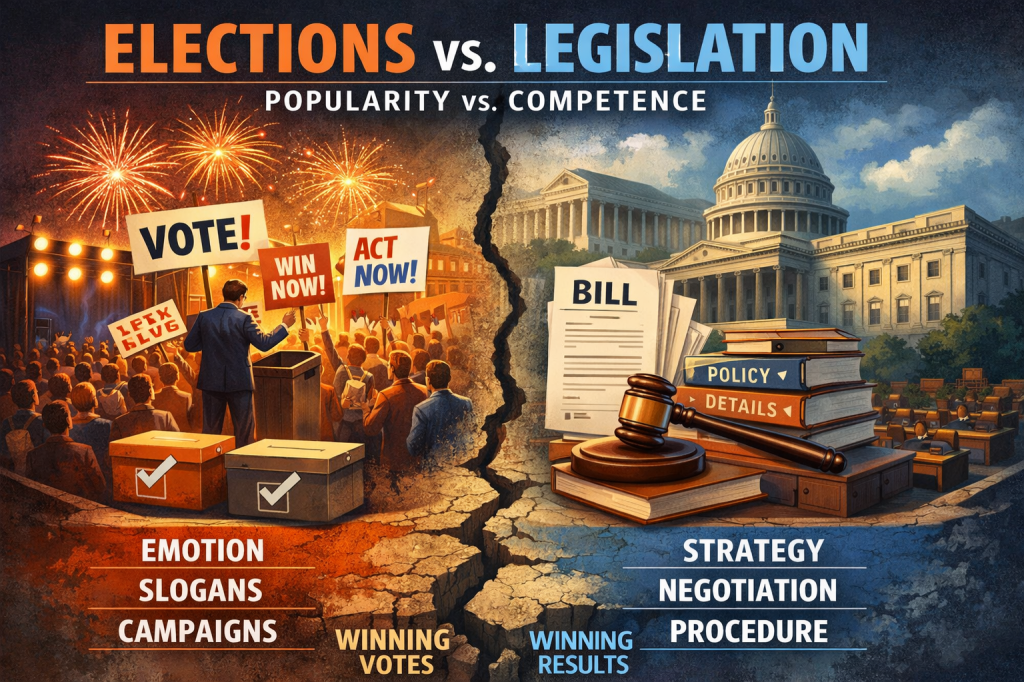
When Competence Shows Up: Electoral Losses vs. Legislative Wins
By Jason Karimi | WeedPress | February 5, 2026
Editors note added Thursday February 5th: After writing this article I am glad Iowa does not have ballot initiatives, so people don’t confuse these differences and conflate the tactics used in electoral and legislative avenues of relief for unconstitutional drug laws tearing apart families from their children and criminalizing religious, community enhancing, pro-social, private rituals. Electoral politics is markedly different from legislative politicking. Personality helps in one arena but actually hurts in the other in many applications. Applied politics borne from competency training education and experience provides insights worth sharing with others who may one day find usefulness in such insights. Which is the sole purpose of WeedPress: help and empower others to truthfully help themselves, so they can help others, not JUST themselves. (Ahem).
In any policy movement — whether it’s cannabis reform, healthcare, transparency, or regulatory change — there’s a tension between winning votes at the ballot box and winning votes in a legislature. On the surface, both are democratic exercises. Below the surface, they reward different skill sets — and that difference exposes a truth worth understanding:
Competence looks the same across domains. But the terrain is different.
Ballots Reward Style. Legislatures Reward Substance
Ballot initiatives are momentary snapshots of public sentiment. They respond to:
• branding
• emotional resonance
• advertising spend
• surface narratives
• turnout dynamics
Winning those environments often requires visibility and vibe — which are not the same as strategy.
Legislative victories, by contrast, demand:
• understanding process
• building relationships across lines
• procedural timing
• compromise without surrender
• detailed knowledge of language and amendment mechanics
Those are structures, not spectacles.
A campaign that excels at ballot visibility but neglects structure will often:
• generate attention
• lose momentum
• misdiagnose why it lost
That’s not failure of passion — it’s failure of competence alignment.
⸻
Competence Is Not Popularity
There’s a popular myth that “winning hearts” translates directly to “winning votes” in policy settings. In electoral contexts that can be true — because voters are connecting emotionally.
But in legislatures, competence is currency, not charisma.
A proposal that’s:
• well-drafted
• logically consistent
• procedurally sound
• backed by clear data
gets far more traction than one that is merely popular.
Competence is not always loud. But it is durable.
⸻
Losing Elections But Winning Policy Is Not Paradoxical
A movement can lose at the ballot box yet persist in lawmaking because:
1. Ballots are broad; legislatures are targeted.
A ballot campaign appeals to a million whims. Legislatures focus on a few key votes.
2. Ballots are emotional; legislatures are analytical.
Legislators read text. Voters read headlines.
3. Ballots reward narratives; legislatures reward clarity.
A catchy slogan might light up ads but doesn’t define statutory language.
When advocates confuse visibility for influence, they set themselves up to win attention and lose outcomes.
⸻
Competence Is Consistency, Not Volume
People who understand the mechanisms of change know:
• when to push
• whom to persuade
• how to frame language
• when silence is leverage
• when to document instead of declare
Volume without direction is noise.
Direction without volume is strategy.
And strategy wins more often, especially in arenas where:
• negotiation matters
• timing matters
• text matters
Competence is calibrated, not theatrical.
⸻
The Compressed Timeframe of Ballots vs. the Expanded Timeframe of Lawmaking
Ballot campaigns are bursts.
Legislative change is a corridor.
Burst thinking teaches urgency.
Corridor thinking teaches patience.
Urgency is seductive.
Patience is productive.
Too many movements treat the corridor like a burst — and wonder why they exhaust themselves before the real work begins.
Competence understands the shape of the battlefield.
⸻
And What Happens When Movements Ignore Competence?
When strategy is absent, movements tend to:
• recycle old arguments
• repeat public displays
• avoid technical conversation
• prioritize emotion over text
• overstretch limited resources
This does not build power — it burns it.
Competent movements accumulate:
• institutional memory
• reputational equity
• political capital
• legislative allies
• procedural knowledge
All of those are absent in flash campaigns that peak early and fade fast.
⸻
Final Thought
Electoral defeats are not always failures — they can be data.
Legislative wins are not always victories — they can be leverage.
But across both, competence looks the same:
• clarity over noise
• structure over chaos
• analysis over assertion
Movements that forget that end up confusing popularity with power — and pay for it with every cycle.
Competence doesn’t guarantee immediate wins.
But without it, you never build the capacity to win consistently.
WeedPress is a policy analysis publication focused on statutory interpretation, administrative procedure, and publicly available records. Our commentary addresses systems, laws, and institutional structures — not private individuals. WeedPress does not encourage harassment, direct contact, or targeting of any person. All analysis is intended for informational and educational purposes.
 WeedPress: The Paper Trail
Leave a comment