South Dakota’s Cannabis Licensing Scheme Shields Insiders and Restricts Market Competition
— And a Federal Court Ruling Signals Constitutional Trouble Ahead
By Jason Karimi | WeedPress| February 6th, 2026
South Dakota’s medical cannabis law contains a quiet but consequential line:
To get a state registration certificate for a medical cannabis establishment, “[a]t least one principal officer is a resident of this state.” (SDCL § 34-20G-55(4)).
That’s a residency gate. Not total protectionism—South Dakota doesn’t say everyone must be local. But it still says: You don’t get in unless a key officer is a South Dakota resident.
And that matters, because a federal appeals court has already started tearing down this kind of rule.
The Warning Shot: Northeast Patients Group v. Maine
In 2022, the First Circuit struck down Maine’s residency requirement for medical cannabis dispensary leadership, holding it violated the Dormant Commerce Clause.
Maine tried the obvious defense: cannabis is federally illegal, so the normal “interstate commerce” rules shouldn’t apply.
The court didn’t buy it.
Commerce is commerce—even when Congress has criminalized it. And states don’t get a free pass to discriminate just because the market is politically awkward.
South Dakota’s Version: Smaller, Still a Gate
South Dakota’s rule is narrower than Maine’s. It’s not “all owners must be residents.” It’s “at least one principal officer must be.”
But it still forces a structural choice: install an in-state officer or don’t get licensed.
And this isn’t only theoretical. Local licensing can stack on top of the state program. Sioux Falls, for example, requires applicants to certify at least one officer or board member is a South Dakota resident as part of its licensing process.
The Core Problem
If the real goal is compliance and enforcement, states have plenty of tools that don’t require residency gatekeeping:
• background checks
• disclosure requirements
• registered agent / consent to jurisdiction
• audits, inspections, license sanctions
South Dakota’s own application process already demands officer/board identification info.
Residency isn’t the only way to ensure accountability. And once a court accepts that, residency starts to look less like “public safety” and more like a thumb on the scale.
What This Means Going Forward
South Dakota lawmakers may prefer a market that stays “local.” But the Constitution doesn’t love local-only economics—especially when residency is used as a licensing key.
The First Circuit’s 2022 decision in Northeast Patients Group v. Maine Department of Administrative & Financial Services marked a turning point, striking down Maine’s strict rule that all officers and directors of medical cannabis dispensaries must be residents. The court held that this violated the Dormant Commerce Clause (DCC)—the constitutional principle that prohibits states from unduly discriminating against or burdening interstate commerce—even though cannabis remains federally illegal under the Controlled Substances Act. The ruling rejected the idea that federal prohibition removes cannabis from DCC scrutiny, as an interstate market exists in practice.
This precedent has influenced challenges and changes elsewhere, though outcomes vary by jurisdiction and the strictness of the rule. Courts are split: some (notably in the First and Second Circuits) apply the DCC to cannabis, while others (e.g., the Ninth Circuit in a 2026 ruling) hold it does not apply due to federal illegality, allowing residency preferences to stand in western states.
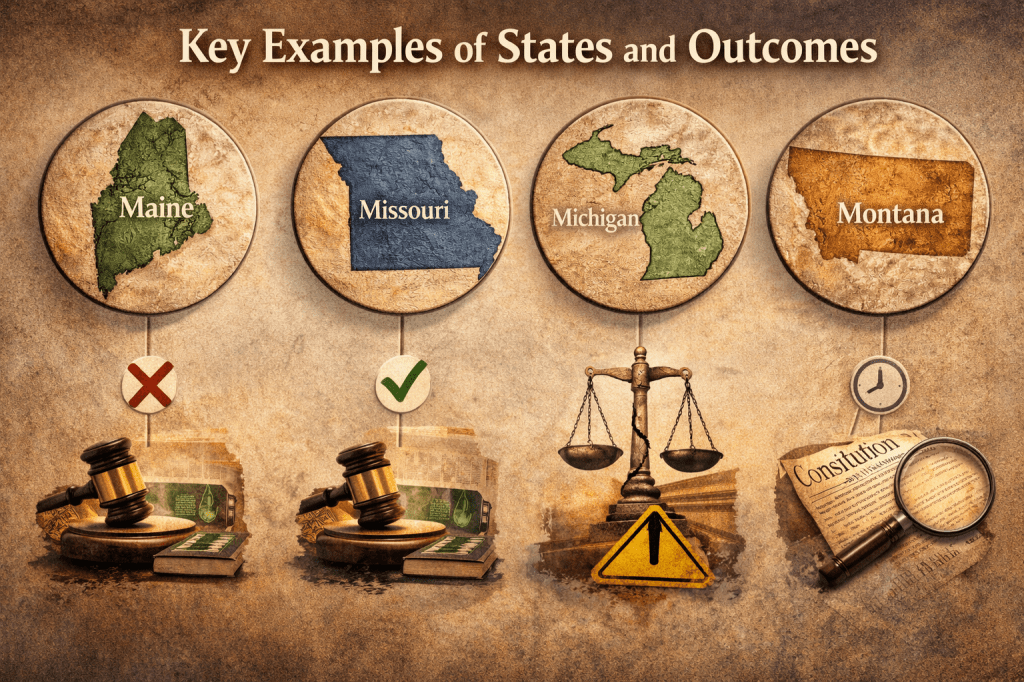
Key Examples of States and Outcomes
- Maine — Strict requirement (all officers/directors must be residents) for medical dispensaries. → Struck down by the First Circuit in 2022 under the DCC as facially discriminatory protectionism.
- Missouri — Required majority (51%+) ownership by Missouri residents (with at least one year residency) for medical licenses. → Challenged and invalidated in federal court (pre-NPG in Toigo v. Missouri, 2021), with the state complying by removing the barrier.
- Michigan — Early rules (especially at municipal levels, like Detroit) included residency preferences or local equity advantages. → Some struck down or enjoined in federal court as DCC violations; broader statewide requirements were largely abandoned or avoided amid litigation risks.
- Oklahoma — Still requires majority ownership (often 75%+) by residents with specific durational residency (e.g., 2+ years recent). → Remains on the books, but widely seen as vulnerable to challenge post-NPG and similar precedents.
- Montana — Residency rules for ownership/investment in cannabis businesses faced legal challenges (e.g., lawsuits by out-of-state investors in 2023). → Some modifications occurred as litigation risks grew, though not a full repeal.
- Alaska — No prominent federal court decision striking down a cannabis-specific residency rule on DCC grounds (earlier privacy cases like Ravin v. State addressed personal use, not commercial licensing).
The Broader Trend
After Northeast Patients Group (and reinforced by later decisions like the Second Circuit’s 2025 ruling in Variscite NY Four v. New York), courts increasingly view cannabis as “commerce” subject to DCC protections in certain circuits. States cannot outright wall off markets with residency gates without strong, non-protectionist justification. Many residency rules have been narrowed, enjoined, repealed, or quietly de-emphasized to avoid lawsuits.
However, it’s not a universal rollback—“most” have not been fully eliminated, as some states (especially in the Ninth Circuit) defend rules by citing federal illegality. The doctrinal split across circuits increases the likelihood of future Supreme Court review.
Where South Dakota Fits
South Dakota’s medical cannabis law requires at least one principal officer to be a state resident (SDCL § 34-20G-55(4)). This raises potential constitutional questions under Commerce Clause and equal protection doctrines. This is narrower than “all owners” or “majority ownership” rules, but it still acts as a residency-based structural barrier, forcing out-of-state applicants to install a local officer for licensing. Local rules (e.g., in Sioux Falls) can add similar requirements. No major successful challenge has invalidated it yet, but it sits in the same vulnerable category as other residency gates—exposed to DCC scrutiny, especially if a plaintiff with standing (like an out-of-state investor) sues.
The Big Picture
Early cannabis programs often assumed federal prohibition shielded them from DCC challenges, allowing protectionist “intrastate-only” designs. Northeast Patients Group disrupted that, treating cannabis markets as real (if federally awkward) commerce. Today, every residency requirement carries constitutional risk unless Congress explicitly authorizes state discrimination—which it hasn’t. States retain tools like background checks, audits, and disclosure rules for enforcement without residency gates. As litigation continues, expect more rollbacks in DCC-friendly circuits and ongoing fragmentation nationwide.
⸻
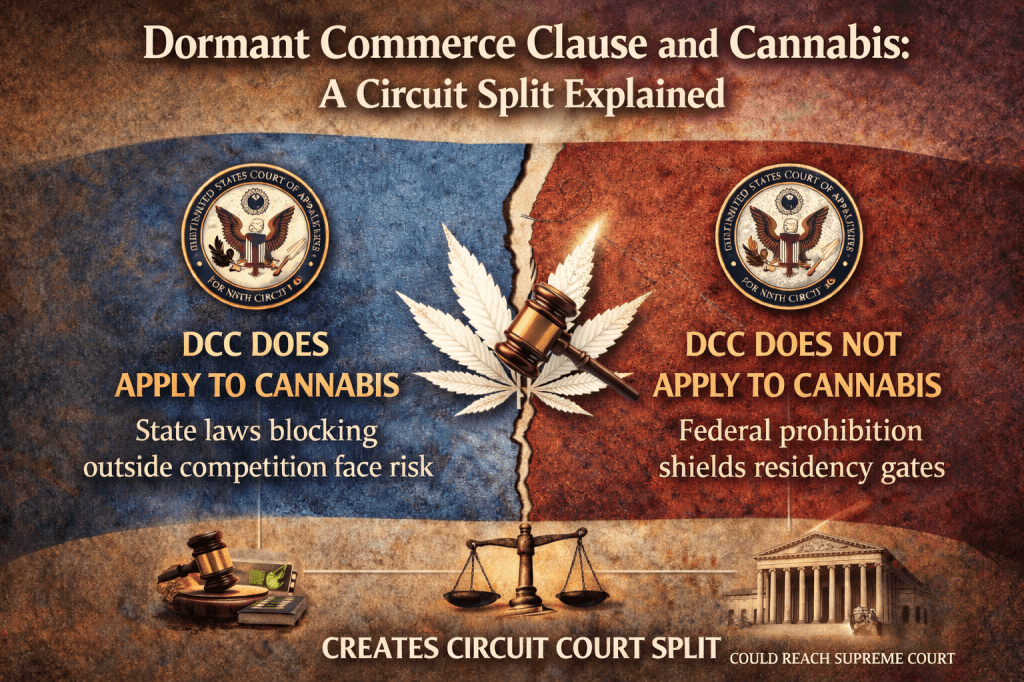
Dormant Commerce Clause and Cannabis: A Circuit Split Explained
Since Northeast Patients Group v. Maine Department of Administrative & Financial Services (First Circuit, 2022), federal appellate courts have taken divergent approaches to whether the Dormant Commerce Clause (DCC) protects cannabis markets — even though cannabis remains illegal under the federal Controlled Substances Act.
Below is a snapshot of how key circuits are handling residency and discrimination claims in cannabis licensing:
⸻
- First Circuit — Northeast Patients Group (2022)
Citation: Northeast Patients Group v. Maine Department of Administrative & Financial Services, 45 F.4th 542 (1st Cir. 2022).
Rule: The Dormant Commerce Clause applies to cannabis licensing, and a residency requirement that discriminates against out-of-state economic actors violates the DCC. Maine’s blanket residency condition for all officers/directors was struck down as unconstitutional protectionism.
Key Point: Federal illegality (CSA) does not remove cannabis from DCC scrutiny. States cannot wall off commerce simply because the product is federally prohibited.
⸻
- Second Circuit — Variscite NY Four (2025)
Citation: Variscite NY Four, Inc. v. New York State Cannabis Control Board (2d Cir. 2025).
Rule: Following Northeast Patients Group, the Second Circuit reaffirmed that cannabis licensing resides within the scope of commerce subject to the Dormant Commerce Clause. A state residency preference that functions as discrimination against interstate commerce is unconstitutional absent a compelling justification.
Key Point: This ruling reinforces Northeast and signals a doctrinal trend in circuits that are more DCC-friendly, treating state cannabis markets like any other commercial market for constitutional purposes.
⸻
- Ninth Circuit — Peridot Tree WA (2026)
Citation: Peridot Tree WA, Inc. v. Washington State Liquor & Cannabis Control Board, No. 24-3481 (9th Cir. Jan. 2, 2026).
Rule: In contrast, the Ninth Circuit held that the Dormant Commerce Clause does not apply to cannabis because marijuana is illegal under federal law. Under this reasoning, states may enforce residency preferences or similar structural barriers in cannabis licensing without running afoul of the DCC.
Key Point: This decision treats cannabis as fundamentally outside the scope of interstate commerce protection due to its federal prohibition — a doctrinal position opposing Northeast and Variscite.
⸻
Different Outcomes, Same Issue
These circuits reach opposing answers on the core question:
Does the Dormant Commerce Clause protect cannabis markets from discriminatory state residency requirements?• First & Second Circuits: Yes — federal prohibition doesn’t negate constitutional protections; residency barriers are suspect. • Ninth Circuit: No — cannabis’ federal illegality means the constitutional commerce guarantee doesn’t apply in the same way, allowing states more leeway to favor residents.
⸻
What This Means for States Like South Dakota
South Dakota sits in a jurisdiction without a binding precedent on this issue. Because the circuits are split:
• A plaintiff could bring a federal challenge presenting the First and Second Circuit reasoning as persuasive authority.
• Conversely, a defendant could argue the Ninth Circuit’s approach if the district leans toward federal illegality as a shield.
This fragmentation heightens the odds that the US Supreme Court will eventually resolve the conflict — a point worth signaling in any discussion of residency gates and cannabis licensing.
WeedPress is a policy analysis publication focused on statutory interpretation, administrative procedure, and publicly available records. Our commentary addresses systems, laws, and institutional structures — not private individuals. WeedPress does not encourage harassment, direct contact, or targeting of any person. All analysis is intended for informational and educational purposes.

I ran the land, just like the ego
In search of the sea, and the sand
But the fire in the sky ran out, mount and scraped the sun
The only light is the one, that shines inside
Days move on some come some go
All along i walk with flow
Nowhere i know, nothing at all
When the kingdom falls, still sing to god
Babylon your gonna go down down down
Babylon your gonna go down
I said i hear the words our higher man say
Babylon your gonna go down
Like david with his stone, knocked goliath off his throne
There’s nothing i can’t do, when i believe in you
And in this world of stress, obstacles and tests
Oh i will do my best, and leave the next world to my rest
This ain’t my city, this ain’t my town
I’m a stranger in a strange land with a strange sound You wanna dance with the devil, tread up on the people
Livin like a rebel, wanna revel in the treble
While you jump another level, yeah you wanna get high
But dont wanna pay the price, wanna slice through the night I reckon get born to the life where the mornin shines on
Got to keep your feet up on the ground
When the beat drops down, ain’t no time to clown around
Sit back and feel nice, carry snakes around your neck
One day this all will change, treat the people all the same
– Matisyahu, “Open The Gates”
 WeedPress: The Paper Trail
Leave a comment