
Table of Contents
Chapter 1 — The First Arrest
Early rupture, authority, and the beginning of resistance
Chapter 2 — Before the File Was Opened
Gifted education, faith, discipline, and early legitimacy
Chapter 3 — Becoming a Problem
Work, exhaustion, collapse, and the cost of visibility
Chapter 4 — Learning the Language of Power
Courts, probation, jail, campaigns, and proximity to decision-makers
Chapter 5 — The Apprenticeship
Training, mentorship, restraint, and learning how power actually works
Chapter 6 — Staying Power
Policy victories, documentation, long-term impact, and avoiding burnout
Chapter 7 — Why I Never Left
Containment, bad actors, ethical boundaries, and knowing when to walk away
Chapter 8 — What the Media Gets Wrong
Narratives, incentives, misinformation, and pretrial risk
Legal Note: Pretrial Publicity, Jury Pools, and Media Risk
Chapter 9 — The Record vs. the Narrative
Why documentation wins when attention fades
Chapter 10 (Epilogue): — What Remains
Author’s Note
Principles — Staying Effective Without Burning Out

Chapter 7: Why I Never Left
The truth is, I did leave.
In 2015, I was done with Iowa.
The marijuana movement there had rotted in a way that was hard to explain to people who weren’t inside it. Too many activists didn’t actually want legalization. They wanted the romance of rebellion. The underground status. The identity. Patients were an afterthought.
I was tired of watching people posture while real people suffered.
So I moved to Minneapolis in the summer of 2015.
That fall, while visiting Iowa, I had a conversation that changed my plans. The head of Iowa NORML told me plainly that if I left the state for good, there would be no one left doing cannabis advocacy competently. Not loudly. Not theatrically. Competently.
I stayed.
Not forever—but long enough.
When I first entered the movement years earlier, its leadership was openly reckless. Emails circulated among activists bragging about smuggling pounds of marijuana into the state. It was treated as credibility. As proof of commitment. As if criminal exposure were a substitute for strategy.
That culture didn’t protect patients. It endangered them.
I understood early that a movement operating like that would eventually implode—or be destroyed—and that when it did, the collateral damage wouldn’t fall on the loudest voices. It would fall on people quietly trying to manage pain, illness, or disability within the law.
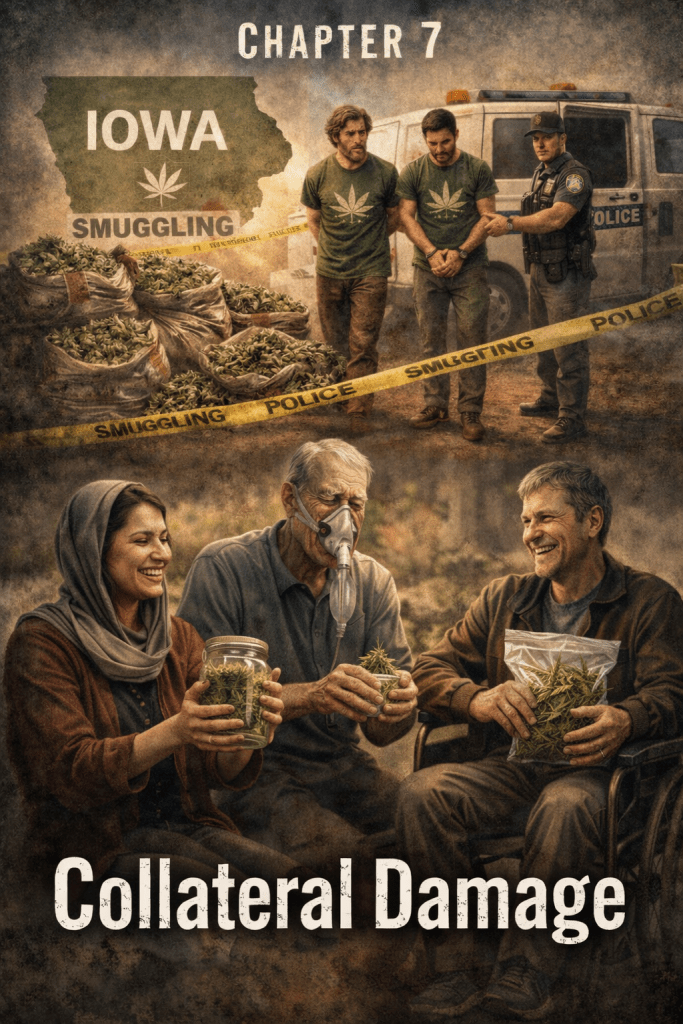
I stayed to change that.
I stayed until 2019, and before I left, I built redundancies. Groups. Relationships. Institutional knowledge shared with people who could be trusted. Because when advocacy depends on a single personality, it collapses the moment that person burns out or gets removed.
Even after leaving five years later in 2020, the work continued. For the next six years, even to today, I still influenced outcomes—not by dominating the space, but by stabilizing it.
One of the main reasons I stayed as long as I did was to keep bad actors out.
Legal gray areas attract opportunists. Iowa’s early medical cannabis framework was especially vulnerable—patients desperate, laws unclear, enforcement inconsistent. That’s when schemes appear.
Companies selling hemp-derived products while lying about their legality. I had NORML attorneys, 20 of them, review the Iowa CBD laws. Keith Stroup himself, the founder of NORML, called me personally to advise CBD was not legal in Iowa. I informed the public, via an interview with ABC Channel 5 News, and got attacked for doing so with character attacks. Activists encouraging people to break laws by misinforming them, then disappearing when consequences arrived.
One CBD company offered me seven thousand dollars a month to promote their products.
I recorded the call.
On that call, they admitted they didn’t know Iowa law—specifically that CBD was illegal at the time. They admitted they were based outside the United States to avoid legal consequences. And they told me plainly that if I didn’t help them, they would find someone else who would.
They spoke like organized crime.
So I spoke back in a language they understood.
I told them I knew the Iowa Attorney General personally—and I did. He came into my Jimmy John’s regularly with his wife. I told them that if they didn’t understand legal compliance but did understand coercion and profit extraction, then I would respond proportionally: by ensuring the Attorney General’s office investigated them if their products appeared in my state.
I told them to stop lying to patients.
There was no threat of physical violence. None. The entire exchange was about law enforcement, regulatory enforcement, and consumer protection. I used metaphor to mock their Mafioso criminal tactics—not to menace them.
I kept the recording.
Years later, when parts of this story were selectively referenced in the media during an unrelated controversy—used to imply I was dangerous or malicious—that recording mattered. It showed exactly what I said, why I said it, and what I refused to do. After our legal argument, that CBD company never set foot in Iowa. Principles matter more than money.
In 2018, the same pattern surfaced again—this time on a college campus.
The chapter president of NORML at Iowa State University came to me with a problem. Out-of-state students were bragging in a Snapchat group about bringing pounds of marijuana from Colorado onto campus. They were using the NORML ISU name and Snapchat while doing it. They were reckless, public, and heading toward arrests.
He asked me to help stop it.
I agreed.
I met in person privately and asked the group to stop using the organization’s name to smuggle weed and to shut the activity down. They refused.
They actually voted to kick me out of the NORML ISU chapter. I was an active member at the time. After their vote, which did vote to kick me out, the NORML chapter advisor, libertarian candidate for office and ISU psych professor Eric Cooper, overruled their vote as illegal. Nobody has ever been voted out of any ISU campus student chapter before except for a tranny in the College Republicans.
So I did the only thing that works when bravado replaces judgment: I documented it.
With the chapter president’s permission, I published the Snapchat messages that had been given to me. The response was immediate. The group panicked. They quit. The ring leader emailed me afterward—not angry, but relieved—thanking me for showing them how easily they could have been caught and saying I had likely saved his future from an arrest record.
That should have been the end of it.
Instead, three individuals lied about me in an effort to shift blame. I was arrested. The charges were later dropped for lack of evidence.
The lesson landed hard.
You can do the right thing, protect people from themselves, and still become the target when dishonest groups feel exposed. Facts don’t protect you from bad faith. Documentation helps—but proximity to chaos always carries risk.
From that point on, I stopped tangling with groups that showed early signs of dishonesty. I walked away from the Mises Caucus for tolerating dishonesty. They let a leader of their caucus continue in leadership after it was determined that leader had been a plant in the Mises Caucus from the Vermin Supreme campaign, as a spy from the Libertarian Socialist faction of the LP.
I learned to just walk away. Honesty matters. Little lies lead to big ones. And honesty is efficient, or so the sign hanging at Jimmy John’s in the lobby advises.
Bad actors fail on their own. They don’t need help. They only need time. Inefficiencies resulting from dishonesty doom margins of error every movement and business encountersZ
I stayed because patients needed someone boring enough to read statutes, disciplined enough to refuse money, and stubborn enough to document everything.
I stayed because movements without adults become scams.
When I finally left the movement, it no longer resembled the one I had entered. There were no criminals running email lists. No bravado about trafficking. No self-destructive theatrics.
It was being run by an attorney of good repute.
That change didn’t happen by accident.
It happened because someone had been willing to stay long enough to drain the poison quietly, redirect the incentives, and make legality—not rebellion—the organizing principle.
I stayed because I understood something many activists don’t: institutions don’t need enemies to fail. They fail perfectly well when no one bothers to constrain the worst actors operating around them.
Eventually, I did leave.
But by then, the work didn’t depend on me being physically present. That was the point.
I never stayed because Iowa was easy.
I stayed because leaving too early would have meant handing vulnerable people over to people who didn’t care what happened to them—as long as they got paid.
That’s not heroism.
That’s containment.
And containment, done quietly and correctly, is often the most effective form of advocacy there is.
 WeedPress: The Paper Trail
Leave a comment