
Schedule 3 Opened. The Record Was Ready With WeedPress.
By Jason Karimi | WeedPress | February 7, 2026
Seventeen years of structural analysis produced elite level policy and statutory analysis in 169 published long form articles over the past 90 days when federal cannabis rescheduling reached procedural ripeness under the CSA and APA. And that was written from off the top of our heads, because nobody researches marijuana laws like someone whose religion requires cannabis sacrament but everyone else can have it but them.
In 2009, when WeedPress first began sketching notes on religion and cannabis law, federal rescheduling was a rumor that lived in law review footnotes and activist wish-lists. The Controlled Substances Act (CSA) sat immovable. Cannabis was Schedule I. Courts deferred. Agencies shrugged. And the Administrative Procedure Act (APA) — the procedural spine of federal rulemaking — was treated like a technicality rather than a battlefield.
So WeedPress did what most serious projects fail to do.
It waited, while publishing an average of one article every three days (1400 in total).
Not passively. Not idly. Strategically.
We waited 17, years. $1.5 million in legal research was accumulated in that 17 year timeline.
⸻
The Ripeness Doctrine — Applied to Journalism
In constitutional law, courts refuse cases that are not “ripe.” The idea is simple: timing matters. Arguments land differently when the structure around them is ready to move.
Federal cannabis rescheduling — the first meaningful reconsideration of Schedule I status since 1970 — created that moment.
And when it did, WeedPress didn’t post a hot take.
It published 169 articles in three months.
That isn’t noise. That’s build-out.
⸻
The Architecture Behind the Surge
The work wasn’t random commentary. It organized into deliberate lanes:
- The CSA Structural Series
An explainer arc unpacking how the CSA actually functions:
• Delegated authority to HHS and DOJ
• Scientific and medical evaluation criteria
• Scheduling factors under 21 U.S.C. § 811; exemption process under 21 U.S.C § 822(d)
• Judicial deference doctrines shaping outcomes
This wasn’t “weed culture.” It was statutory engineering.
- The APA Procedural Framework
A parallel series explaining:
• Notice-and-comment rulemaking
• Arbitrary-and-capricious review
• Record building and litigation exposure
• How federal agencies insulate (or expose) themselves during rescheduling
Most outlets treat the APA like background radiation. WeedPress treated it like the lever.
- The WeedPress Origin & Evolution Series
A serialized narrative tracing:
• The early activist years
• Strategic repositioning away from personality conflict
• Documentation discipline
• Long-form structural pivoting
• The decision to wait for federal ripeness
It framed the project as institutional memory, not ego.
⸻
Why Seventeen Years Matters
Seventeen years means:
• Watching states legalize while federal law stagnated.
• Watching ballot initiatives rise and collapse.
• Watching enforcement rhetoric shift from “gateway drug” to “public safety.”
• Watching activists burn out by mistaking immediacy for impact.
When federal rescheduling became formally proposed in 2024–2025, the terrain changed. Suddenly:
• Administrative record arguments mattered.
• Litigation exposure mattered.
• Federalism architecture mattered.
• Preemption theory mattered.
WeedPress didn’t scramble to learn it.
We had already mapped it.
Along the way WeedPress helped quietly reschedule Minnesota to Schedule 3 (it’s been there for years but you never heard WeedPress brag about that win). A Young Americans for Liberty endorsed lawmaker helped make that happen.
That’s a story, for another day.
So is the story about meeting with the top expert on drug laws in Congress, and being told we had figured all the laws out correctly.
Knowledge, power…you know, the thing.
Now we share it freely.
⸻
169 Articles: What That Actually Signals
Publishing 169 articles in roughly 90 days is not volume for volume’s sake. It’s a structural maneuver:
• Build archive weight.
• Demonstrate competency breadth.
• Create durable citations.
• Establish expertise in both statutory text and administrative mechanics.
• Preempt narrative capture by less rigorous actors.
It’s the difference between posting opinions and building a record.
And in an APA environment, records win.
⸻
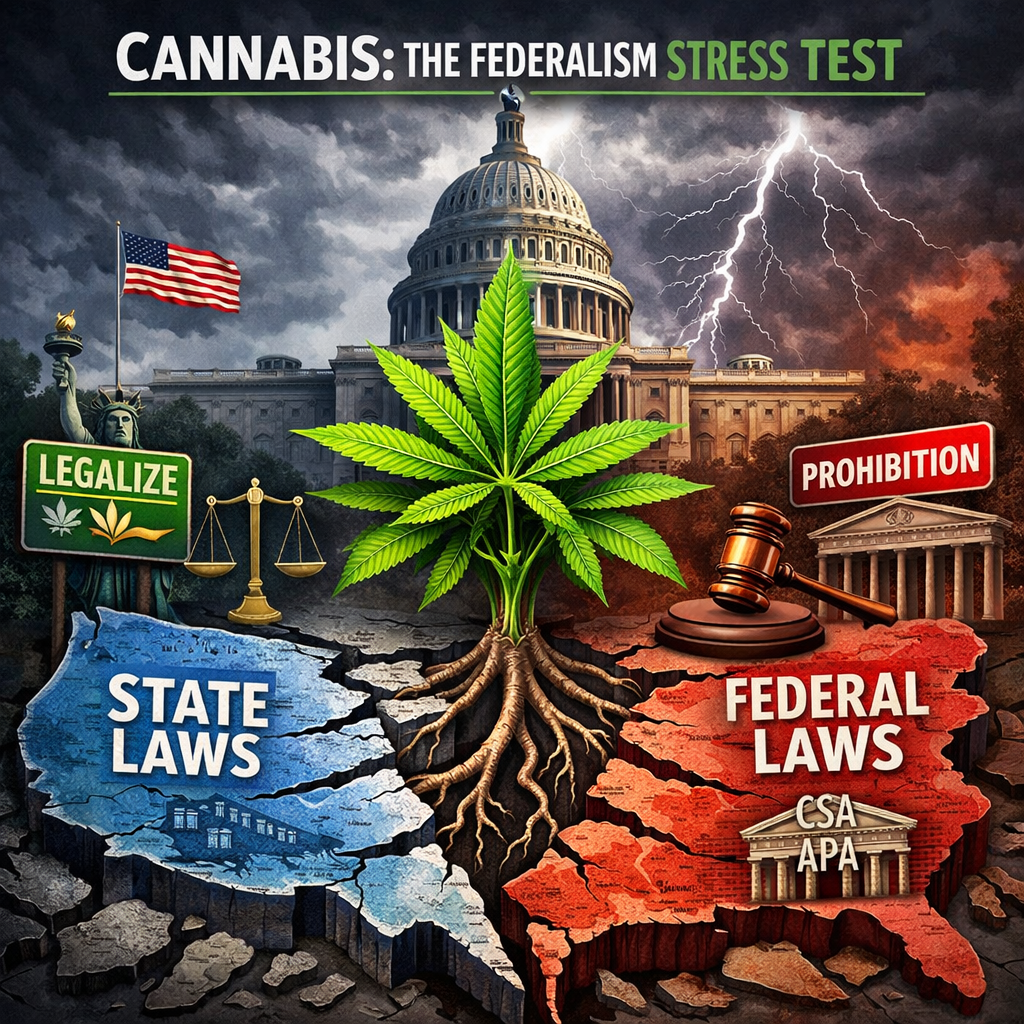
Federalism Is the Real Story
The rescheduling debate is not cultural. It is architectural.
The CSA is a federal statute layered atop fifty state systems. When rescheduling shifts cannabis from Schedule I to Schedule III, it does more than change criminal penalties:
• It alters tax treatment under § 280E.
• It shifts research barriers.
• It modifies enforcement posture.
• It reframes federal preemption arguments.
WeedPress treated this not as a lifestyle pivot — but as a federalism stress test.
⸻
The Discipline of Timing
Most media cycles reward immediacy. WeedPress chose latency.
Seventeen years of latency.
Then, when the federal mechanism moved, it responded with:
• Multi-part doctrinal breakdowns
• Legislative risk assessments
• Litigation exposure mapping
• Structural federalism explainers
• Serialized institutional narrative
It didn’t just comment on rescheduling.
It contextualized it within the full architecture of American drug law.
⸻

Why It Matters Now
Rescheduling is not legalization.
It is not cultural victory.
It is not finality.
It is a procedural shift inside the machinery of the CSA and the APA.
Understanding that distinction is what separates commentary from structural analysis.
WeedPress waited until the federal system itself moved — and then deployed seventeen years of accumulated perspective in a ninety-day build-out.
That’s not reaction.
Hi That’s timing.
And in administrative law, timing is everything.

 WeedPress: The Paper Trail
Leave a comment