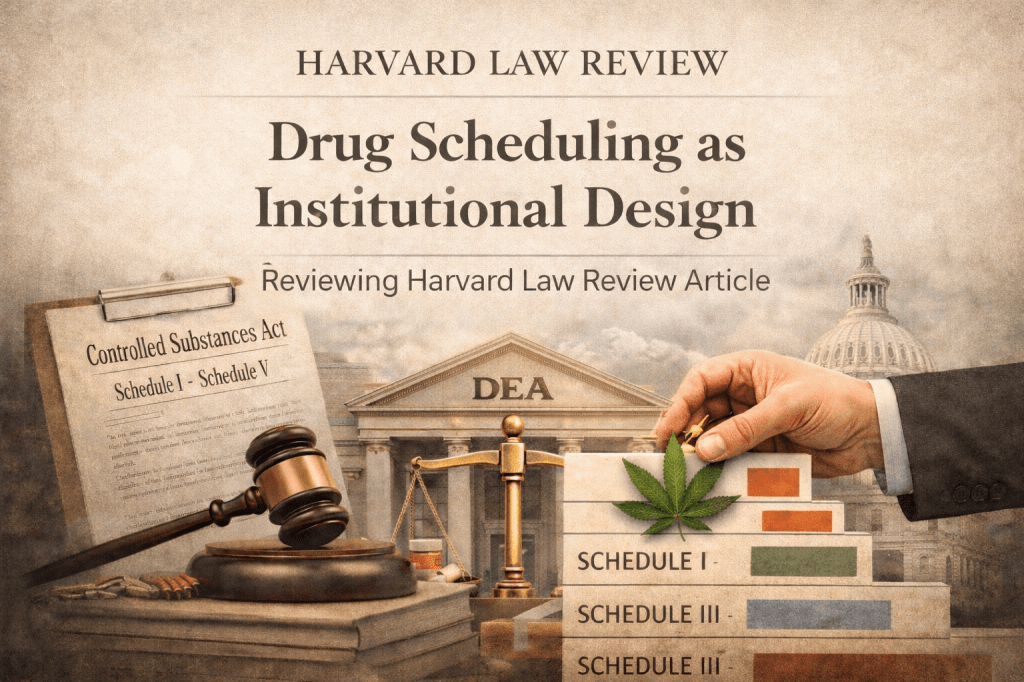
Drug Scheduling Is Institutional Design — And That Changes Everything
By Jason Karimi | WeedPress | Feb 10, 2026
In Volume 139 of the Harvard Law Review (p. 849), Matthew B. Lawrence and David E. Pozen published a piece that should be required reading for anyone serious about cannabis reform: “Drug Scheduling as Institutional Design.”
Their thesis is deceptively simple.
Drug scheduling isn’t just about science.
It isn’t just about criminal law.
It’s about how power is structured inside the federal government.
And once you see it that way, you can’t unsee it.
⸻
The Core Insight: Scheduling Is Structural
The Controlled Substances Act (CSA) is usually framed as a classification regime:
• Schedule I → no accepted medical use
• Schedule II → high abuse potential, accepted medical use
• Schedule III–V → descending risk tiers
But Lawrence and Pozen argue that this framing hides the real issue.
Scheduling determines which institutions control substances, which actors participate in decisions, and what kinds of expertise count.
That’s institutional design.
Not chemistry.
Not morality.
Architecture.
⸻
The Three Structural Problems
The article identifies three major design failures baked into the CSA.
- The Prohibition Problem
Blanket bans don’t eliminate markets. They reshape them. Often violently.
When a substance is placed in Schedule I, the system doesn’t eliminate demand — it pushes activity into criminalized or gray markets. That design choice has ripple effects:
• Enforcement-heavy regulation
• Reduced research pathways
• Criminalization externalities
That’s not an accident. That’s a structural feature.
⸻
- The Pharma Problem
The CSA distinguishes sharply between illicit markets and FDA-approved pharmaceutical channels.
But that distinction creates institutional bias:
• Pharmaceutical companies operate through approval pipelines
• Independent or state-based systems don’t
• Federal regulators default toward FDA-style legitimacy
In other words, the structure advantages certain actors over others.
Cannabis reform debates often miss this: rescheduling does not equal decentralization. It may simply shift control toward federal pharmaceutical gatekeeping.
⸻
- The Pluralism Problem
Drug policy isn’t purely scientific. It reflects moral, political, and cultural judgments.
Yet the current framework routes scheduling decisions through administrative processes dominated by executive agencies — particularly the Drug Enforcement Administration.
The DEA isn’t just enforcing the CSA. It plays a decisive role in shaping classification.
That means the enforcement institution also influences the underlying legal architecture.
That is not neutral design.
That is consolidation of authority.
⸻
Why This Matters for Cannabis Right Now
We are in the middle of a federal rescheduling moment.
Most commentary treats it as:
• A medical validation question
• A tax question (280E)
• A criminal justice question
But this article forces a deeper lens:
What kind of federalism model is being constructed?
If cannabis moves to Schedule III, the system does not become “free.”
It becomes re-routed through pharmaceutical-regulatory infrastructure.
That means:
• FDA oversight pressure
• Institutional conflicts between state regimes and federal approval systems
• Continued tension between enforcement and administrative governance
The fight isn’t just about classification.
It’s about who governs the category once classification changes.

⸻
Cannabis as a Federalism Stress Test
The CSA centralizes authority at the federal level.
State cannabis systems represent distributed experimentation.
The friction between those models isn’t temporary — it is structural.
Lawrence and Pozen’s framing makes something clear:
The CSA was designed for prohibition, not pluralistic coexistence.
So every rescheduling debate exposes the seams.
And seams are where institutional stress shows.
⸻
The Strategic Takeaway
If you’re serious about reform, you cannot treat scheduling as a technical adjustment.
You must ask:
• Who gains power under the new classification?
• Which agencies expand?
• Which actors are marginalized?
• How are states integrated — or sidelined?
Drug scheduling is not merely regulatory housekeeping.
It is institutional engineering.
And institutional engineering determines outcomes decades downstream.
⸻
Final Thought
The question isn’t simply:
Should cannabis be rescheduled?
The real question is:
What kind of governance architecture do we want built around it?
Because once the structure hardens, changing it is exponentially harder.
And if we’ve learned anything from fifty years of the CSA, it’s this:
Design choices echo.
For decades.

 WeedPress: The Paper Trail
Leave a comment