When Public Criticism Is Miscast as Harassment
By Jason Karimi | WeedPress | February 10, 2026
Under South Dakota law, a protection order requires evidence of harassment or threats causing reasonable fear of harm — not mere criticism.
Today, a South Dakota court dismissed—again—a temporary protection order petition filed against me by Melissa Mentell. It was the third attempt with a third judge in a matter of weeks to persuade a judge that my public writing and criticism of her policy positions constituted harassment. For the second time, the court rejected that claim as legally unsupported.
The evidence presented consisted almost entirely of blog posts and online commentary—articles in which I discussed matters of public concern involving South Dakota’s cannabis industry. There were no threats, no stalking, and no direct contact. Only speech.
Protection orders exist to protect people from real harm. They are intended for situations involving violence or genuine intimidation. They are not designed to be tools for silencing criticism. Yet in my view, that is how this process functioned: an effort to use the courts to suppress lawful expression.
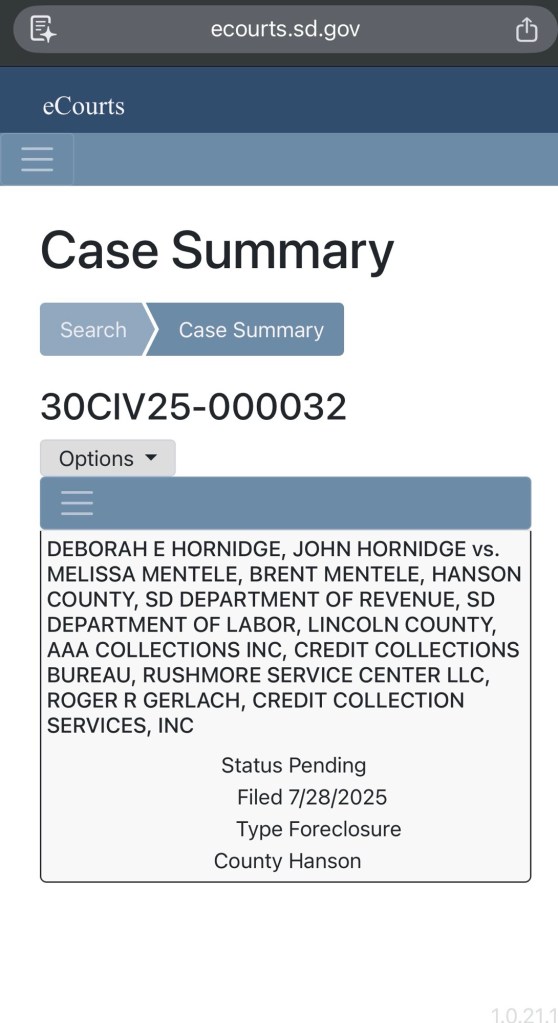
These filings followed reporting I published based on publicly available court records, including the existence of a foreclosure case filed against her. That information was drawn directly from court documents open to public inspection:
I also reported that she had stated she was foregoing a salary of approximately $150,000 due to company financial concerns. That information was not speculative. It came from her directly during a private phone call between us, in which she voluntarily disclosed that fact herself.
Publishing public records and accurately reporting statements made to me is not harassment. It is standard journalistic practice.
After the first petition was dismissed for lack of evidence, a second was filed relying on largely the same material. When a claim fails in court and is promptly recycled, it begins to resemble strategy rather than fear.
From my perspective, the implication was clear: stop writing, stop scrutinizing, or continue being forced to defend against legally unsupported filings.
Even when a petition is weak, the process itself imposes costs. Court appearances, legal preparation, and the risk of criminal penalties for violating an order that should never issue create pressure regardless of the outcome. In such cases, the objective does not have to be winning. Sometimes the objective is simply making speech expensive.
I declined to be deterred.
What these proceedings demonstrated was not harassment by me, but repeated attempts to reframe criticism as criminal behavior. Disagreement is not harassment. Reporting is not stalking. Writing critically about individuals involved in public controversies does not justify a protection order.
The Constitution does not include an exception for hurt feelings or lack of mental fortitude and resilience.
Participation in public, regulated industries necessarily invites scrutiny. Public debate can be uncomfortable, but discomfort is not danger. Attempts to convert criticism into a legal emergency undermine the purpose of protective orders and dilute their importance for those who genuinely need them.
The courts recognized this.
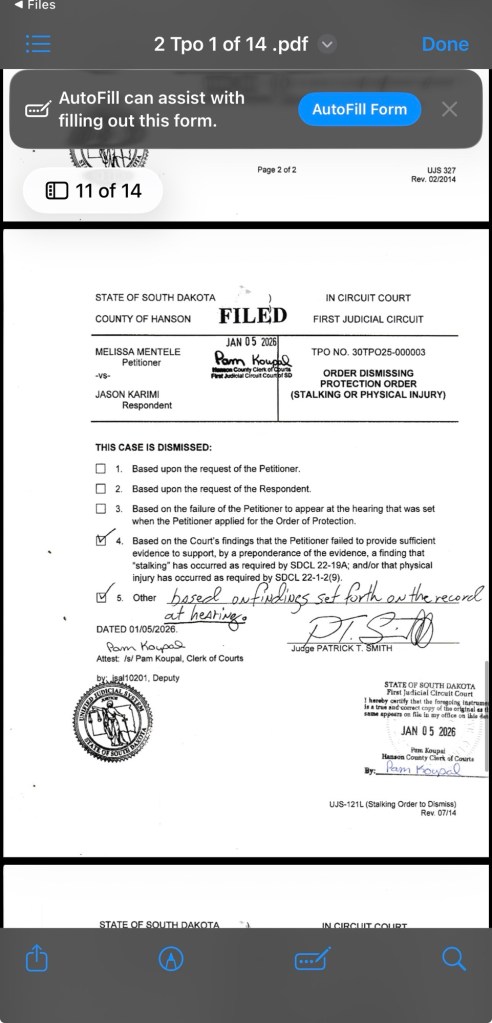
These dismissals matter because they reaffirm a principle larger than any individual dispute: the legal system cannot be used to silence protected speech. Judges are not arbiters of reputational grievances, and protection orders are not censorship mechanisms.
I have no interest in ongoing conflict and no desire to spend time in court. But I will not stop writing about issues that affect South Dakotans simply because scrutiny is unwelcome.
My reporting has always relied on publicly available records, regulatory filings, and matters of legitimate public concern. The court found no statutory basis for a protection order and no evidence of harassment. The court rejected the argument that public commentary about a person actively engaged in a regulated public industry could be converted into harassment absent direct contact or threats, as on December 22nd Mentele was quoted in the news as a public figure didn’t convince the judge after 45 minutes of giving complaints about hurt feelings in court on the record.
Her basis for her third protective order filing against WeedPress, in a matter of weeks, was that I had blogged a response to her December statement, disagreed with her assertion to Dakota News Now that nobody knew what rescheduling laws entailed (I blogged to the advocacy community that WeedPress knows for those who want the advance legal arguments and structural architecture at a level, believe me, nobody else knows. Let me tell you. Lawyers learn from us. So do policy makers clerks reporters prosecutors…)
Going forward, WeedPress will continue to focus on policy, compliance, and consumer protection—not personal disputes. When individuals or companies attempt to suppress criticism through misuse of legal processes, that conduct may itself become newsworthy. But the mission remains unchanged: facts first, public interest always.
Independent journalism requires persistence, restraint, and a willingness to document rather than intimidate. I intend to continue doing that work—calmly, lawfully, and without fear.
The court found no statutory basis for a protection order.
The matter is resolved.
WeedPress will continue focusing on policy and public records.

WeedPress is a policy analysis publication focused on statutory interpretation, administrative procedure, and publicly available records. Our commentary addresses systems, laws, and institutional structures — not private individuals. WeedPress does not encourage harassment, direct contact, or targeting of any person. All analysis is intended for informational and educational purposes.
 WeedPress: The Paper Trail
Leave a comment