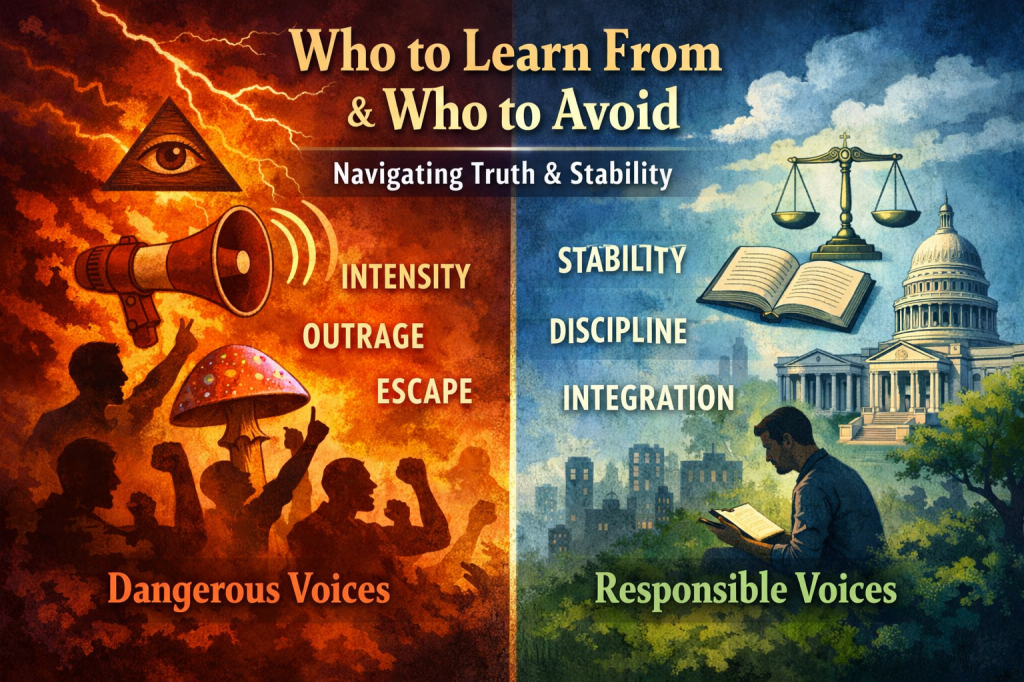
Who to Learn From—and Who to Avoid—When You Care About Truth and Stability
By Jason Karimi | WeedPress | February 2026
“Cannabis is not the subject. It’s the stress test. The subject is constitutional process.” – Jason Karimi
“Don’t waste time defending the past. Leadership is about providing continuously to make people’s lives easier. Talk about the future.” – Mentor
Not every smart voice is a healthy teacher—especially if you’re serious about courts, policy, or long-range advocacy.
Some thinkers sharpen judgment. Others spike intensity. Both can sound persuasive. Only one helps you stay effective.
This isn’t a blacklist. It’s a fit test—about incentives, tone, and what a voice does to your nervous system over time.
⸻
The Standard I Use
I’m looking for teachers who:
• emphasize responsibility before revelation
• respect limits, institutions, and process
• warn against intensity without integration
• make you calmer, steadier, and more precise—not charged or righteous
If a voice consistently makes you feel destined, uniquely awake, or above the rules, that’s a warning sign—not enlightenment.
⸻
A Baseline Example of “Decent, Stabilizing Teaching”
A good reference point is Jiang Xueqin.
What he models isn’t ideology; it’s containment: insight that arrives after discipline, meaning that respects consequence, and skepticism of hype—especially psychedelic or political.
That standard—structure before transcendence—is what I use below.
⸻
Voices to Be Careful With (for People Prone to Intensity)
These thinkers aren’t “bad.” They’re simply high-activation—and that matters if you’re trying to do serious, durable work.
Jordan Peterson
Brilliant at patterning and mythic framing, but often too activating. Archetypal language can blur into identity fusion (“this explains everything”), which is risky if insight outpaces integration.
Takeaway: Useful ideas; avoid immersion.
⸻
Gabor Maté
Deep compassion and trauma insight—but can drift toward over-pathologizing. Without equal emphasis on structure, the lens can keep people oriented toward wounds instead of agency.
Takeaway: Read selectively; don’t marinate.
⸻
Charles Eisenstein
Poetic and humane, but often offers meaning without guardrails. Beautiful language can substitute for discipline, especially around dissolution and transformation.
Takeaway: Appreciate the prose; avoid adopting the posture.
⸻
Terence McKenna
Explicitly celebrates boundary-dissolution and treats intensity as truth. There’s little containment ethic here.
Takeaway: For anyone with a history of over-intensity, this lane is already exhausted.
⸻
Bret Weinstein
Strong on incentives and institutional decay, but prone to pattern overreach. Can reinforce “I see what others don’t” narratives.
Takeaway: Frameworks, not conclusions—and sparingly.
⸻
Andrew Huberman
Often solid science, but optimization culture can become self-surveillance. Endless tweaks can distract from judgment and restraint.
Takeaway: Tools are fine; avoid turning life into a dashboard.
⸻
The Type to Avoid (More Important Than Names)
Be cautious with anyone who:
• frames insight as liberation from limits
• flatters you for “seeing through” institutions
• validates intensity over restraint
• turns outrage into clarity
• implies you’re special for understanding them
Those voices hijack the nervous system. They don’t build credibility. Rather than speak logically, which activates the pre-frontal cortex through thinking, voices of intensity and emotionality physically activate the limbic system threat alert biological warning signals that once activated override logical critical thinking.
⸻
A Simple Rule That Actually Works
If listening makes you calmer, more patient, and more responsible—lean in.
If it makes you charged, righteous, or destined—step back.
That rule alone will save years.
⸻
Why This Matters for Advocacy
Effective advocacy isn’t fueled by adrenaline. It’s built on:
• consistency
• documentation
• procedural literacy
• emotional containment
Teachers who push intensity weaken all four—even when they sound profound.
Choose voices that help you stay boring, precise, and durable. Courts and policy makers reward that posture.
⸻
Bottom Line
You don’t need more insight.
You need integration.
Avoid teachers who promise transcendence.
Stick with those who insist on responsibility.
That’s how truth actually travels.
 WeedPress: The Paper Trail
Leave a comment