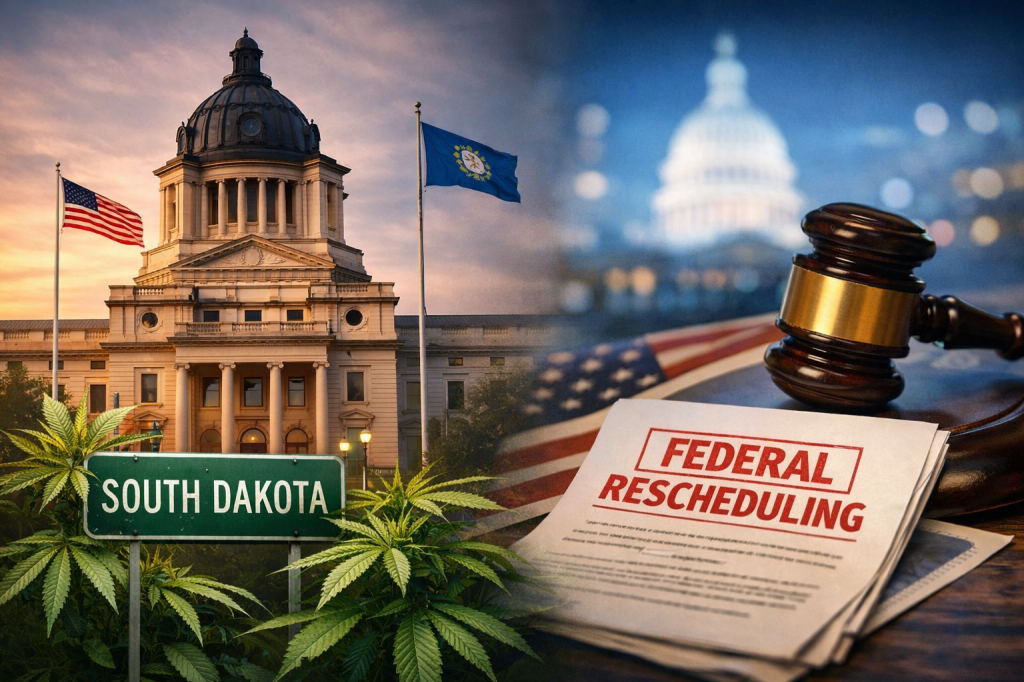
What Federal Cannabis Rescheduling Means for South Dakota — And the Conversation Still Ahead
By Jason Karimi | WeedPress | February 2026
Editor’s Note: WeedPress views Emmett Reistroffer as a good-faith contributor to South Dakota’s cannabis policy discussion. This article is not intended as a critique of his analysis, but as an extension of the conversation it helps frame. Explaining what federal rescheduling does not immediately change is an important public service; examining what reform opportunities may follow is a separate — and necessary — step. WeedPress engages with both in the interest of informed, responsible cannabis policy development in South Dakota.
A recent article by Emmett Reistroffer, published at Dakota War College, offers a clear and grounded explanation of what federal cannabis rescheduling does — and does not — mean for South Dakota.
The piece correctly emphasizes an important point often lost in public discussion: federal rescheduling alone does not automatically change state law. South Dakota’s medical cannabis framework remains in place unless and until state policymakers choose to revisit it. That clarification is useful, especially as national headlines risk overstating immediate legal effects.
At the same time, the article highlights an issue worth exploring further — not as a disagreement, but as the next phase of the conversation.
Explaining the Law vs. Examining Its Future
Reistroffer’s analysis focuses on stability and continuity: reassuring readers that South Dakota’s medical cannabis law remains valid and relevant even as federal policy shifts. That framing is understandable, especially in a state where voters and lawmakers have experienced years of legal uncertainty around cannabis.
What the article does not attempt to do — and likely did not intend to do — is address whether federal rescheduling creates a new opportunity or obligation for reform within South Dakota.
That gap isn’t a flaw. It simply reflects the article’s scope.
But it is precisely where the broader policy discussion now needs to go.
Federal Rescheduling Changes the Context, If Not the Statute
Federal rescheduling marks an official acknowledgment by the federal government that cannabis has accepted medical use. While this doesn’t rewrite South Dakota law overnight, it does shift the legal, medical, and administrative context in which state policy operates.
Questions that naturally follow include:
• Whether South Dakota’s medical program adequately reflects current medical consensus
• How rescheduling may affect probation conditions, employment policies, or court treatment of cannabis use
• Whether enforcement practices remain proportionate in light of evolving federal standards
These are not radical questions. They are the ordinary consequences of a federal policy shift that signals movement rather than stasis.
An Opening, Not a Verdict
Nothing in Reistroffer’s piece argues that South Dakota’s cannabis laws should be frozen in time. Rather, it explains where things stand today. That distinction matters.
If anything, the article helps establish a baseline from which more substantive discussions can proceed — discussions about access, patient protections, criminal penalties, and regulatory alignment.
Those debates are not a rejection of South Dakota’s medical cannabis law. They are a continuation of it.
Why This Moment Matters
South Dakota has a history of cannabis reform driven by voters first and policymakers second. Federal rescheduling adds another layer to that dynamic, creating pressure — not to rush change — but to thoughtfully evaluate whether current policies still serve their intended purpose.
Reistroffer’s article contributes clarity at a moment when clarity is needed. The next step is building on that foundation by asking what reform, if any, should follow.
That’s not a critique of the status quo. It’s how policy evolves.
The Takeaway
Federal rescheduling doesn’t force South Dakota’s hand. But it does invite reflection.
As the national posture toward cannabis continues to shift, South Dakota will eventually face choices about whether its laws merely persist — or adapt. Thanks to voices like Reistroffer’s, that conversation can start from an informed place rather than a reactionary one.
And that’s exactly where serious reform discussions should begin.
 WeedPress: The Paper Trail
Leave a comment