
The “Lazy but Ambitious” Minority: Why 15–20% of People Are Wired Differently — and How That Can Be a Strength
By Jason Karimi
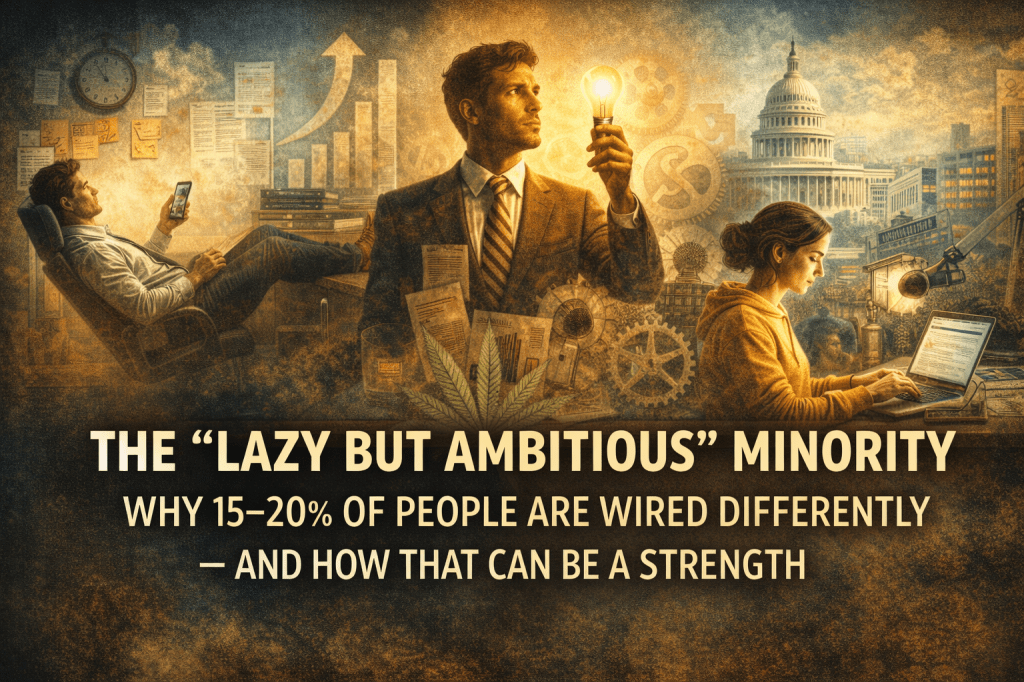
A growing body of productivity and behavioral-psychology content points to a counterintuitive personality pattern: a significant minority of people — often estimated informally at 15–20% of the population in coaching and productivity literature — are both deeply ambitious and chronically resistant to traditional models of hustle, grind, and constant effort.
These individuals are not lazy in the classic sense. They want high achievement, impact, and success. But they are structurally misaligned with systems that reward long hours, constant busywork, and brute-force discipline.
The result is a misunderstood group: people labeled as procrastinators, underperformers, or unmotivated — despite having unusually strong long-term vision and drive.
⸻
Ambition Without Tolerance for Grind
The core trait described in popular “ambitious but lazy” frameworks is not lack of desire — it is low tolerance for inefficient effort.
People in this category often:
• Think in big goals and long horizons
• Get bored by repetitive, low-leverage tasks
• Resist systems that reward time spent rather than results
• Delay action until a system feels “worth it”
• Appear inconsistent — intense bursts followed by withdrawal
This pattern aligns with research on intrinsic vs. extrinsic motivation and task-value theory in psychology, which shows that people are more likely to disengage from work they perceive as low-impact or misaligned with identity, even if they care deeply about outcomes.
Psychologists studying motivation have long distinguished between:
• Outcome-oriented motivation (focused on end states)
• Process-oriented motivation (focused on daily habits and grind)
“Lazy but ambitious” types skew heavily toward outcome orientation.
⸻
Why Traditional Productivity Systems Fail This Group
Most productivity culture is built for high process-tolerance personalities:
• Daily routines
• Habit stacking
• Long to-do lists
• Incremental daily progress
• Visible busywork
For the ambitious-but-lazy minority, these systems backfire.
Instead of increasing output, they often trigger:
• Cognitive resistance
• Perfectionism paralysis
• Task avoidance
• “All-or-nothing” cycles
Behavioral economics research on present bias and friction costs helps explain this. When effort feels high relative to perceived impact, people delay — even if they care deeply about the outcome.
This doesn’t mean they lack discipline. It means their discipline is selectively activated by high-leverage, high-meaning tasks.
⸻
The 15–20% Claim: Typology, Not Diagnosis
It’s important to be precise: the claim that 15–20% of people fall into this category is not a formal clinical statistic. It appears in:
• Coaching frameworks
• Entrepreneur typologies
• Productivity and self-optimization literature
• Online behavioral personality models
What is supported in academic literature is that a sizable minority of people score high on:
• Openness to experience
• Future orientation
• Low tolerance for low-autonomy work
These traits cluster in founders, creatives, strategists, and policy-oriented thinkers — people who do not thrive in rigid, grind-based systems but can outperform in leverage-based environments.
⸻
The High-Leverage Personality
What distinguishes this group is not laziness — it is leverage sensitivity.
They are more likely to thrive in environments where:
• One action produces outsized results
• Systems replace repetition
• Automation replaces manual effort
• Strategy replaces brute force
• Writing, policy, design, or systems-building matter more than hours logged
They often perform poorly in:
• Entry-level grind work
• Repetitive operational roles
• Jobs where effort is disconnected from outcome
This is why many appear to “underperform” early in life and then suddenly outperform when they gain autonomy.
⸻
Why This Matters in Politics, Media, and Advocacy
This personality type is disproportionately represented in:
• Independent journalism
• Policy analysis
• Activism
• Entrepreneurial media
• Investigative work
• Legal and regulatory advocacy
These fields reward:
• Long-term thinking
• Narrative framing
• Strategic pressure
• Information leverage
• Selective intensity
They do not reward constant low-impact activity.
In other words, many people driving change are not grinders — they are strategic exertion types.
⸻
Reframing “Lazy” as Selective Effort
For this minority, the productive move is not “work harder.”
It is:
• Reduce friction
• Increase leverage
• Align tasks with identity
• Eliminate low-impact obligations
• Design systems that reward bursts of deep work
This aligns with research on deep work, flow states, and self-determination theory, which shows that autonomy, competence, and meaning drive sustained performance more than sheer effort.
⸻
Why This Group Is Often Misunderstood
Institutions are built for people who:
• Tolerate repetition
• Accept incrementalism
• Respond to external structure
• Can grind without meaning
The ambitious-but-lazy minority often:
• Reject arbitrary authority
• Resist busywork
• Demand internal justification
• Appear noncompliant or difficult
But in high-leverage environments, these same traits become assets.
⸻
The Strategic Advantage
When properly aligned, this personality style can produce:
• Faster scaling
• Higher creativity
• Better system design
• Stronger narrative framing
• Outsized influence relative to effort
The key is not more hustle.
The key is better leverage.
⸻
Bottom Line
The so-called “lazy but ambitious” group is better understood as a high-leverage personality type — a minority wired for strategy, systems, and impact rather than grind.
They are not optimized for traditional productivity culture.
They are optimized for environments where thinking, design, and selective execution matter more than hours logged.
In a media, policy, and advocacy economy increasingly driven by leverage rather than labor, this minority may be more relevant than ever.
 WeedPress: The Paper Trail
Leave a comment