HB 1065 Heads to the Floor: The Primary Gap in South Dakota’s Medical Cannabis Politics
As restriction legislation advances, the absence of effectively deterrent electoral pressure reveals a leverage problem within the state’s cannabis movement.
As House Bill 1065 advances to the South Dakota House floor, the moment calls for structural reflection rather than rhetorical reaction. The bill’s movement is not simply about one statutory adjustment to medical cannabis defenses. It is a data point — one that reveals how political leverage operates in practice.
When restriction legislation clears committee by an 8–3 margin and proceeds without evident electoral consequence, it signals something deeper than policy disagreement. It signals a primary gap — the absence of organized electoral pressure capable of altering legislative incentives.
Politics in South Dakota is not chaotic. It is incentive-driven. Lawmakers respond to risk. Where risk is absent, restriction becomes viable. Where primary pressure is credible, hesitation follows.
HB 1065 is therefore more than a bill. It is a diagnostic.
South Dakota politics is not complicated.
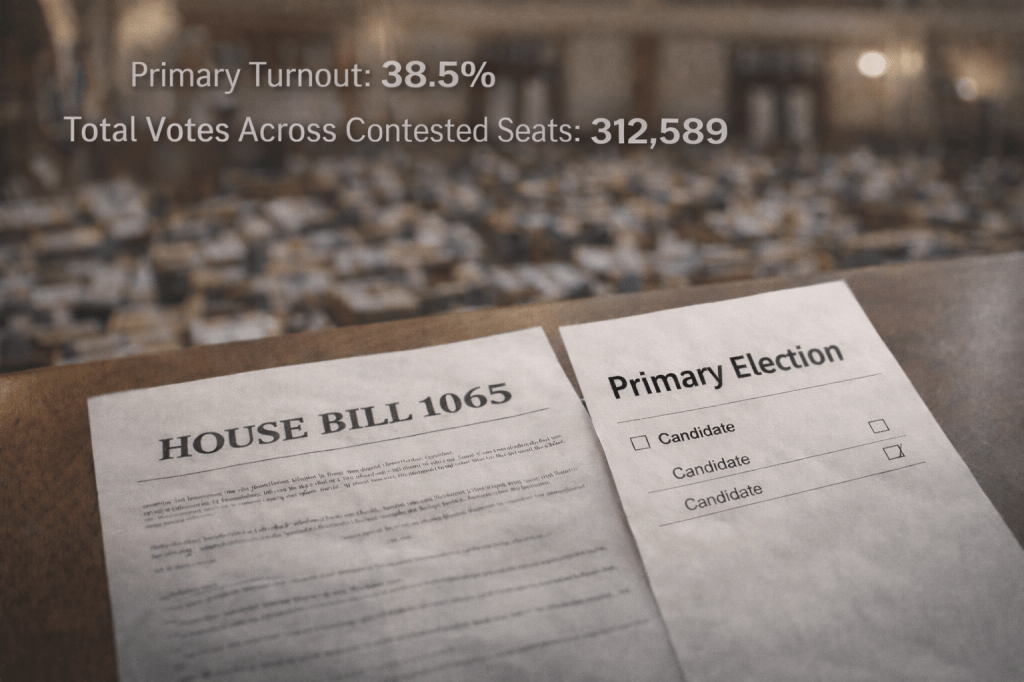
If a movement does not challenge lawmakers who worked to repeal or materially narrow its central policy achievement, it is sending a message — whether it intends to or not.
The message is simple:
We cannot impose consequences.
In politics, consequences are currency.
Primaries against lawmakers voting for medical cannabis restrictions are the legislative enforcement mechanism.
⸻
Exhibit A: HB 1065
House Bill 1065 — which would eliminate the ability to raise a medical cannabis defense without a registry card — just cleared committee 8–3 and is heading to a full House vote.
That is not symbolic.
That is structural narrowing.
The original voter-approved framework included broader defensive protections. HB 1065 tightens the system by conditioning legal protection on strict administrative compliance.
Reasonable lawmakers may view HB 1065 as administrative clarification rather than restriction.
You can debate the policy merits.
But politically, the signal is clear: restriction bills can advance.
If lawmakers who supported repeal or restriction face no primary pressure, then advancing 1065 is rational.
No electoral cost means no deterrent. Voting is the best means of limiting terms for lawmakers harming business interests in South Dakota for medical cannabis industry stability. Remove the lawmakers, or at least talk about removing them starting now, and then work to focus on that. If the voters reelect those lawmakers, the medical cannabis laws will invite further instability.
1. Impose primary risk on lawmakers who advance material restrictions.
2. Develop deep federalism literacy to prepare for post-rescheduling litigation.
This is, unfortunately, the time for leaders to prove they’re fighting and not co-opted or playing zero-sum opportunist games when existential threats to medical cannabis keep being promoted by people whose only consequence for doing these things is being primaried and removed from office. Supposedly one lawmaker already has two people primarying them for supporting South Dakota repeal efforts but it needs to be used NOW in discussions with these lawmakers or they will, with this testing bill HB 1065, confirm they can remove voter protections with no risk of being unelected and there has to at least be a risk leveraged now and then followed through on. The headache of facing primaries is persuasive politics 101.
⸻
Politics 101: Risk Creates Leverage
Medical cannabis in South Dakota exists because voters imposed it.
But after implementation, control shifted from ballot initiative to committee structure.
When legislators move to:
• Repeal
• Restrict
• Narrow defenses
• Tighten eligibility
And there is no credible primary threat, the institutional lesson is absorbed quickly:
“There is no organized electoral risk.”
Movements that cannot generate primary risk lose negotiating leverage — not rhetorically, but structurally.
If restriction-aligned lawmakers can advance bills like HB 1065 and return to office unchallenged, the message is permission.
Future narrowing becomes easier.
⸻
This Session Is Not a Dud
Earlier repeal attempts this week stalled.
But 1065 is moving.
That tells you where the real strategy is.
Full repeal may lack votes.
Incremental narrowing does not.
Restriction through procedural tightening is politically safer than overt dismantling.
And without electoral consequences, it is sustainable.
⸻
The Federal Variable Is Still Being Ignored
While the House debates 1065, the larger structural shift is unfolding at the federal level.
Federal rescheduling is not symbolic.
It is the most significant shift in federal drug policy in fifty years.
Yet the state-level conversation remains almost entirely legislative and reactive.
Few appear prepared to analyze what federal rescheduling alters in:
• State criminal classifications
• Administrative rule authority
• Agency enforcement discretion
• Interstate commerce exposure
• Dormant Commerce Clause vulnerability
• Licensing protectionism rationales
• Federal–state preemption analysis
A state regulatory system constructed in the shadow of federal illegality will not remain structurally identical after federal recognition shifts.
Ignoring that is not strategy.
It is delay.
⸻
Where Power Is Actually Moving
The next durable battleground is not floor debate.
It is administrative law and federalism litigation.
Power is shifting toward:
• Agency rulemaking records
• Judicial scrutiny of protectionist licensing
• Federal–state preemption arguments
• Interstate commerce challenges
• Attorney General interpretations
Movements focused only on legislative theatre risk being blindsided by judicial recalibration.
Courts do not negotiate.
They invalidate.
⸻
Electoral Leverage Still Determines Outcomes
HB 1065 advancing 8–3 is the data point.
Influence exists when:
• Legislators hesitate before filing restriction bills.
• Committee margins narrow due to anticipated backlash.
• Amendments are softened preemptively.
If restriction bills move comfortably, the inference is unavoidable:
Electoral risk is insufficient.
Politics is not emotional.
It is incentive-based.
No primary risk equals no structural leverage.
⸻
Administrative Durability Is the Real Question
The long-term question is not cultural acceptance.
It is durability.
If federal recognition narrows the illegality gap, then:
• Economic protectionism rationales weaken.
• Interstate barriers face litigation exposure.
• State agency justifications require recalibration.
• Licensing schemes may face constitutional scrutiny.
Programs that fail to adapt risk destabilization through courts rather than committees.
⸻
The Strategic Fork
The movement faces a dual obligation:
One without the other is incomplete.
Electoral enforcement without structural preparation is shallow.
Structural literacy without electoral leverage is weak.
HB 1065 moving to the House floor is not the end of the program.
But it is evidence.
If there are no primaries, there is no influence.
And if there is no preparation for federal structural change, there is no durability.
Politics is not granted.
It is imposed.
And when it is not imposed, it shifts elsewhere.
 WeedPress: The Paper Trail
Leave a comment