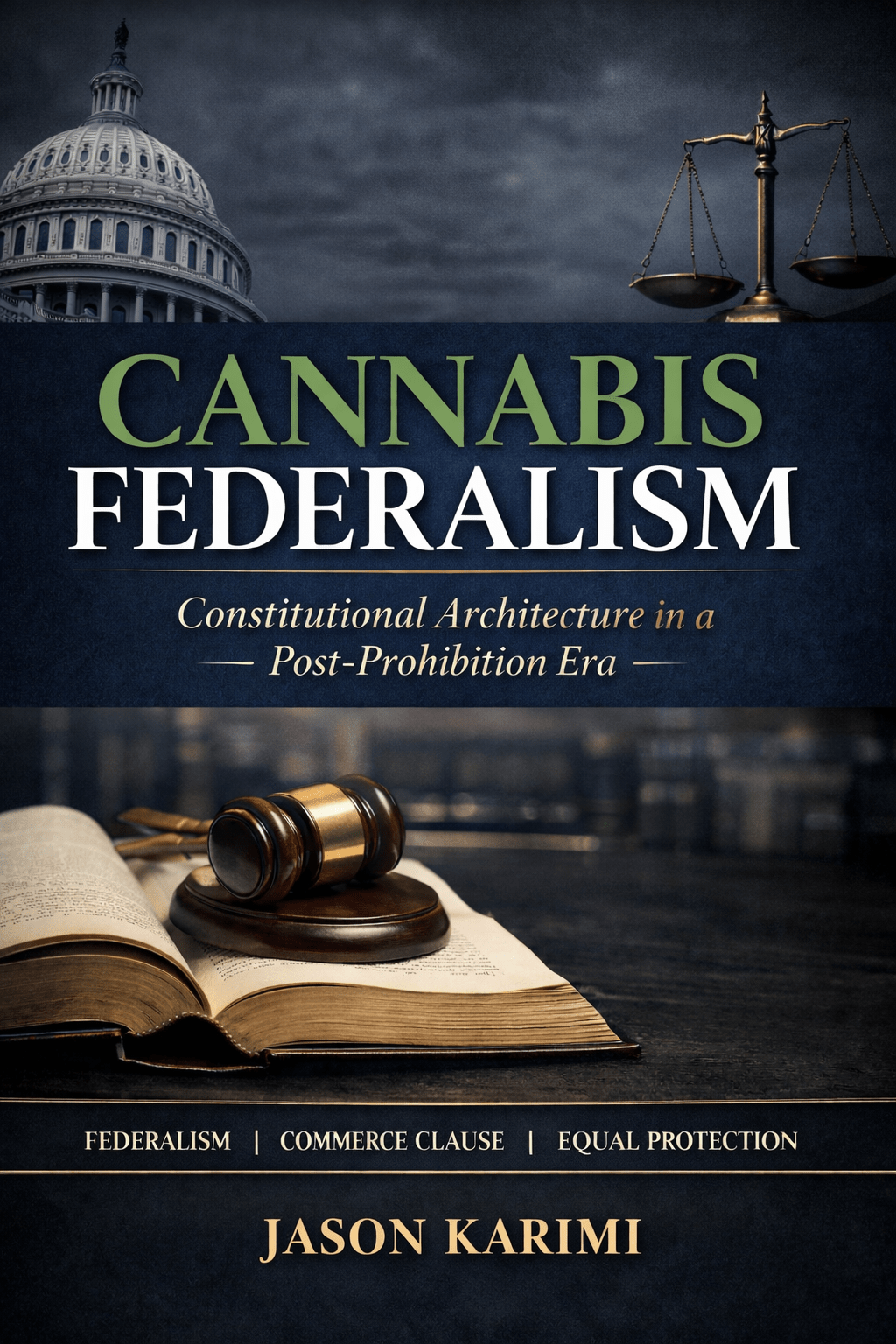
New book in monograph form incoming.
Estimated release date: July 4, 2026
Cannabis Federalism: Constitutional Architecture in a Post-Prohibition Era
Subtitle:
A Structural Analysis of Vertical Preemption, Horizontal Protectionism, and Patient-Centered Regulatory Design
By Jason Karimi
Proposed Table of Contents
Preface
From Conflict to Architecture
Brief, measured acknowledgment of the volatility of the cannabis policy era
Why structural analysis matters more than cultural argument
Framing the book as institutional, not personal
(Keep this disciplined. No memoir tone.)
Introduction
Cannabis as a Federalism Stress Test
Why cannabis reform is not primarily a cultural issue
The collapse of the “state laboratory” myth under federal illegality
The tension between state innovation and federal supremacy
Thesis: Cannabis reform exposes unresolved constitutional architecture problems
This sets the intellectual spine.
Part I — Vertical Federalism
Chapter 1
The Controlled Substances Act and Structural Supremacy
Federal scheduling architecture
Statutory design of prohibition
Congressional intent and administrative delegation
Chapter 2
Preemption After Rescheduling
Conflict preemption
Obstacle preemption
Administrative harmonization
How rescheduling alters — but does not eliminate — supremacy tension
Chapter 3
Administrative Law and Agency Deference in Cannabis Regulation
Post-deference era implications
Agency discretion limits
Litigation exposure under modern APA doctrine
Part II — Horizontal Federalism
Chapter 4
The Dormant Commerce Clause and Emerging Cannabis Markets
Protectionism in limited-license regimes Residency requirements
Interstate transport barriers
Structural tension once federal illegality weakens
Chapter 5
Interstate Market Fragmentation and Constitutional Pressure
State-to-state inconsistencies
Economic
Balkanization Litigation pathways
This is where your national relevance expands.
Part III — Equality and Market Design
Chapter 6
Equal Protection and Cannabis Licensing Structures
Rational basis review
Incumbent protectionism
Lottery systems
Public health justification analysis
Chapter 7
Economic Protectionism and Constitutional Limits
When regulatory equity becomes exclusionary Distinguishing social equity from structural favoritism
Constitutional vulnerability mapping
Part IV — Durability and Patient-Centered Design
Chapter 8
The Myth of the “Laboratory of Democracy”
Why cannabis reform shows the limits of the metaphor
Federal instability and state overconfidence
Chapter 9
Patient-Centered Constitutional Design
Access durability
Administrative clarity
Avoiding structural fragility
Designing systems resilient to federal shifts
This chapter is morally grounding without being emotional.
Part V — The Architecture Ahead
Chapter 10
Post-Prohibition Constitutional Realignment
What rescheduling does and does not solve
The inevitability of interstate litigation
Structural reforms required for stability
Conclusion
From Policy Debate to Constitutional Settlement
Cannabis reform as a generational structural event
Why federalism must be consciously designed, not improvised
The long-term institutional implications
Page Count Projection
If each chapter runs ~12–15 pages:
10 chapters = 120–150 pages Preface + Intro + Conclusion = ~20–25 pages
Total: 150–175 pages.
Perfect density.
Why This Works
It:
Preserves existing analysis
Organizes it by doctrine instead of blog number
Makes it citeable
Signals national seriousness
Elevates the series into a unified thesis

 WeedPress: The Paper Trail
Leave a comment