The District Math: How Primary Elections Actually Decide Legislative Power in South Dakota
By Jason Karimi | WeedPress
February 23, 2026
If HB 1065 was a diagnostic, district math is the operating manual.
Political influence in South Dakota is not determined by statewide sentiment alone. It is determined district by district — often by a few hundred votes.
Understanding that math is the difference between frustration and leverage.
⸻
- The Scale of the Battlefield
South Dakota has 35 legislative districts. Each district elects one Senator and two House members.
That means 105 legislative seats.
But power is not distributed evenly across those seats. It concentrates in districts where primary turnout is modest and margins are narrow.
That is where leverage exists.
⸻
- Primary Elections Decide Most Seats
In many South Dakota districts, the decisive contest is the primary, not the general election.
Why? Because South Dakota is an anti-Democrat/Progressive state, so Democrats don’t win elections (or help marijuana optics and reputation at the Capitol). Only the primary matters. Republicans always win the general.
For activists seeking influence, this is the structural reality:
The primary is the gatekeeper.
⸻
- What Turnout Actually Looks Like
Primary turnout in contested legislative races frequently ranges between 30–40% of registered party voters.
In raw numbers, that can mean:
• 2,000–5,000 votes cast in a legislative primary.
• Winning margins sometimes under 500 votes.
• In some districts, margins under 300 votes.
That is not abstract.
It is arithmetic.
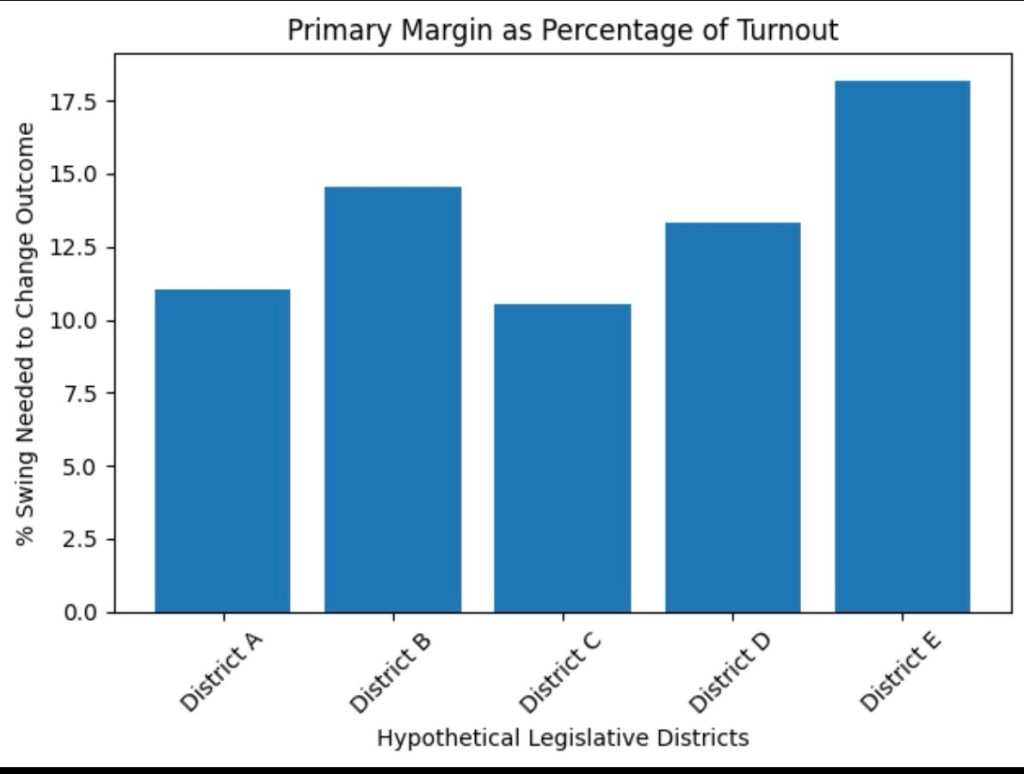
If a district’s last primary was decided by 412 votes out of 3,200 ballots cast, a shift of roughly 13% of participants would have changed the outcome.
That level of influence is within reach of organized networks.
⸻
- Margin Is More Important Than Ideology
Movements often target the loudest opponents.
Math suggests targeting the closest races.
The key questions are:
• What was the margin in the last primary?
• Was the incumbent unopposed?
• Is turnout trending upward or downward?
• Has the district experienced demographic change?
A legislator who won by 2,500 votes in a 6,000-vote primary is not strategically vulnerable.
A legislator who won by 380 votes in a 3,100-vote primary may be.
Leverage follows margin, not emotion.
⸻
- A Hypothetical Example
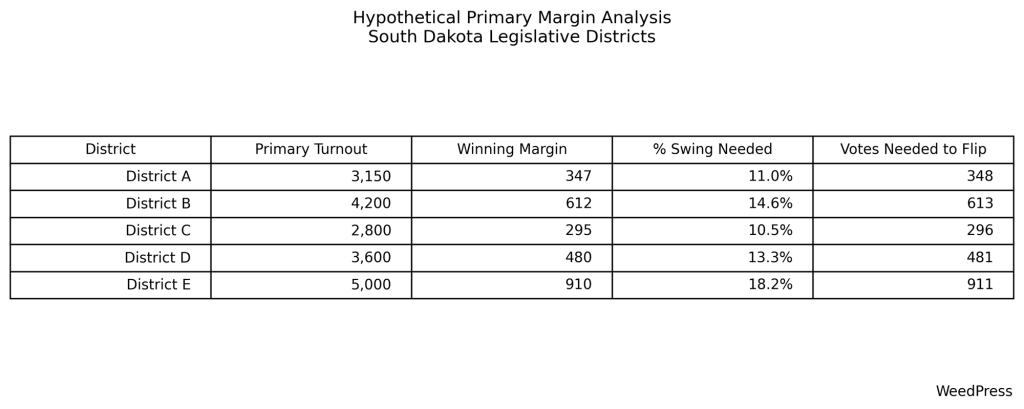
Consider a hypothetical District X:
• Last primary turnout: 3,150 voters
• Winning margin: 347 votes
• No challenger in the most recent cycle
In that district, organizing 400–500 reliable primary voters would represent roughly 13–15% of the electorate.
That is not a statewide movement.
That is targeted organization.
The lesson is not about attacking any particular legislator. It is about recognizing that margins of this size exist — and they are numerically manageable.
Where margins are narrow, influence is realistic.
⸻
- The Incumbent Effect
Incumbents frequently run unchallenged in primaries.
That does not mean they are invulnerable.
It means the math has not been tested.
When incumbents face no competition, they internalize safety. When incumbents face even credible early opposition, behavior can change before ballots are printed.
The signal of competition alone alters incentives.
⸻
- Turnout Variability Creates Opportunity
Primary turnout is not fixed.
It fluctuates based on:
• Contested statewide races
• National political climate
• Local organization
• Mobilization efforts
In lower-salience cycles, turnout can decline.
Lower turnout amplifies organized blocs.
In a district where 3,000 voters participate, mobilizing 400 disciplined voters represents more than 13% of the electorate.
In electoral math, that is not symbolic.
It is decisive.
⸻
- Resource Reality
District math only matters if someone is prepared to act on it.
That requires:
• Access to voter lists
• Understanding party registration data
• Monitoring filing deadlines
• Recruiting credible candidates
• Funding focused, compliant outreach
This is less about statewide messaging and more about district-specific organization.
Legislative politics in South Dakota is intimate.
That intimacy is leverage.
⸻
- Where to Find the Data (Legally and Publicly)
District math is not guesswork. It is based on publicly available information.
In South Dakota, activists can lawfully access:
• Official election results through the South Dakota Secretary of State
• County-level election data through county auditor offices
• Party registration and turnout statistics from public archives
• Candidate filing deadlines and petition requirements through state election resources
Strategic organization should always remain lawful, transparent, and grounded in respectful civic participation.
The math is public.
Whether it is used strategically is a separate question.
⸻
- The Incentive Shift
When legislators know:
• Their last primary was decided by 350–500 votes
• Turnout was under 3,500
• A challenger is organizing early
Behavior adjusts.
Not because of ideology.
Because of arithmetic.
Bills are reconsidered.
Amendments are moderated.
Committee votes tighten.
Incentives shift when margins are credible.
⸻
- Conclusion: Math Is Strategy
Movements that understand district math stop reacting emotionally and begin operating strategically.
If medical cannabis advocates want durable influence, the roadmap is clear:
• Identify the 5–8 districts with the narrowest primary margins.
• Study turnout history.
• Evaluate candidate viability.
• Organize early.
Influence in South Dakota is not built statewide first.
It is built district by district.
HB 1065 tested leverage.
District math constructs it.
Politics is not mystical.
It is numerical.
And numbers, properly understood, alter behavior.
 WeedPress: The Paper Trail
Leave a comment