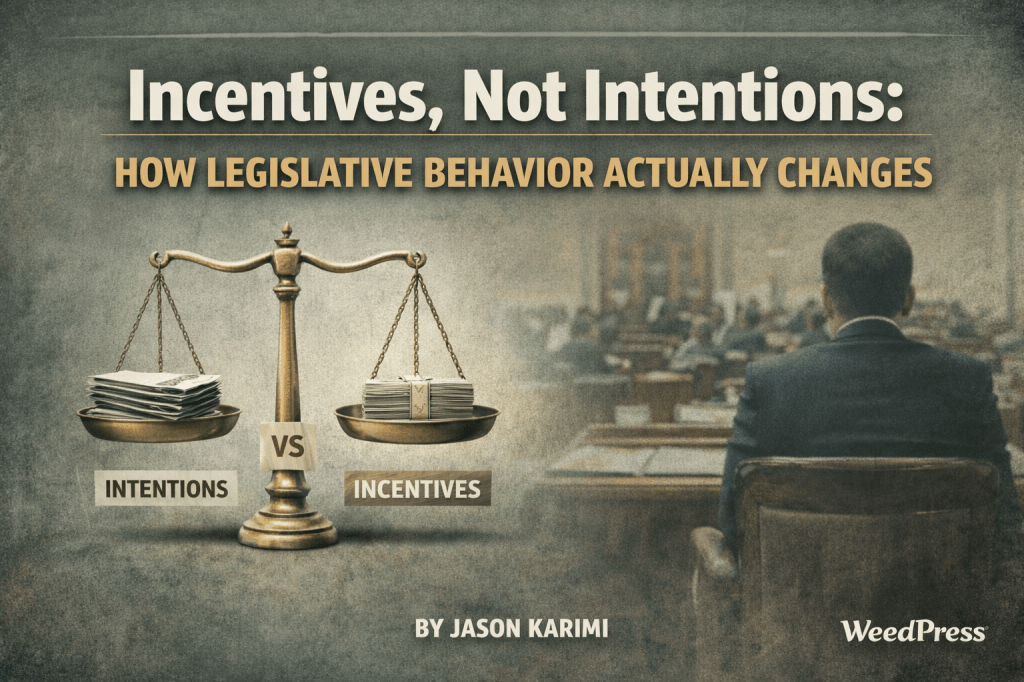
Incentives, Not Intentions: How Legislative Behavior Actually Changes
By Jason Karimi | WeedPress
March 2, 2026
Political movements often misread opposition.
They assume legislation advances because lawmakers are hostile, ideological, or morally opposed.
Sometimes that is true.
More often, legislative behavior is shaped by incentives — not intentions.
⸻
- Lawmakers Respond to Risk, Not Volume
A thousand angry emails do not necessarily create risk.
A credible challenger does.
A viral post does not necessarily change a vote.
A narrow primary margin does.
Legislators operate within a predictable system:
• If reelection appears secure, policy preferences can be pursued freely.
• If reelection appears uncertain, caution increases.
The difference is rarely moral transformation.
It is electoral math.
⸻
- Stability Produces Boldness
When incumbents believe:
• They face no primary challenger,
• Turnout patterns are stable,
• Advocacy groups lack organization,
They act with confidence.
That confidence produces:
• Restriction bills.
• Hardline amendments.
• Procedural tightening.
Not solely because of ideology.
Because there is no measurable electoral counterweight.
⸻
- Uncertainty Produces Moderation
When legislators perceive:
• Early challenger recruitment,
• Organized turnout blocs,
• Narrow historical margins,
Behavior moderates.
Language softens.
Bills narrow.
Compromises emerge.
Not because lawmakers abandoned their beliefs.
Because incentives shifted.
Uncertainty introduces restraint.
⸻
- Why Outrage Often Fails
Outrage assumes persuasion.
Incentive models assume self-preservation.
Legislative change rarely occurs because one side convinces the other it was wrong.
It occurs when the cost of maintaining a position increases.
That cost is electoral.
Volume without leverage creates noise.
Leverage without noise creates adjustment.
⸻
- The Durable Model
Movements that understand incentives stop debating motives and begin shaping risk.
They ask:
• What changes this legislator’s probability of reelection?
• What narrows the margin?
• What introduces credible uncertainty?
When uncertainty becomes measurable, behavior adjusts.
That adjustment is structural.
⸻
- The Long Game
Incentives compound.
One close primary alters committee calculations.
Two competitive districts reshape caucus discussions.
Three credible challenges shift leadership posture.
Durable influence is cumulative.
It is built through repeated demonstrations of electoral capacity.
⸻
Legislative behavior does not change because intentions are debated.
It changes because incentives are recalibrated.
Movements that internalize this stop reacting emotionally and start operating structurally.
That is how policy shifts endure.
 WeedPress: The Paper Trail
Leave a comment