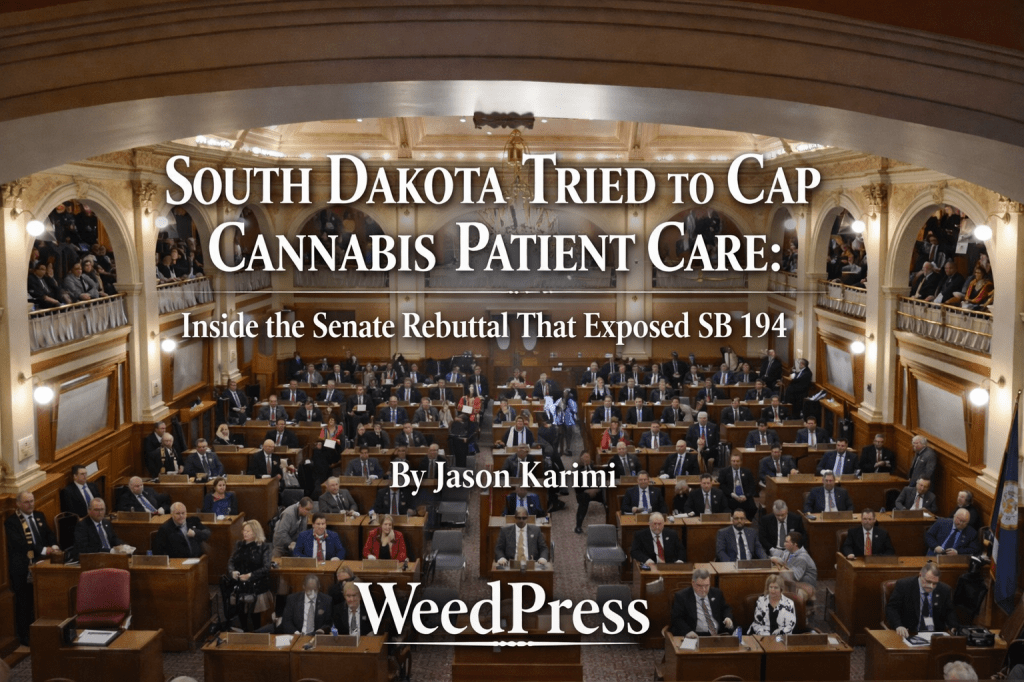
South Dakota Tried to Cap Cannabis Patient Care: Inside the Senate Rebuttal That Exposed SB 194
By Jason Karimi | WeedPress
March 4, 2026
During the South Dakota Senate Health and Human Services Committee hearing on SB 194—the bill to impose THC potency caps on medical cannabis products—Sen. John Carley used an unusual rebuttal tactic: he tried to enlist a pro-legalization figure’s prior words as rhetorical cover for restricting the medical program.
SB 194 didn’t survive the hearing. The committee deferred the bill to the 41st legislative day (a standard procedural way to kill it), 6–1.
But the rebuttal exchange matters, because it previews a recurring legislative strategy: reframing medical access as a “public safety” problem and then citing cannabis advocates to make restrictions appear bipartisan and reasonable.
The setup: SB 194 as a “potency cap” bill
SB 194 was presented as a guardrail—an attempt to limit product strength. News coverage summarized it plainly: Carley argued the potency cap had “precedents” elsewhere, while industry opponents called it arbitrary and political.
Outside advocacy reporting described SB 194 as a direct hit on patient choice, including specific caps on product types (oils, edibles servings, concentrated products).
The rebuttal moment: “Even your side agrees with limits”
In the rebuttal phase (around the 1:23:00–1:24:00 range of the hearing video), Carley attempted to show a short clip involving Matthew Schweich (executive director of South Dakotans for Better Marijuana Laws). The committee rules blocked showing video, so Carley pivoted: he read/paraphrased a statement instead.
The message he wanted on the record was simple:
• Schweich (or a Schweich-adjacent discussion) referenced structured possession limits and equivalency-style accounting for different product forms; and
• Carley used that to argue: See? Even legalization advocates accept “limits,” so potency caps for medical patients are just “responsible regulation.”
This is a classic rhetorical move: take a regulatory concept designed for one context (adult-use initiative drafting, campaign messaging, political coalition-building) and transpose it onto a different context (a patient-protection medical program), as though the logic carries over unchanged.
What Carley was really borrowing: the IM 29 “THC total” framing
Whether or not Carley’s paraphrase was perfectly faithful, the broader point he was leaning on is easy to document: Initiated Measure 29 (2024)—the adult-use measure Schweich helped lead—included explicit possession ceilings, including a total THC limit:
• 2 ounces of marijuana,
• 16 grams of concentrate, and
• 1,600 mg of THC contained in cannabis products.
So yes: the adult-use proposal contained structured limits. But that fact doesn’t automatically justify medical potency caps, because the design goals are different:
• Adult-use policy often prioritizes broad political palatability, uniform rules, and messaging that reassures skeptical voters.
• Medical policy exists to protect individualized treatment—where formulation, concentration, onset time, and patient tolerance are the whole point.
Carley’s rebuttal tried to collapse those two worlds into one: limits exist somewhere → therefore limits belong here.
Why this tactic is persuasive—and why it’s misleading
Carley wasn’t trying to win a pharmacology debate. He was trying to win a credibility debate.
By invoking a recognizable pro-legalization advocate, he attempted to recast SB 194 as:
• not anti-cannabis, but “pro-structure,” and
• not an attack on patients, but alignment with what “responsible” people already accept.
But that framing hides the key question legislators must answer honestly:
Are potency caps medically justified in South Dakota’s program, given patient needs and available evidence—or are they simply a politically convenient way to shrink what patients can buy?
That’s why opponents kept returning to the same themes in testimony (as reflected in post-hearing summaries): patients dose differently, conditions differ, and one-size caps are a blunt instrument—especially when the existing program hasn’t demonstrated the kind of crisis narrative potency caps are usually built around.
The outcome: SB 194 is dead—but the playbook isn’t
On paper, the committee’s action was decisive: SB 194 was deferred to the 41st day and effectively killed.
But the rebuttal maneuver is the headline, because it signals what comes next:
• Future restriction efforts will likely be packaged as “reasonable guardrails,”
• justified with selective borrowing from adult-use debates, and
• sold with the implication that “even cannabis advocates agree.”
That’s the pivot patients should watch for: when legislators stop arguing the merits and start arguing optics
 WeedPress: The Paper Trail
Leave a comment