DOH Confirms Receipt: South Dakota’s Schedule I Review Petition Is Officially in the Record
By Jason Karimi | WeedPress
March 5, 2026
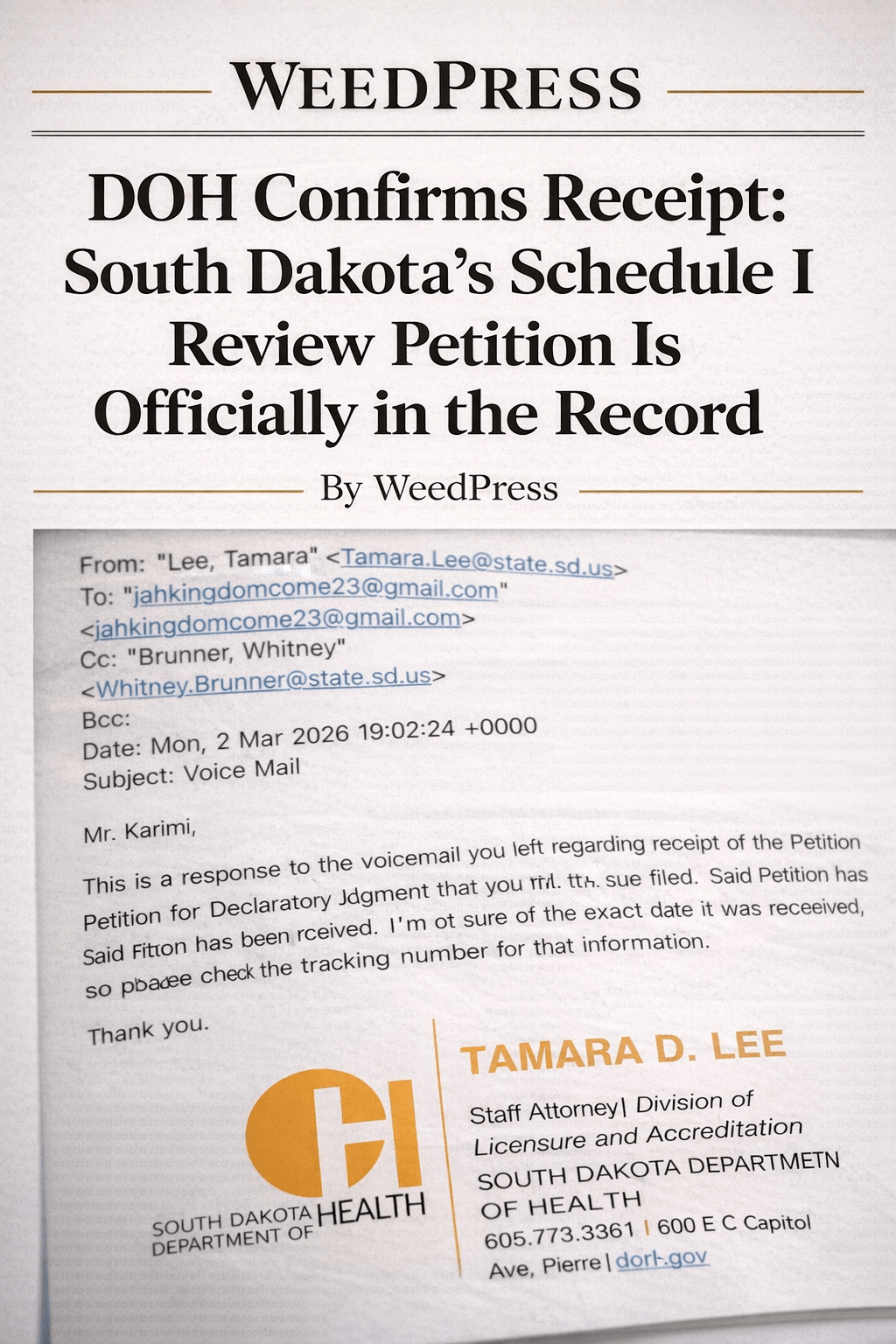
The South Dakota Department of Health has now confirmed it received my Petition for Declaratory Judgment and Mandatory Scheduling Review of Cannabis. This matters for one reason: it removes any ambiguity about whether the petition actually entered the agency’s administrative record.
In a brief email responding to my voicemail, DOH counsel stated that the petition “has been received,” and advised that the exact receipt date should be verified using the carrier tracking number. That’s bureaucratic speak for: we have it, it’s in the building, and you can tie the timestamp to delivery confirmation.
That confirmation is not a “win” by itself. It’s something more useful than a dopamine hit: it’s a clean procedural anchor. When agencies slow-walk issues, the first fight is often over whether the request was even properly received. That fight is now off the table.
Why receipt confirmation is a big deal (even when it looks small)
Administrative processes live and die on the record. Once a petition is confirmed as received, everything that happens next—delays, responses, requests for clarification, nonresponses—becomes legible and documentable. That’s how serious challenges are built: step-by-step, with dates, notices, and paper.
Receipt confirmation also matters because agencies sometimes behave like your submission exists only when they decide to acknowledge it. A simple “we received it” collapses that discretionary fog. From this point forward, the posture changes. The petition is no longer something I say I filed—it’s something the Department has admitted exists.
What happens next
There are a few likely paths from here, and none of them require me to speculate about outcomes.
1. Substantive response: DOH could address the petition on the merits—granting, denying, or partially granting relief, or issuing a declaratory ruling that frames their authority and obligations.
2. Procedural response: DOH could claim a threshold issue (jurisdiction, form, process, or statutory interpretation) as a way to avoid addressing the core Schedule I conflict. This is common. It’s also useful, because procedural dodges still create a record you can respond to.
3. Delay / silence: DOH could do nothing. Silence is not neutral; it’s a choice. And with confirmed receipt, silence becomes trackable and politically meaningful—especially when an agency is charged with public health responsibilities and is asked to reconcile its own statutory framework.
Whatever path they take, the important point is this: the agency is now on notice, and the administrative record is alive.
What I’m doing with this confirmation
I’m treating this as the “receipt receipt”—the moment where the public side of the process begins. My next steps are simple:
• Preserve the email confirmation alongside the petition packet and delivery tracking.
• Document dates carefully: submission, delivery, agency acknowledgment.
• Press for an internal reference number (if one exists) so future communications can’t be bounced around as “we don’t see it.”
And I will continue to publish updates in a way that keeps the focus on the legal conflict itself—without turning the process into clout-chasing or performative outrage.
The larger point: agencies can’t fix what they won’t acknowledge
South Dakota’s Schedule I posture isn’t just a political argument. It’s an internal statutory and administrative problem with real-world consequences: for patients, for regulated businesses, for enforcement discretion, and for the credibility of “medical” policy in a state that recognizes medical use in one part of law while denying it in another.
This follow-up is simply the public confirmation that the Department has the petition in hand. Now we see what they do with it.
If you missed the original filing post, it’s here:
https://weedpress.org/2026/02/23/south-dakotas-schedule-i-problem-is-now-in-the-administrative-record/
 WeedPress: The Paper Trail
Leave a comment