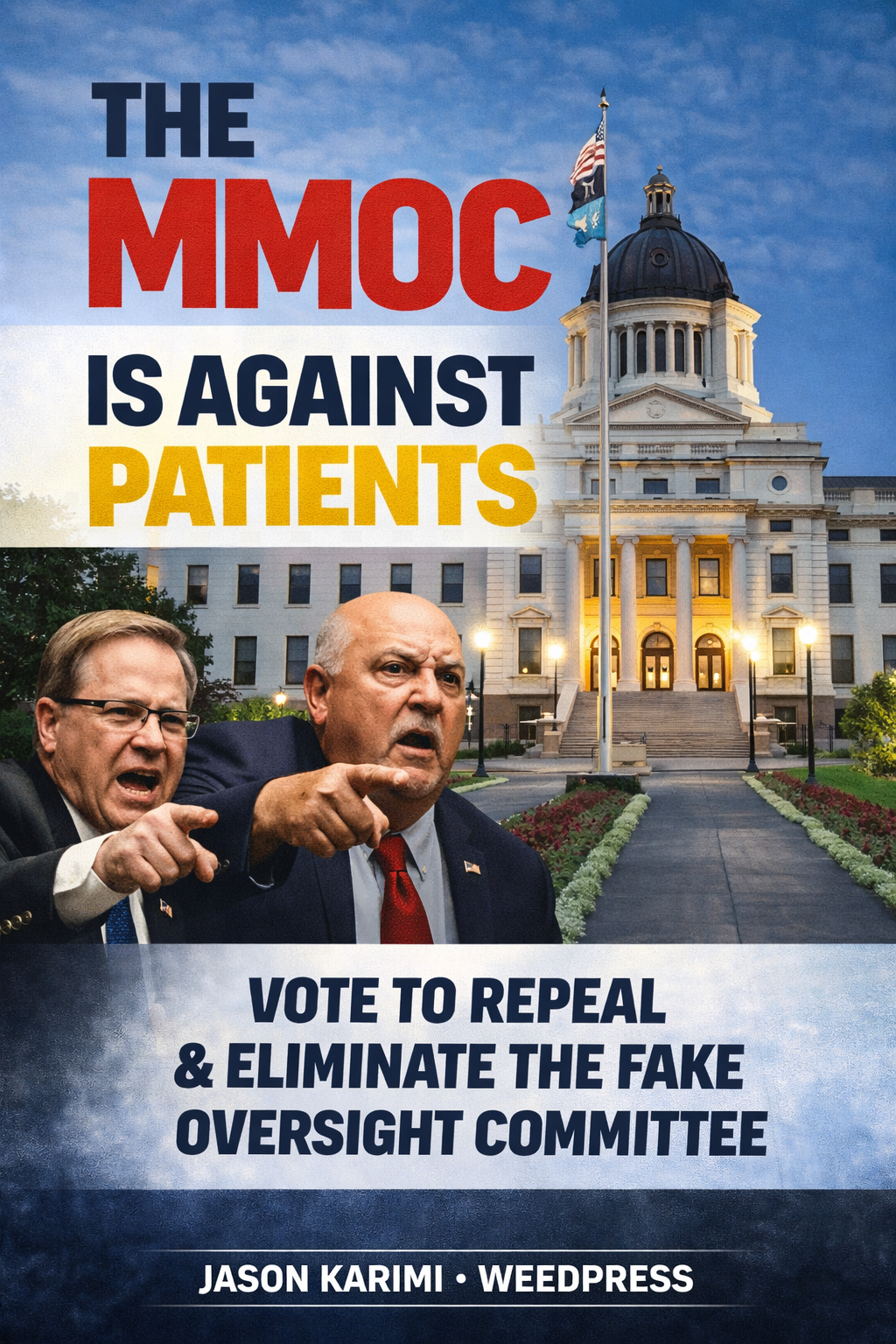
HB 1160 Should Pass: The MMOC Lost Any Claim to Speak for Patients
By Jason Karimi | WeedPress
March 7, 2026
South Dakota’s Medical Marijuana Oversight Committee should be repealed, and the Senate should stop dragging out the inevitable.
HB 1160—the bill to repeal the MMOC—was smoked out of committee and forced back onto the Senate floor. Good. That is exactly where it belongs. But even after the smoke out, lawmakers still have not clearly scheduled the final vote. So the public is left watching another round of procedural fog while a failed committee limps around on borrowed time.
Let’s be honest about what the MMOC became.
It was sold as patient oversight. In practice, it became political insulation. A stage set. A decorative advisory structure the state could point to while patients were ignored, advocates were brushed off, and serious policy failures kept piling up. If the committee existed to represent patients, it failed. If it existed to create the appearance of accountability without delivering it, it succeeded perfectly.
That is why HB 1160 matters.
Not because the MMOC was some sacred institution under attack. Not because repeal is radical. But because keeping a hollow body alive just to maintain the fiction of patient input is worse than admitting the thing does not work.
On March 4, 2026, the Senate Health and Human Services Committee voted 4–3 to send HB 1160 to the 41st legislative day, which is the Legislature’s standard burial ground for bills lawmakers want dead without plainly saying so. Then on March 5, Sen. Davis used Joint Rule 7-7 to force the committee to deliver the bill to the Senate floor anyway. The smoke out succeeded. HB 1160 was revived.
But as of the revised Senate calendar for Monday, March 9, 2026, the bill appeared under “Consideration of Reports of Committees” as returned without recommendation, not in the section for “Second Reading of House Bills and Joint Resolutions.” In plain terms: the repeal bill was brought back, but not yet clearly set for the decisive floor vote.
That procedural delay should not distract from the bigger point.
The MMOC does not deserve to survive because it has “oversight” in the title.
A body can call itself oversight and still function as a bottleneck, a shield, or a public-relations prop. And for many patient advocates, that is exactly what this committee became. Instead of serving as a serious vehicle for patient protection, it became associated with public shaming, hostility toward advocates, and a style of engagement that treated the people most invested in the program like irritants rather than stakeholders. That is not oversight. That is institutional contempt wearing a name tag.
If lawmakers truly believe the MMOC is valuable, they should explain what value it actually delivered.
Did it secure patient dignity?
Did it force accountability?
Did it materially improve access, pricing, product quality, or regulatory sanity?
Did it give advocates a fair hearing instead of turning them into targets?
If the answer is no, then repeal is not an attack on patients. Repeal is an admission that the state built something performative and wants to finally clear it away.
And let’s cut through another false frame: opposing the MMOC is not the same as opposing patient interests.
In fact, there is a strong pro-patient argument for killing it.
A fake channel for patient voice can be more dangerous than no channel at all, because it gives the political class cover. It lets officials say patients have representation while real power remains elsewhere. It lets them point to meetings, titles, and formal structures while the actual program continues to be shaped by agencies, lawmakers, and insiders who face little real accountability. A bad oversight body does not solve that problem. It helps conceal it.
HB 1160 would repeal the statutes creating and governing the MMOC. That includes removing the committee that state law charged with reviewing issues like patient access, pricing, complaints, security concerns, testing-facility sufficiency, and program implementation. If that sounds important, ask the harder question: what did the committee actually do with that authority, and for whom?
Because institutions should be judged by performance, not branding.
And by that standard, the MMOC has earned repeal.
The South Dakota Senate now needs to stop hiding behind process and finish the job. Put HB 1160 on the floor. Hold the vote. Make senators own their position. No more procedural haze. No more pretending this committee is some indispensable guardian of patients. No more deference to a body that, in the eyes of many advocates, discredited itself.
If the MMOC was meaningful, its defenders should be able to defend its record.
If it was hollow, then repeal it.
If it was hostile to patient advocates, then all the more reason to end it.
South Dakota patients do not need symbolic oversight. They do not need another committee that exists mostly on paper while advocates are talked down to in public. They need direct, serious, accountable policymaking. And if repealing the MMOC helps strip away one more layer of empty theater, then repeal is the right call.
The smoke out happened.
The committee was dragged back into the light.
Now the Senate should stop stalling and kill it for good.
 WeedPress: The Paper Trail
Leave a comment