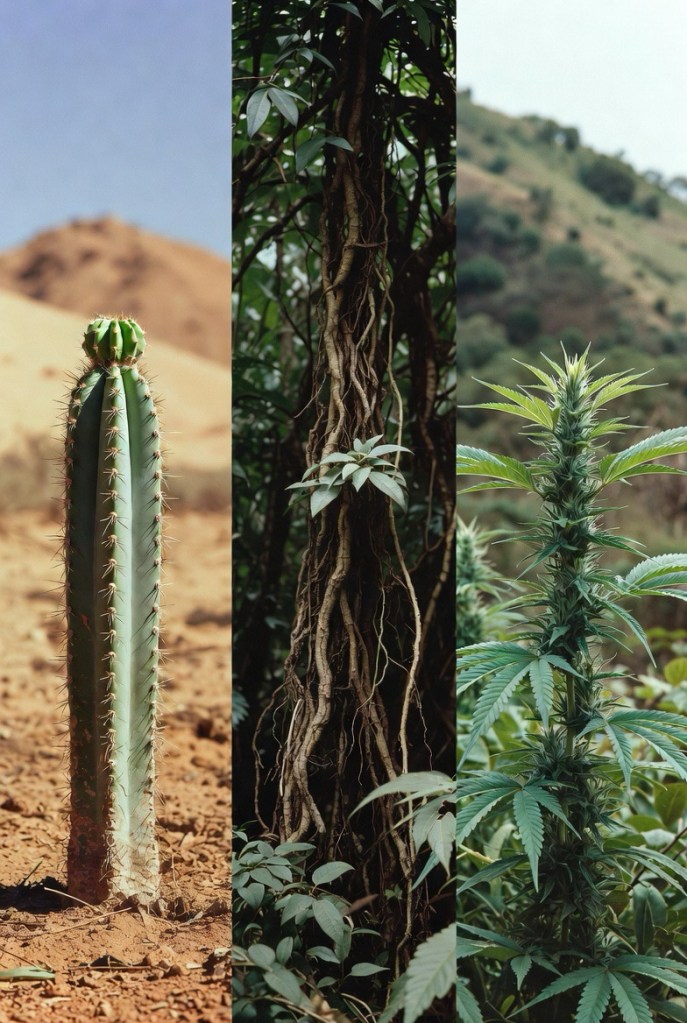
The Hidden Pattern Behind Religious Drug Exemptions: They’re Granted Because the Faiths Are Indigenous
By Jason Karimi | WeedPress
March 16, 2026
In the decades-long “War on Drugs,” nearly every controlled substance is treated the same: illegal, dangerous, zero tolerance. Yet three high-profile exceptions keep popping up—peyote, ayahuasca, and cannabis in Rastafarian practice. Courts, legislatures, and regulators bend the rules for these sacraments while cracking down on everything else.
The reason isn’t “religious freedom for everyone.” The reason is simpler and older than the drug laws themselves: these are indigenous faiths using medicines that belong to the land and the people who have lived on it for centuries. When the plant, the ceremony, and the culture are all native to the same soil, governments eventually carve out exemptions. The pieces fit together perfectly once you see the pattern.
Peyote: The Cactus That Is Literally Indigenous to America
The peyote cactus (Lophophora williamsii) grows wild in the deserts of Texas and northern Mexico—nowhere else on Earth. Indigenous tribes in that region have used it in healing and vision ceremonies for at least 5,000 years. When the Native American Church (NAC) formalized the practice in the late 1800s, it was simply codifying what had already been happening on this continent long before European contact.
U.S. law recognized this reality in 1994 with the American Indian Religious Freedom Act Amendments. The statute explicitly allows members of federally recognized tribes to possess, transport, and ingest peyote in bona fide religious ceremonies. No other religious group in America gets a blanket federal exemption for a Schedule I hallucinogen. Why? Because the entire practice—plant, people, and faith—is indigenous to the land. Courts didn’t invent a new right; they protected an ancient one.
Ayahuasca: The Vine and the Leaf That Belong to the Amazon
Ayahuasca is not a single plant but a brew made from the Banisteriopsis caapi vine and the Psychotria viridis leaf—both native to the Amazon rainforest. Indigenous tribes across Brazil, Peru, Colombia, and Ecuador have drunk this “vine of the souls” in shamanic ceremonies for millennia. The modern Brazilian churches União do Vegetal (UDV) and Santo Daime blended the indigenous brew with Christian elements in the 20th century, but the sacrament itself remains the same Amazonian medicine.
In 2006 the U.S. Supreme Court ruled unanimously in Gonzales v. O Centro Espírita Beneficente União do Vegetal that the federal government could not ban the UDV’s religious use of ayahuasca. Lower courts have extended similar protections to Santo Daime congregations. Brazil itself legalized religious use decades ago. Again, the exemption tracks indigeneity: the plants grow in the rainforest, the original knowledge lives with the forest peoples, and the religions that carry the tradition trace straight back to that soil. Non-indigenous groups trying to import the same brew for “new age” ceremonies face far steeper legal hurdles.
Rastafari: The Faith That Is Indigenous to Jamaica
Rastafari was born in the slums of Kingston, Jamaica, in the 1930s. It is a distinctly Jamaican religion—forged from African spiritual roots, Biblical prophecy, Ethiopianism, and the lived experience of Black Jamaicans under colonial rule. The movement’s central sacrament is the “holy herb,” cannabis, which Rastas view as the “tree of life” mentioned in the Bible and a tool for meditation and reasoning.
Cannabis itself was brought to the Caribbean centuries earlier, but the religious use of it became uniquely Jamaican through Rastafari. In 2015 Jamaica passed the Dangerous Drugs (Amendment) Act, explicitly decriminalizing cannabis for Rastafarian religious purposes. Rastas may now grow, possess, and use the herb sacramentally without fear of arrest. The law even allows Rastafarian organizations to cultivate their own sacramental fields. The government’s rationale was straightforward: this is a faith indigenous to Jamaican soil and culture; suppressing it would be an attack on national heritage.
In the United States the picture is patchier—federal law still technically prohibits it—but the same logic appears in state-level accommodations and court arguments. The pattern holds: where the faith is native to the land, exemptions follow.
Why the Pattern Exists
Look at the three cases side by side and the common thread is unmistakable:
• The sacrament is tied to a specific geography (Southwest deserts, Amazon basin, Jamaican hills).
• The faith grew out of the people who have lived on that land (Native tribes, Amazonian indigenous groups, Jamaican descendants of enslaved Africans).
• The practice predates modern drug prohibition by centuries or is culturally inseparable from the place.
Governments are not “favoring” exotic religions. They are acknowledging a reality older than the Controlled Substances Act: some medicines and some faiths are part of the indigenous fabric of a country. Trying to rip them out is both culturally destructive and politically impossible once the people whose ancestors invented the tradition demand recognition.
Contrast this with a hypothetical new religious movement in New York that wants to use synthetic DMT or European-sourced psilocybin. No deep roots in the land, no centuries of continuous cultural practice, no indigenous claim. Courts treat those claims differently—and history shows they usually lose.
The Pieces Fit Together
Peyote is indigenous to America → Native American Church gets an exemption.
Ayahuasca is indigenous to South America → UDV and Santo Daime get court protection.
Rastafari is indigenous to Jamaica → Jamaica writes the exemption into national law.
It’s not coincidence. It’s recognition that some drug laws collide with something deeper than pharmacology: the spiritual relationship between a people, their land, and their medicine. When that collision happens, the law eventually yields to the older claim.
The next time you read about another religious exemption for a “strange” drug, ask the simple question: Is this faith and this plant native to the place where the believers live? The answer almost always explains why the exemption exists—and why so many other groups never get one.
The pattern isn’t hidden. Once you see it, everything else falls into place.
 WeedPress: The Paper Trail
Leave a comment