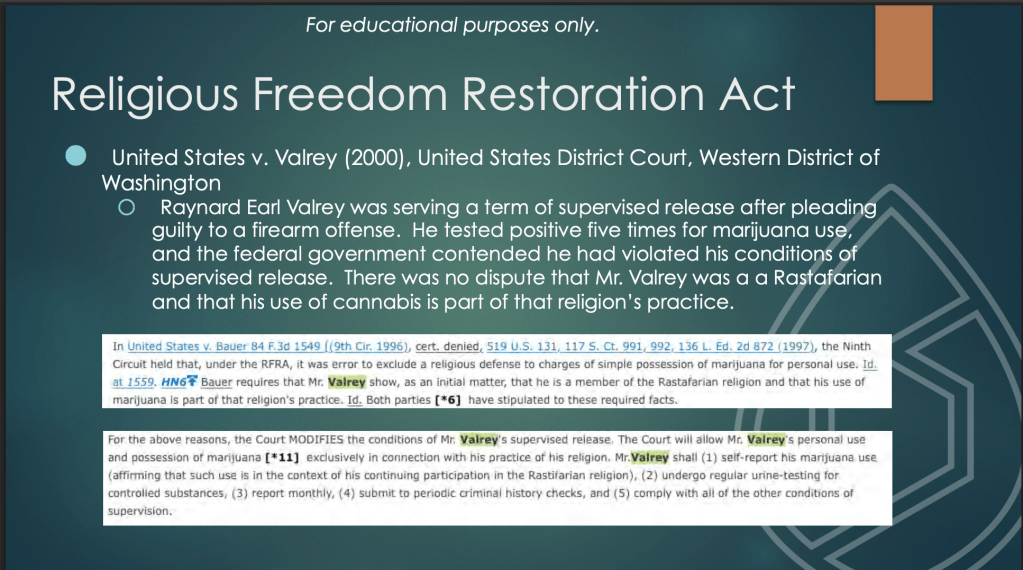
United States v. Valrey (sometimes spelled Valery or Vairey in references, but most commonly cited as Valrey), decided on February 22, 2000, by the U.S. District Court for the Western District of Washington (case number CR96-549Z or similar). It’s an unpublished district court opinion (2000 WL 692647), meaning it’s not in the official Federal Reporter series but is available via legal databases like Westlaw or Lexis.
Key Details from the Case
• Defendant: Raynard (or Raynard Earl) Valrey, a practicing Rastafarian on federal supervised release (probation/parole equivalent after prison) following a guilty plea to a firearm offense.
• Issue: He repeatedly tested positive for marijuana use (five times noted). The government sought to revoke his supervised release for violating the standard no-controlled-substances condition.
• Religious Claim: There was no dispute that Valrey was a sincere Rastafarian and that his personal use and possession of marijuana (cannabis/ganja) was part of his religion’s practices—as a sacrament for spiritual connection, meditation, and reasoning with Jah (God).
• Legal Basis: Valrey invoked the Religious Freedom Restoration Act (RFRA), 42 U.S.C. §§ 2000bb et seq., which requires the government to show a compelling interest and least restrictive means when substantially burdening sincere religious exercise (post-Employment Division v. Smith fix for federal actions).
• Court’s Reliance on Precedent: The court cited United States v. Bauer, 84 F.3d 1549 (9th Cir. 1996), cert. denied (1997), where the Ninth Circuit held that excluding a religious defense to simple marijuana possession violated RFRA. Bauer required showing membership in the religion and that use is part of its practice—both stipulated here.
• Ruling: The district court modified (not revoked) the conditions of supervised release instead of incarcerating him. It allowed personal use and possession of marijuana exclusively for religious purposes, with strict safeguards:
1. Self-report marijuana use, affirming it’s tied to Rastafarian practice.
2. Regular urine testing for other controlled substances.
3. Monthly reporting.
4. Periodic criminal history checks.
5. Compliance with all other supervision terms.
• Outcome: This created a narrow, court-supervised religious exemption for his ongoing supervised release—no blanket free pass, but accommodation under RFRA rather than revocation.
Context and Rarity
This is one of the very few (if not the only prominent) federal cases where a court granted a religious exemption for Rastafarian marijuana use on supervised release. Most similar federal probation/revocation challenges fail (e.g., United States v. Israel, 317 F.3d 768 (7th Cir. 2003), where the 7th Circuit upheld revocation despite sincere beliefs, citing administrative burdens and uniform enforcement). Courts often distinguish Rastafarian cannabis claims from peyote (Native American Church) or ayahuasca (UDV/Santo Daime) due to scale, federal scheduling, and lack of the same “indigenous” historical/cultural entrenchment.
The Valrey ruling stayed at the district level (no appeal noted in records), so it’s persuasive but not binding precedent elsewhere. It gets cited in later cases (e.g., United States v. Jefferson, 175 F. Supp. 2d 1123 (N.D. Ind. 2001); discussions in RFRA analyses) as an example of successful RFRA accommodation in the supervised release context
 WeedPress: The Paper Trail
Leave a comment