South Dakota DOH Avoids the Merits on Cannabis Scheduling, Hides Behind Procedure
The Department of Health did not defend cannabis Schedule I status on the merits. It said Jason Karimi used the wrong procedural vehicle, declined to resolve the statutory conflict, and left the core contradiction untouched.
By Jason Karimi | WeedPress
March 19, 2026
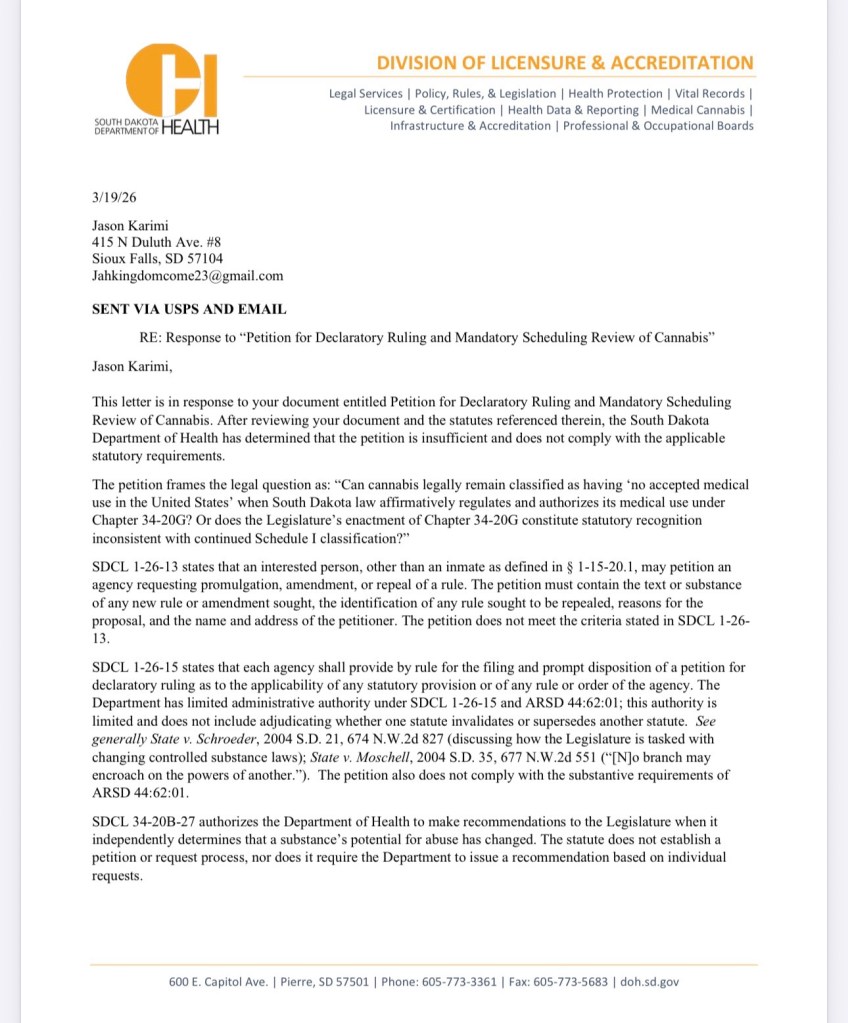
The Department did not engage the core merits argument. Instead, it rejected the filing on procedural / authority grounds:
What they said, in plain English:
They say my petition was insufficient because it did not satisfy the requirements for a rulemaking petition under SDCL 1-26-13. Specifically, they say that statute requires the text or substance of a proposed new rule, amendment, or repeal, and they say this filing did not do that.
They also say the Department’s declaratory-ruling authority is limited and does not include deciding whether one statute overrides or invalidates another statute. In other words, they are saying: “we are not the body that gets to decide whether the medical-cannabis law conflicts with continued Schedule I status.”
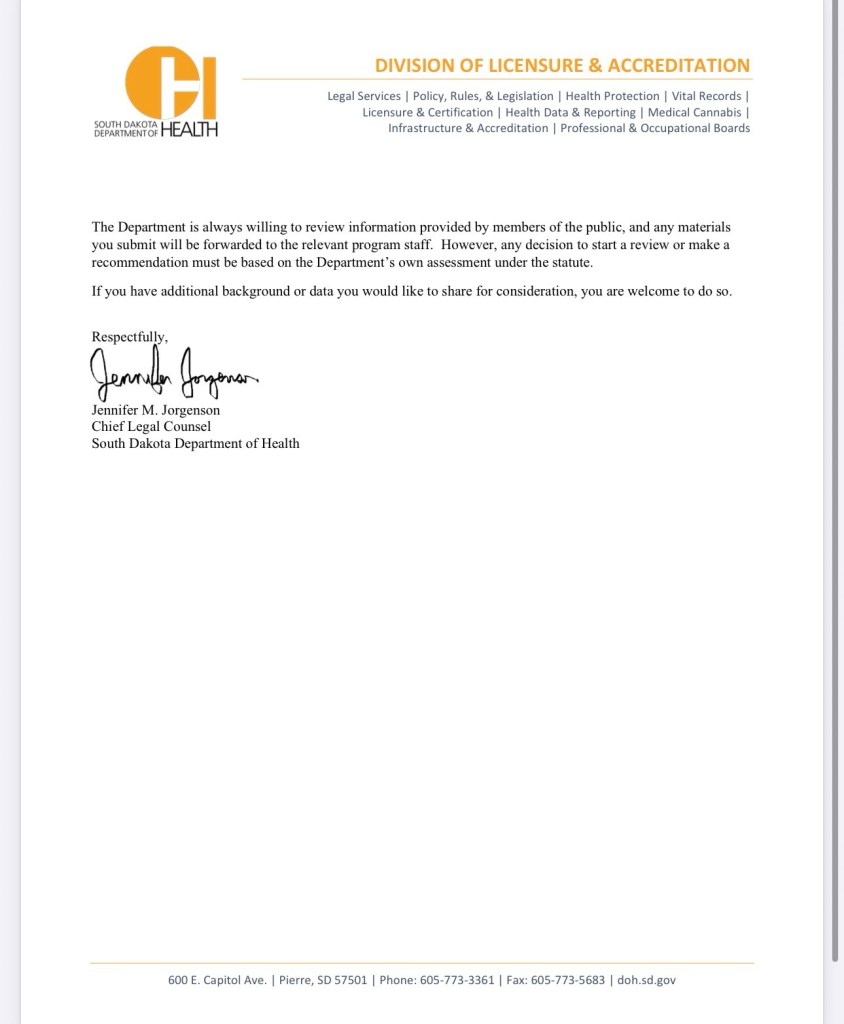
And on SDCL 34-20B-27, they take the position that the statute lets the Department make recommendations to the Legislature when the Department itself independently determines abuse potential has changed, but that the law does not create a mandatory petition process forcing them to act on a citizen request.
So what this means:
My petition was not denied on the scientific or logical merits of the cannabis-scheduling argument. It was denied because the Department says:
1. I used the wrong procedural vehicle,
2. I did not package it in the format they think 1-26-13 requires, and
3. They lack authority to decide the statutory-conflict question WeedPress framed.
That is actually important, because the original petition squarely asked them to decide whether cannabis can remain Schedule I when South Dakota affirmatively regulates medical use, and to issue a final ruling subject to review. Their response avoids that merits question and instead narrows the fight to agency power and procedure.
My read of the letter:
It is not a humiliating loss. It is more like a bureaucratic sidestep.
Their strongest points are:
• The WeedPress filing blended rulemaking petition, declaratory ruling, and mandatory review demand into one document;
• 1-26-13 usually wants an actual proposed rule text or amendment substance;
• 34-20B-27, as quoted in the WeedPress petition, triggers when the department determines a change, which gives them room to say the statute does not compel a citizen-driven review.
The strongest counters are:
• The Department issued a written response within the 30-day period, which helps show there was a real agency disposition; compare your petition’s reliance on SDCL 1-26-13 and final-action language with their written denial
• They did not say my substantive medical-use theory was wrong;
• They effectively admitted they are choosing not to initiate the review process based on WeedPress’s submission, while inviting “additional background or data.”
Best strategic read:
This letter sets up two cleaner lanes going forward.
Lane 1: Refile narrowly as a true rulemaking petition.
Give them exactly what they said was missing: the proposed text or substance of the rule change. Their letter specifically faults that omission.
Lane 2: Treat this as a refusal to exercise authority and move toward judicial review / mandamus-style theories, depending on South Dakota procedure.
That would be the argument that the agency cannot hide behind “limited authority” while administering a medical cannabis regime and simultaneously refusing to confront whether the statutory scheduling criteria are still met. Your Exhibit D is built exactly to show the Department itself recognizes and administers medical use.
One caution: this petition leaned heavily on the idea that the Department had a mandatory duty to recommend rescheduling once circumstances changed. The Department’s reply attacks that premise directly by saying the statute creates no public petition mechanism and leaves the trigger to the Department’s own assessment. That is probably the main legal battleground now.
Also, one thing to tighten later: Exhibit E appears to rely on an executive order and framing that would need careful verification before using it aggressively in court, because if that citation is off, the state would use it to portray the whole submission as sloppy.
Bottom line:
The response means “we refuse to decide this in the form you presented it”, not “your cannabis argument is wrong.”
That is frustrating, but it also clarifies the next fight:
• either force the issue with a cleaner procedural vehicle, or
• use this denial as evidence that the agency is ducking the merits of a serious statutory inconsistency
To Judicial Review Or Not Judicial Review, That Is The Question
I would lean toward preserving judicial review first, not refiling first. The big reason is timing: if this letter is treated as an appealable agency disposition, South Dakota’s APA appeal window is generally 30 days after service of the final decision, and stays are tied to an even shorter 10-day window.
Why I lean that way:
The best hook for review is that SDCL 1-26-15 says a ruling disposing of a declaratory-ruling petition has “the same status as an agency decision or order in a contested case.” My filing expressly asked for a declaratory ruling / final agency ruling, and the Department issued a written response refusing to decide the merits on authority/procedure grounds.
The risk of refiling first is that I may accidentally let the review deadline expire while trying to “fix” the petition. Once that deadline passes, the Department can argue I chose a new administrative path instead of challenging the denial already issued. I cannot say for certain a court would accept that argument, but it is a real litigation-risk concern. The 30-day appeal timing rule is the part I would treat as the danger clock.
That said, judicial review is not a layup. The Department will likely argue this was not a proper contested case or final reviewable decision under chapter 1-26, and that my filing was really just a defective rulemaking request under SDCL 1-26-13, which requires the text or substance of the proposed rule. Their letter already tees that up.
So the practical answer is:
Yes — if choosing between refiling or judicial review, judicial review comes first.
Not because it is guaranteed to win, but because it preserves the harder-edged path while the deadline is live. Refiling can usually still be done later in a cleaner form; a missed review deadline usually cannot be fixed.
My strategic ranking would be:
1. Preserve review now while still inside the window.
2. Then prepare a clean refile that gives them exactly what 1-26-13 asks for: proposed rule text / amendment substance.
3. In the review petition, emphasize that the Department did not reject the merits; it disclaimed authority and refused to act despite administering the medical-cannabis scheme.
4. In the refile, drop the blended format and make it a narrow, surgical rulemaking petition.
The one caveat: because the Department can argue lack of appellate jurisdiction, this is one of those moments where a South Dakota administrative-law lawyer could add real value fast. But on pure strategy, I would not let the judicial-review clock expire.
Time to send this to some attorneys and see what they think?
*********
The main practical risk is missing the appeal window if the March 19, 2026 letter is reviewable, because South Dakota administrative appeals generally must be served and filed within 30 days.
1) Core issue
The issue is whether the Department’s March 19 letter is an appealable disposition of this petition under SDCL 1-26-15, or instead just a nonappealable refusal to entertain a defective request. My petition expressly invoked SDCL 1-26-15, asked for a declaratory ruling, and requested a final written determination subject to judicial review. The Department responded in writing, rejected the petition as “insufficient,” said it lacked authority to resolve the statutory-conflict question, and refused to treat SDCL 34-20B-27 as creating a citizen-triggered mandatory process.
2) Jurisdiction theory
My lead jurisdiction theory is:
This was a petition for declaratory ruling under SDCL 1-26-15, and the Department’s written denial was a “ruling disposing of a petition,” which the statute says has the same status as an agency decision or order in a contested case. SDCL 1-26-15 says exactly that.
That matters because SDCL 1-26-30 gives judicial review rights for final decisions in contested cases, and South Dakota’s Supreme Court has already recognized that agency declaratory-ruling proceedings can be reviewed in circuit court under the APA. In In re Petition for Declaratory Ruling re SDCL 62-1-1(6), the Court held that the Department and the circuit court had jurisdiction to consider the declaratory-ruling petition and the appeal.
My cleanest framing is not “the Department ruled against me on the merits,” but:
The Department issued a final written disposition refusing to decide the petitioned question, and that refusal itself is the reviewable agency action. That tracks the text of 1-26-15 better than trying to force the letter into a merits ruling.
3) Deadline
Under SDCL 1-26-31, an administrative appeal is taken by serving the notice of appeal and filing it in circuit court within 30 days. South Dakota cases repeatedly treat that deadline as mandatory, and failure to comply can destroy appellate jurisdiction.
So the conservative deadline is:
Serve and file no later than April 18, 2026
or, if service rules push the date, use the earliest defensible deadline anyway.
Also, if I want a stay, SDCL 1-26-32 says the application must be made within 10 days of receipt or failure to accept delivery of the agency decision.
4) Venue
The appeal goes to South Dakota circuit court, not federal court, under the South Dakota APA. South Dakota’s appeal statutes place administrative appeals in circuit court, and the venue statute provides county-based venue rules for such appeals.
Practically, the two counties that matter most are:
• Hughes County, because Pierre is the seat of the Department’s principal operations and South Dakota administrative appeals often land there; the Leach declaratory-ruling appeal was in Hughes County.
• Minnehaha County, if the venue statute allows filing where the appellant resides. The venue summary for SDCL 1-26-31.1 indicates county-of-appellant and single-action venue rules exist.
Because venue defects can become procedural ammunition, Hughes County is the safer conservative choice unless I confirm Minnehaha is expressly authorized under 1-26-31.1. Sending this article to attorneys now.
5) Strongest arguments for reviewability
Argument A: The statute itself gives you the hook
The petition was plainly styled and presented as a petition for declaratory ruling under SDCL 1-26-15, and the Department’s letter plainly disposed of it. That is the exact event 1-26-15 describes as having “the same status as an agency decision or order in a contested case.”
Argument B: Leach helps me
In Leach, the South Dakota Supreme Court held that both the agency and the circuit court had jurisdiction to consider a declaratory-ruling petition and its appeal. That case is useful because it rejects the idea that declaratory-ruling review is categorically unavailable just because there is not a classic enforcement hearing or conventional contested case in the background.
Leach case: https://law.justia.com/cases/south-dakota/supreme-court/2016/27463.html
Argument C: The Department actually exercised judgment, not just silence
This was not agency inaction. The Department:
• reviewed the petition,
• identified the legal question Iasked,
• concluded the filing was insufficient under 1-26-13,
• said its authority under 1-26-15 and ARSD 44:62:01 did not reach my question,
• said 34-20B-27 did not create a citizen-forced process,
• and invited more background or data later.
That reads like a completed agency disposition, not mere acknowledgment correspondence.
Argument D: The Department’s own rules support the existence of a petition-and-ruling process
ARSD 44:62:01:01 provides a form for a Department declaratory-ruling petition, and 44:62:01:02 says the Department may request more information before issuing a ruling. That helps me argue the agency had a real petition channel available and chose to resolve my filing by denial rather than by requesting clarification.
6) Best merits-adjacent arguments inside the review petition
The WeedPress initiated review petition does not need to prove cannabis must be rescheduled tomorrow. It needs to show the Department’s refusal is reviewable and legally flawed.
Your strongest points are:
First: the Department did not say WeedPress’s substantive theory was wrong. It refused to answer it because it said my filing mixed vehicles and exceeded its authority. That supports a remand theory: the court should require the agency to properly entertain or more clearly rule on the declaratory-ruling request.
Second: my petition asked for interpretation of statutory criteria the Department administers, including whether cannabis can still satisfy Schedule I criteria under SDCL 34-20B-11 given South Dakota’s medical-cannabis regime and the Department’s own role in administering that regime.
Third: even if the Department was right that this filing was not a proper rulemaking petition under SDCL 1-26-13, that does not fully answer the separate declaratory-ruling request under 1-26-15. My appeal can argue the agency improperly collapsed those two tracks together.
7) Biggest obstacles the State will raise
I should expect these hard counterarguments:
Obstacle 1: not a real contested case / no appealable order.
The State will likely argue this looks more like the nonappealable refusal letter in cases like Petersen, where the Court held a later refusal to reopen was not a final decision in a contested case.
My likely answer: Petersen involved a later refusal to revisit an already completed parole determination, not a formal statutory declaratory-ruling petition governed by 1-26-15. Your case is closer to Leach because you invoked the declaratory-ruling mechanism directly.
Peterson case: https://law.justia.com/cases/south-dakota/supreme-court/2018/28449.html
Obstacle 2: defective petition under agency rule.
They will say my petition did not conform to ARSD 44:62:01:01 and improperly demanded resolution of whether one statute supersedes another.
My likely answer: even if imperfect, the Department still disposed of it in writing, which is what makes the denial reviewable; and its own rule allowed it to request more information rather than simply shut the door.
Obstacle 3: 34-20B-27 is discretionary until the Department determines change.
They will argue the statute does not let a private petitioner compel initiation of the recommendation process. The letter says that directly.
My likely answer: that may defeat a direct command to recommend rescheduling, but it does not necessarily defeat my narrower claim that the Department had to properly address the declaratory-ruling request about statutory applicability and its own authority.
8) What the notice of appeal / petition should aim to ask for
The most realistic ask is:
• a ruling that the March 19 letter is reviewable agency action;
• reversal of the Department’s refusal to entertain the declaratory-ruling request as framed;
• remand directing the Department to process the declaratory-ruling petition under the correct standard, or to issue a legally adequate ruling that cleanly separates the 1-26-15 question from the 1-26-13 rulemaking question.
That is cleaner than asking the circuit court to immediately order cannabis rescheduled.
9) Best practical path
My strongest strategic recommendation is:
File to preserve judicial review now, then refile separately later if I want a cleaner 1-26-13 rulemaking petition. South Dakota cases are unforgiving about appeal deadlines and service requirements. Missing the administrative appeal deadline is the biggest self-inflicted risk on this board.
The refile can fix what the Department said was missing:
• actual proposed rule text or amendment substance under 1-26-13,
• a cleaner ARSD 44:62:01:01 declaratory-ruling format,
• and removal of weaker material that could distract from the core issue.
10) Bottom line
My opinion: this request and review theory is not frivolous. The strongest hook is statutory: SDCL 1-26-15 says a ruling disposing of a declaratory-ruling petition has the same status as an agency decision or order in a contested case, and Leach confirms South Dakota courts can review that kind of agency ruling.
All of this article opinion is subject to change after I speak with attorneys. I am not a lawyer, and nothing on my blog is legal advice.
South Dakota Departs from the Federal and Uniform Scheduling Model
The federal Controlled Substances Act preserves a meaningful administrative mechanism for challenging outdated scheduling decisions. Under 21 U.S.C. § 811(a), proceedings to add, transfer, or remove a substance may be initiated by the Attorney General, at the request of the Secretary of Health and Human Services, or “on the petition of any interested party.” The same subsection requires rulemaking on the record after an opportunity for a hearing. And 21 U.S.C. § 877 provides judicial review for any person aggrieved by a final decision of the Attorney General.¹ ²
South Dakota’s statutory scheme is materially narrower. Its Schedule I criteria remain fixed in statute and require a high potential for abuse, “no accepted medical use in the United States,” and a lack of accepted safety for use under medical supervision.³ But South Dakota’s rescheduling provision does not mirror the federal petition model. Instead, SDCL 34-20B-27 provides that the Department “shall make recommendations to the Legislature” only “when the department determines” that a substance has a different potential for abuse.⁴ That language places the trigger inside the Department’s own determination rather than creating an express interested-party right to compel the commencement of a scheduling review proceeding. South Dakota does provide judicial review for final Department determinations under chapter 34-20B, but that is not the same as granting a citizen a statutory right to force reconsideration of an existing schedule classification.⁵ ⁶
This design places South Dakota at odds not only with the federal model but also with more uniform-act-style systems. Iowa law expressly requires its board to make annual recommendations to the General Assembly regarding deletions from or revisions in the schedules and further requires a recommendation when a substance’s abuse potential is not properly reflected by the existing schedules. Iowa also requires the board, when objecting to a federal designation, to publish the reasons for objection and “afford all interested parties an opportunity to be heard.”⁷ Arkansas likewise uses a more dynamic model: Arkansas Code section 5-64-216 provides that the Secretary of the Department of Health “shall revise and republish the schedules annually.”⁸
Accordingly, South Dakota’s framework is not merely different in form; it is narrower in operation. Federal law preserves a petition-hearing-review pathway. Iowa preserves an annual review-and-recommendation model with hearing rights tied to federal scheduling objections. Arkansas preserves annual revision and republication. South Dakota, by contrast, appears to center rescheduling on departmental self-initiation and legislative follow-through, without an equally clear citizen right to force administrative reconsideration of an allegedly obsolete classification.¹ ⁴ ⁷ ⁸
That structural difference matters sharply in the cannabis context. South Dakota now maintains a medical cannabis statutory regime in chapter 34-20G while its Schedule I statute still defines Schedule I substances as having “no accepted medical use in the United States.”³ ⁹ Whether or not that contradiction ultimately compels rescheduling as a matter of law, South Dakota’s statutory framework offers a weaker and less reviewable mechanism for citizens seeking administrative reconsideration than the federal scheme and other state models discussed above.³ ⁴ ⁵ ⁷ ⁸
Footnotes
¹ 21 U.S.C. § 811(a) (proceedings may be initiated by the Attorney General, at the request of the Secretary, or “on the petition of any interested party”; rules made on the record after opportunity for a hearing).
² 21 U.S.C. § 877 (any person aggrieved by a final decision of the Attorney General may obtain review in the appropriate United States Court of Appeals within thirty days after notice of the decision).
³ S.D. Codified Laws § 34-20B-11 (Schedule I criteria: high potential for abuse, no accepted medical use in the United States, and lack of accepted safety under medical supervision). This exact language is also quoted in WeedPress DOH petition materials.
⁴ S.D. Codified Laws § 34-20B-27 (“The department shall make recommendations to the Legislature … when the department determines that such substance has a different potential for abuse.”). This language is also reflected in the WeedPress petition and the Department’s response.
⁵ S.D. Codified Laws § 34-20B-92 (providing judicial review of final determinations, findings, and conclusions of the Department under chapter 34-20B). The Department’s letter takes the position that no citizen-triggered petition process exists under § 34-20B-27.
⁶ See S.D. Codified Laws § 1-26-15 (declaratory-ruling mechanism under the South Dakota APA). The WeedPress filed petition expressly invoked that statute, but the Department answered on limited-authority grounds rather than reaching the scheduling merits.
⁷ Iowa Code § 124.201(1), (2), (4) (board must annually recommend schedule revisions; must recommend changes when current schedules do not properly reflect abuse potential; when objecting to a federal designation, board must publish reasons and afford interested parties an opportunity to be heard). https://www.legis.iowa.gov/docs/code/124.201.pdf
⁸ Ark. Code Ann. § 5-64-216 (2024) (“The Secretary of the Department of Health shall revise and republish the schedules annually.”). https://law.justia.com/codes/arkansas/title-5/subtitle-6/chapter-64/subchapter-2/section-5-64-216/
⁹ See S.D. Codified Laws ch. 34-20G (South Dakota medical cannabis framework). My Exhibit D documents the Department’s administration of the medical-cannabis program.
 WeedPress: The Paper Trail
Leave a comment