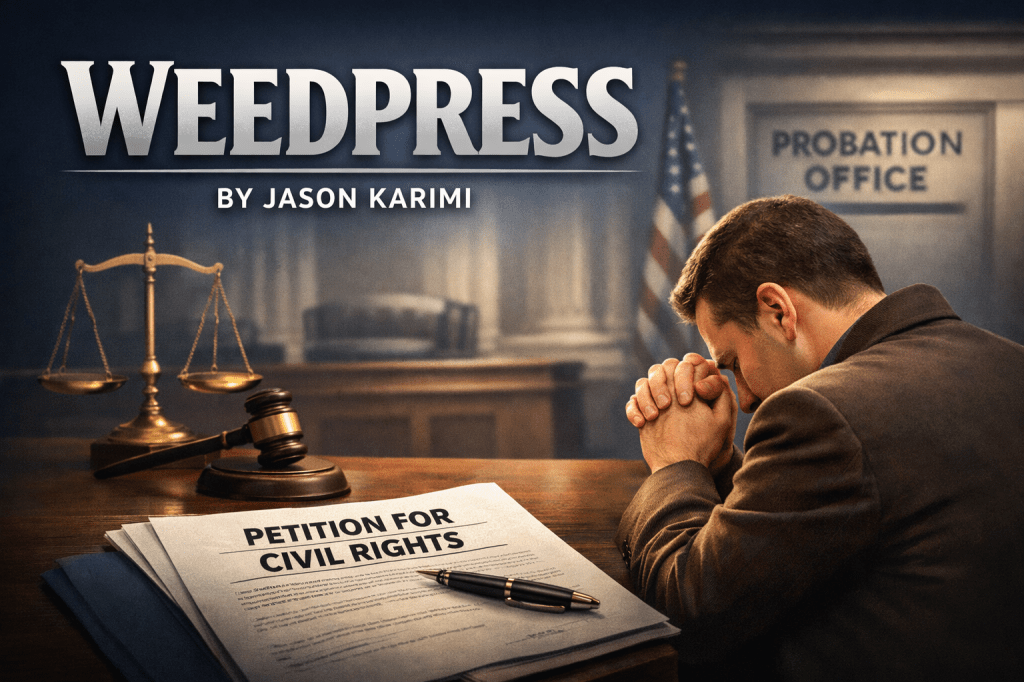
Today’s Probation Meeting Matters More Than It Looks
Today’s meeting with probation may end up being one of the most important timeline entries in this entire case.
At the meeting, my probation officer indicated that he had been planning to administer a UA. But once the pending religious evidentiary hearing was part of the picture, he decided not to do it. I also handed him my paperwork relating to the case and made clear that, once the evidentiary hearing is over next month, I intend to pursue civil litigation for the damages caused by what happened to me.
That interaction matters.
On the surface, some people may see this as just another routine probation contact. It was not. In the context of an ongoing dispute over religious accommodation, probation conditions, THC testing, and the legality of same-day jailing, this meeting becomes part of the documentary timeline. And in litigation, timeline is everything.
Why this meeting is important
The biggest takeaway from today is that probation did not simply move forward as if nothing were pending.
If a UA was going to happen, and then did not happen because there is now an evidentiary hearing on the religious issue, that suggests the matter is being treated as an active legal dispute rather than a closed question. That does not mean I have won. But it does mean the issue is live, serious, and significant enough to affect probation’s conduct in real time.
That is the kind of fact that matters later.
It matters because one of the recurring themes in probation-related disputes is whether the person under supervision was just refusing to comply, or whether there was a legitimate, unresolved legal and constitutional issue under active consideration. These are very different stories. Today’s meeting supports the second one.
Why documentation matters right now
Every important case eventually becomes a sequence of dates, decisions, statements, and responses.
That is why documentation is so critical. Not vague memory. Not rough impressions. Actual chronology.
Today’s meeting should be documented as precisely as possible:
• the date and approximate time of the meeting,
• where it occurred,
• that the probation officer indicated he had planned to do a UA,
• that he then decided not to do it because the religious hearing is pending,
• that I provided him with paperwork related to the case,
• and that I stated my intent to pursue litigation after the evidentiary hearing.
That kind of record can become useful for multiple reasons. It may help show notice. It may help establish knowledge. It may help demonstrate that probation understood the dispute was active and unresolved. And it may help rebut any later attempt to frame this as simple defiance or concealment.
In cases like this, timeline documentation is not filler. It is evidence architecture.
What this may mean for the hearing
The upcoming evidentiary hearing to amend probation conditions is now even more important.
The hearing is where the issue is supposed to be addressed openly and on the record. If probation is already adjusting its conduct because the hearing is pending, that reinforces the obvious point: this is not a trivial claim. It is serious enough that the system is pausing, recalculating, and waiting for a judicial ruling.
That matters because evidentiary hearings create records. Records create findings. Findings create appellate and civil consequences.
The hearing is not just about next month. It is about what can be proven afterward.
If the court eventually rules on the religious issue after hearing evidence, then the timeline leading up to that ruling matters. What probation knew before the hearing matters. What alternatives existed matters. What actions were or were not taken matters. And whether less restrictive options were considered matters.
Today’s meeting fits directly into that chain.
Why this also matters for future civil claims
Civil claims in this area are never won by broad outrage alone. They depend on specifics: who acted, under what authority, with what notice, with what alternatives available, and with what awareness of the religious claim and legal dispute.
That is why moments like today matter so much.
If probation is acting differently now that a religious hearing is on the calendar, then that becomes part of the larger factual picture. It can help show that the issue was recognized as substantial. It can help show that the dispute was not imaginary or invented after the fact. And it can help show that the system understood there were legal sensitivities surrounding enforcement.
Again, none of that automatically wins a lawsuit. But it is exactly the kind of factual development that serious litigation is built on.
The difference between emotion and record
A lot of people in legal conflicts make the mistake of focusing only on how wrong something feels.
That feeling may be valid. But feelings do not win hearings.
Records do.
Today’s development is important because it adds to the record. It provides another point on the timeline showing that this controversy is real, active, and being treated as such by the people involved. It gives structure to the narrative. It creates a before-and-after contrast. And it makes it harder for others to pretend later that nothing meaningful was in dispute.
That is why I take meetings like this seriously.
Not because every meeting produces a dramatic breakthrough, but because every meeting can produce a useful fact.
What happens next
The immediate focus remains the evidentiary hearing next month.
That hearing is the next major checkpoint. It is where the legal question surrounding amendment of probation conditions, religious exercise, and THC-related enforcement is supposed to be addressed in a formal way. It is where evidence can be weighed and where the court will have to confront the issue directly.
After that, the next phase begins.
For me, that next phase includes evaluating and pursuing civil claims for damages tied to the same-day jailing and the broader conduct surrounding this dispute. But as always, the strongest path forward is not noise. It is disciplined documentation, careful chronology, and a record that speaks for itself.
Today helped build that record.
And that is exactly why it matters.
— Jason Karimi
Isaiah 42
42 Behold my servant, whom I uphold; mine elect, in whom my soul delighteth; I have put my spirit upon him: he shall bring forth judgment to the Gentiles.
2 He shall not cry, nor lift up, nor cause his voice to be heard in the street.
3 A bruised reed shall he not break, and the smoking flax shall he not quench: he shall bring forth judgment unto truth.
4 He shall not fail nor be discouraged, till he have set judgment in the earth: and the isles shall wait for his law.
5 Thus saith God the Lord, he that created the heavens, and stretched them out; he that spread forth the earth, and that which cometh out of it; he that giveth breath unto the people upon it, and spirit to them that walk therein:
6 I the Lord have called thee in righteousness, and will hold thine hand, and will keep thee, and give thee for a covenant of the people, for a light of the Gentiles;
7 To open the blind eyes, to bring out the prisoners from the prison, and them that sit in darkness out of the prison house.
8 I am the Lord: that is my name: and my glory will I not give to another, neither my praise to graven images.
9 Behold, the former things are come to pass, and new things do I declare: before they spring forth I tell you of them.
10 Sing unto the Lord a new song…
 WeedPress: The Paper Trail
Leave a comment