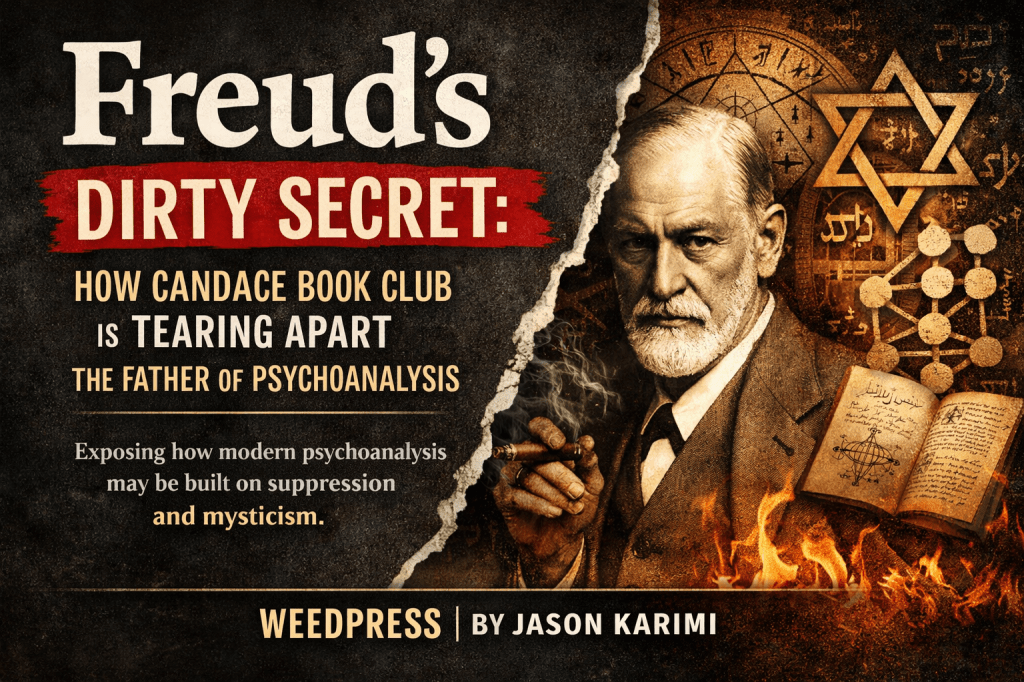
Freud’s Dirty Secret: How Candace Book Club Is Tearing Apart the Father of Psychoanalysis
By Jason Karimi | WeedPress
March 22, 2026
The Assault on Truth and Sigmund Freud and the Jewish Mystical Tradition do not just question Freud’s legacy. They argue that modern psychoanalysis may have been built on suppression, repackaging, and intellectual disguise.
Candace Owens’ book club has spent serious time circling Sigmund Freud from two different angles. On Candace’s forum, The Assault on Truth was presented under the blunt description, “Freud wasn’t the good guy that history likes to paint him,” and forum posts indicate the club then moved on to David Bakan’s Sigmund Freud and the Jewish Mystical Tradition afterward.
That pairing is not random. It is a deliberate one-two punch. The first book attacks Freud as a man and as a builder of modern psychoanalysis. The second attacks the mythology around Freud’s originality by arguing that psychoanalysis did not emerge from neutral modern science alone, but from older religious and mystical ideas that were secularized and repackaged.
What follows is a thorough review of both books in the spirit Candace’s audience has approached them: not as polite academic footnotes, but as books that ask whether one of the most influential thinkers of the modern age was built on suppression, reframing, and intellectual disguise. Still, it is worth saying clearly that these are controversial arguments, not settled consensus; even sympathetic readers acknowledge that Masson and Bakan are making revisionist cases against the standard heroic story of Freud.
Why Candace’s book club landed on Freud
Candace’s forum history makes the sequence pretty clear. The book club centered a category for The Assault on Truth, then users discussed moving into Sigmund Freud and the Jewish Mystical Tradition, with forum posts explicitly saying Candace had finished Masson’s book and was beginning the Freud/Bakan selection next.
That matters because Candace’s framing is not merely literary. It is civilizational. Freud is not just being read as a psychologist. He is being read as an architect of a modern worldview: one that reinterpreted innocence, sexuality, trauma, family, desire, guilt, and religion. That is exactly why these two books fit together so well for her audience. One argues Freud covered up a truth. The other argues Freud translated older mystical concepts into scientific-sounding modern language.
Book One: The Assault on Truth — the case against Freud’s retreat from abuse reality
Jeffrey Moussaieff Masson’s The Assault on Truth: Freud’s Suppression of the Seduction Theory is the more explosive of the two books. Its core claim is that Freud originally took seriously the possibility that some patients’ symptoms were rooted in real childhood sexual abuse, but later abandoned that line of thought and replaced it with theories that relocated the source of conflict into fantasy, infantile desire, and inner psychic drama. Masson presents this not as an innocent development in thought, but as a suppression.
That thesis hits hard because it suggests something bigger than an academic mistake. It suggests that one of the founding turns of modern psychology involved moving attention away from what may have been done to vulnerable people and toward what was allegedly imagined by them. Masson’s case is powerful because it lands on terrain that still matters: whether institutions prefer theories that protect social order over truths that disrupt it.
Candace’s audience was primed to respond to that argument because it fits a broader suspicion of elite narratives. If Freud really stepped back from confronting abuse in respectable families and instead developed theories that made the scandal more bearable to society, then the issue is not just psychoanalysis. The issue is establishment self-protection. That is the emotional and political force of this book club choice.
What makes Masson’s book compelling
The book’s strength is moral clarity. Masson does not write like someone trying to protect the prestige of a profession. He writes like a man accusing a canonized thinker of betrayal. That gives the book urgency. It also explains why it caused such intense controversy when published. The book was treated as a major attack on psychoanalysis, and even many critics admitted it struck a nerve.
Another strength is that Masson had unusual access to Freud archival material through the Sigmund Freud Archives. That access gave his challenge more weight than a casual outsider polemic would have had. He was not simply yelling from outside the building; he was accusing the custodians of the building from inside it.
And most importantly, the book forces readers to confront a real historical tension. Freud is widely remembered for theories like the Oedipus complex, infantile sexuality, repression, and dream symbolism. Britannica still summarizes him as the creator of psychoanalysis and one of the most influential intellectual figures of the modern era. Masson’s challenge is that Freud’s rise may have depended in part on turning away from unpleasant external realities and toward internally generated explanatory myths.
Where Masson is strongest — and where he is weakest
Masson is strongest when he makes readers doubt the clean textbook story of Freud’s intellectual development. Once that doubt enters, Freud stops looking like a neutral scientist calmly following evidence and starts looking like a theorist navigating social and institutional pressures.
But Masson is weaker when he seems to imply that exposing Freud’s retreat automatically validates every element of the earlier seduction theory. Critics argued that Masson sometimes overstated his case, misrepresented aspects of Freud’s record, or treated actual abuse as a near-total explanatory key for hysteria and neurosis. The reception was mixed, not universally affirming.
That does not destroy the book. It just means the book should be read as an insurgent brief, not as the final word. And honestly, that is part of why it works in Candace’s orbit. It is not a safe, credentialed summary. It is a challenge text. It asks whether modern elites built a huge portion of therapeutic culture on a strategic retreat from ugly truth.
Weedpress verdict on The Assault on Truth
This is the more important of the two books if the question is power. It directly attacks the founding legitimacy of Freud’s system. It is readable, provocative, and morally serious. Even where it overreaches, it overreaches in a way that opens necessary questions. A reader can finish Masson without agreeing with every conclusion and still feel that the official Freud story has been permanently destabilized.
Book Two: Sigmund Freud and the Jewish Mystical Tradition — the case that Freud secularized older esoteric ideas
If Masson says Freud suppressed one truth, David Bakan says Freud concealed another origin story. Bakan’s book advances the premise that Freudian psychoanalytic theory is deeply rooted in Jewish religion, especially Kabbalistic or mystical traditions, rather than being wholly new and wholly scientific. Dover’s description of the book states this premise plainly, and Bakan himself wrote elsewhere that concepts in the Zohar strongly suggest links to psychoanalytic ideas, including themes of bisexuality and sexuality.
This is the more difficult and speculative book of the pair, but it may be the more radical one in long-range cultural terms. If Bakan is even partly right, then Freud did not merely invent a modern science of the unconscious. He translated inherited metaphysical and mystical patterns into a secular intellectual system that modern people would treat as science.
That helps explain why Candace’s club appears to have read Bakan after Masson. Once The Assault on Truth weakens faith in Freud’s moral and clinical honesty, Bakan invites readers to ask a second question: if Freud was not telling the whole truth, where did his system really come from?
What Bakan is arguing
Bakan’s basic move is not to deny Freud’s brilliance. It is to relocate it. Freud’s “technical genius,” on this reading, lies less in discovering timeless psychological truths from scratch and more in repackaging themes that had older roots in Jewish interpretive and mystical traditions. Retail and library summaries of the book consistently emphasize this point: Freud’s heritage and surrounding intellectual environment may have influenced the structure of psychoanalysis more than the standard secular biography admits.
This argument is fascinating because Freud presented psychoanalysis with the prestige language of modern inquiry. Yet Bakan asks readers to see behind that language and notice parallels with religious symbolism, esoteric anthropology, hidden meanings, and layered interpretation. In plain English: Freud may have looked like a doctor of the modern mind while functioning partly like a translator of older sacred or mystical systems into modern therapeutic form.
For a Candace-style audience, that is catnip. It turns Freud from scientist into cultural alchemist. It also fits the broader instinct that much of what modernity markets as neutral expertise is often inherited dogma wearing a lab coat. That is not a quotation from Candace. It is the interpretive frame her forum’s Freud interest naturally points toward.
What makes Bakan’s book valuable
Bakan’s biggest strength is that he widens the debate. Freud is too often argued over only on clinical grounds: Did the Oedipus complex hold up? Was dream analysis valid? Was repression real? Bakan says those are not the only questions. We should also ask where Freud’s categories came from, why they took the shape they did, and whether their structure owes more to tradition than moderns admit.
That makes the book intellectually rich. It encourages readers to look at psychoanalysis not just as medicine or psychology, but as a symbolic system. In that sense, it can actually explain why Freud’s ideas had such enormous cultural staying power. A system does not dominate the modern imagination for generations merely because it is clinically useful. Sometimes it dominates because it functions like a mythic grammar.
Where Bakan is vulnerable
The weakness of Bakan’s book is that it is easier to admire than to prove. Intellectual influence, symbolic resemblance, and cultural inheritance are tricky things to demonstrate with absolute certainty. Similarities between psychoanalysis and mystical tradition can be suggestive without being conclusive. That is why even sympathetic readers tend to describe the book as an argument or premise rather than as settled demonstration.
There is also a risk that readers come away thinking Freud is “explained away” entirely by hidden tradition. That would be too simple. Freud still built a system that reshaped psychiatry, literary criticism, education, and popular culture. Britannica’s treatment of him as a towering twentieth-century intellectual figure is not accidental. The question is not whether Freud mattered. The question is what, exactly, he was doing when he made his system.
Weedpress verdict on Sigmund Freud and the Jewish Mystical Tradition
This is the more ambitious and less immediately accessible book. It does not have Masson’s courtroom drama. But it may have greater explanatory power for readers who suspect modernity often disguises inherited metaphysics as science. It is best read not as a takedown on its own, but as a decoder text after Masson has already cracked Freud’s halo.
How the two books work together
Read together, these books do something more interesting than simply say “Freud was wrong.” They suggest a fuller indictment.
Masson’s book says Freud may have diverted attention away from real harms and recast them into inner fantasy. Bakan’s book says Freud’s supposedly modern system may itself have been a reframing of older mystical patterns. Put those together and Freud begins to look less like the fearless discoverer of psychological truth and more like a powerful interpreter who redirected, translated, and systematized reality in ways that served the needs of modern intellectual culture.
That synthesis is probably the deepest reason Candace’s book club went here. These are not random contrarian books. They are books about how authority is manufactured. Who gets to define truth? Who gets to rename trauma? Who gets to convert inherited metaphysics into scientific legitimacy? And what happens when entire generations accept those translations as objective fact?
Final assessment
Candace’s book club deserves credit for choosing books that do more than flatter the reader. These selections push directly into one of the central factories of twentieth-century elite thought. Based on the public forum framing, Candace’s club approached Freud not as an untouchable genius, but as a figure whose legacy should be interrogated hard. That framing is fair.
The Assault on Truth is the sharper blade. It is more dramatic, more concrete, and more morally forceful. It leaves readers asking whether psychoanalysis was born through a refusal to face social evil honestly.
Sigmund Freud and the Jewish Mystical Tradition is the deeper tunnel. It asks whether psychoanalysis was ever what it claimed to be in the first place. It leaves readers asking whether modern intellectual systems are often disguised inheritances rather than original discoveries.
Taken together, the books form a coherent Candace-style critique: Freud may have been less a doctor uncovering the mind than a mythmaker recoding truth, trauma, desire, and authority for the modern age. Whether readers accept all of that or not, one thing is certain: after reading these two books, it becomes much harder to look at Freud as just the harmless old father of psychology from the textbooks.
 WeedPress: The Paper Trail
Leave a comment