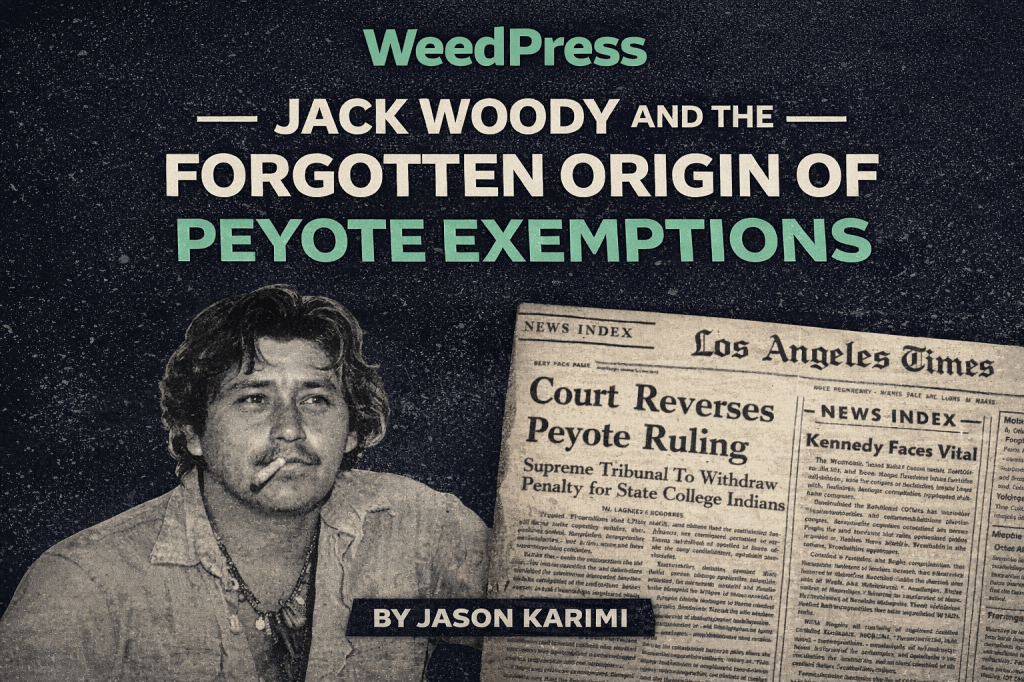
Jack Woody and the Forgotten Origin of Peyote Exemptions
By Jason Karimi | WeedPress
March 23, 2026
Before peyote exemptions were narrowed into modern statutory categories, the issue was simpler: people were being prosecuted for practicing their religion.
That is what People v. Woody was about. In 1964, the California Supreme Court reversed peyote convictions arising from a Native American religious ceremony. The case matters because it shows the original pressure behind peyote protection was not abstract policy or church paperwork. It was criminal prosecution of actual practitioners.
That point is easy to lose today. The origin story did not begin with government generously carving out a privilege for an institution. It began with the state trying to punish sacramental use and a court refusing to let that happen on the record before it. Woody was about believers first.
The 1981 Office of Legal Counsel memo is important for the same reason. OLC said Congress intended to exempt peyote use by the Native American Church and other bona fide peyote-using religions in which peyote use was central to established religious beliefs and practices. OLC also warned that limiting the exemption only to American Indian peyotists might itself raise constitutional problems.
The current federal regulation is narrower. It says Schedule I treatment does not apply to the nondrug use of peyote in bona fide religious ceremonies of the Native American Church. Congress later codified protection in Native-specific terms as well: 42 U.S.C. § 1996a protects the use, possession, and transportation of peyote by an Indian for bona fide traditional ceremonial purposes in connection with a traditional Indian religion. https://www.ecfr.gov/current/title-21/chapter-II/part-1307/subject-group-ECFR68c82f2ca866120/section-1307.31 ; https://uscode.house.gov/view.xhtml?edition=prelim&num=0&req=granuleid%3AUSC-prelim-title42-section1996a
But that broader view is not where the law ultimately settled.
So the history is broader than the law that followed. OLC described a larger principle. The codified federal protection that emerged was narrower and Native-centered. In practice, the legal protection ended up attached to Native American Church ceremonies and to Indians engaged in traditional Indian religious practice, not to “other bona fide religions” as a general rule.
That is what makes Jack Woody worth remembering. The original conflict was human and concrete. People faced criminal punishment for sacramental use, and courts had to confront that directly. Later law did not erase that origin. It formalized it, narrowed it, and confined it.
The forgotten part of the story is that peyote exemptions did not start as a sterile institutional category. They started because criminal law collided with real religious practice — and Jack Woody was one of the people standing at that collision point.
 WeedPress: The Paper Trail
Leave a comment