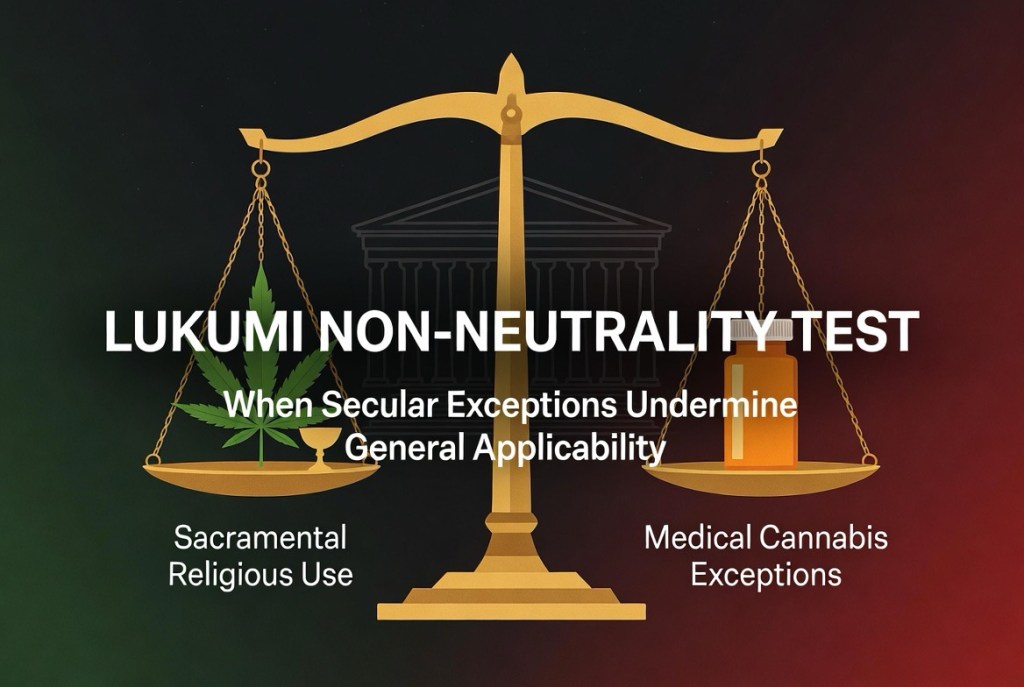
Why Medical Cannabis Programs Usually Don’t Trigger Lukumi Strict Scrutiny
Why take a detour to get to strict scrutiny when you don’t need to? State RFRA may be inferior to a world where Smith is overruled, but in actual cannabis litigation it is usually superior to relying on Smith exceptions alone.
By Jason Karimi | WeedPress
March 23, 2026
The Lukumi non-neutrality (and general-applicability) test is the critical exception to Employment Division v. Smith (1990) that religious litigants invoke when arguing that a state’s cannabis prohibition loses its “neutral and generally applicable” character—and thus triggers constitutional strict scrutiny—because the state has carved out a regulated medical-cannabis program (use, cultivation, sales, physician recommendations). While the argument has surface appeal under Church of the Lukumi Babalu Aye, Inc. v. City of Hialeah, 508 U.S. 520 (1993), it is almost universally rejected in controlled-substance cases precisely because drug laws (unlike the Hialeah ordinances) do not have as their object the suppression of religion and do not create the kind of “religious gerrymander” or selective underinclusion that Lukumi condemned. Below is a precise dissection of the test, its elements, its post-Smith evolution (including Fulton v. City of Philadelphia, 141 S. Ct. 1868 (2021)), and its application to claims.
1. Lukumi Facts and Core Holding (in a Nutshell)
After the Santería church announced plans to move to Hialeah and practice animal sacrifice, the city council passed a series of resolutions and ordinances that (1) expressed “concern” over “ritual” sacrifice, (2) banned the “unnecessary” killing of animals in “ritual or ceremony” (while exempting most food-slaughter, pest control, hunting, and euthanasia), and (3) defined terms to sweep in Santería rites but exclude virtually all secular analogs. The Supreme Court (Kennedy, J.) unanimously struck them down.
Key quote that defines the trigger for strict scrutiny:
“A law failing to satisfy [neutrality and general applicability] must be justified by a compelling governmental interest and must be narrowly tailored to advance that interest. Neutrality and general applicability are interrelated, and failure to satisfy one requirement is a likely indication that the other has not been satisfied.” (508 U.S. at 531–32, citing Smith).
The ordinances failed both prongs because their object was suppression of a religious practice and they imposed burdens only on religiously motivated conduct while leaving secular conduct that caused the same harms (animal cruelty, public-health risks from carcasses) largely untouched.
2. The Two Interrelated Prongs of the Lukumi Test
A. Neutrality (Object or Purpose Inquiry)
A law is non-neutral if “the object of [the] law is to infringe upon or restrict practices because of their religious motivation.” (Id. at 533).
• Start with facial text: Does it refer to religious practice without a secular meaning? Words like “sacrifice” and “ritual” were suggestive but not dispositive (they have secular uses). A law can be facially neutral yet still fail.
• Look beyond face: Legislative history, timing, statements of officials, and the “real operation” of the law. In Lukumi: ordinances passed immediately after the church’s announcement; council minutes dripped with hostility (“these people” practicing “voodoo”); design “gerrymandered” to hit only Santería.
• Key indicators of illicit object: (1) targeting the central element of a religion while leaving other conduct untouched; (2) suppressing more religious conduct than necessary; (3) animus (even “subtle departures from neutrality” or “covert suppression”).
B. General Applicability
Even a facially neutral law fails if it “prohibits religious conduct while permitting secular conduct that undermines the government’s asserted interests in a similar way” (id. at 542) or creates “a mechanism for individualized exemptions” that the government refuses to extend to religious hardship (Smith at 884, amplified in Lukumi and Fulton).
• Underinclusiveness: The city pursued animal-cruelty and health interests only against religious sacrifice, not against kosher slaughter, hunting, or commercial food processing that posed identical risks.
• Selective exemptions: Exemptions for secular reasons (food consumption, licensed establishments) but none for religion showed the law “impose[d] burdens only on conduct motivated by religious belief.” (508 U.S. at 543).
• Fulton clarification (2021): A law is not generally applicable if it contains discretionary “individualized exemptions” (e.g., commissioner could waive anti-discrimination rules at “sole discretion”) or treats comparable secular conduct more favorably. This does not require proving identical secular conduct; the question is whether the government is willing to make case-by-case judgments that could accommodate religion without undermining its interest.
If either prong fails, strict scrutiny applies (compelling interest + least-restrictive means). In Lukumi the ordinances failed both and could not survive.
3. How Courts Apply Lukumi to Controlled-Substance Laws with Medical/Research/Peyote Exceptions
• Object is not religious suppression: Federal and state controlled-substance acts (CSAs) were enacted long before any particular religious claimant appeared, for public-health and abuse-prevention reasons that apply to everyone. No legislative history shows animus toward the Ethiopian Zion Coptic Church or sacramental cannabis. See, e.g., Olsen v. Mukasey, 541 F.3d 827 (8th Cir. 2008) (explicitly rejecting Olsen’s Lukumi claim); U.S. Solicitor General opposition in Olsen v. Holder (No. 08-777) (“Petitioner does not and cannot contend that the ‘object of [the CSA] is to infringe upon or restrict practices because of their religious motivation’—the governing Lukumi standard”).
• Medical exceptions do not create a “religious gerrymander”: Courts uniformly hold that categorical medical/research exemptions (or alcohol/tobacco distinctions) are policy judgments based on “accepted medical use,” not secular analogs that undermine the interest in the same way religious use does. “General applicability does not mean absolute universality. Exceptions do not negate that [drug laws] are generally applicable.” (Olsen 8th Cir.; United States v. Meyers, 95 F.3d 1475 (10th Cir. 1996); Gonzales v. O Centro, 546 U.S. 418 (2006) itself noted the distinction). The peyote exemption for the Native American Church is a narrow religious carve-out created by Congress/DEA, not proof that the baseline prohibition is non-neutral toward other religions.
• No individualized-exemption system: State medical-cannabis programs are structured, physician-driven regulatory regimes, not open-ended “good cause” or commissioner-discretion waivers like Sherbert unemployment or Fulton foster-care contracts. A religious claimant cannot demand automatic extension of the medical track. Post-Fulton, lower courts still treat drug schedules as generally applicable unless the government grants ad-hoc secular waivers while denying religious ones (rare in cannabis cases).
• Underinclusiveness fails: The state’s interest in preventing diversion, abuse, and unregulated distribution is undermined far more by uncontrolled religious/commercial use than by tightly regulated medical channels. Courts credit the distinction (see U.S. v. Christie, 9th Cir. 2016, rejecting Hawaii Cannabis Ministry claim despite medical exceptions).
Result in virtually every reported case: cannabis prohibitions (even with medical programs) remain neutral and generally applicable under Lukumi. Strict scrutiny is triggered only via RFRA (or a state RFRA), not the Constitution.
4. Strategic Bottom Line For Claimants
• Pleading both layers remains essential: Lead with state RFRA (strict scrutiny regardless of neutrality). Plead constitutional claim “in the alternative” invoking Lukumi non-neutrality via medical exceptions + legislative history (if any post-2024 Iowa medical-expansion statements can be spun as hostile). But expect the court to cite the 8th Circuit’s prior Olsen rulings and hold the law is neutral/general.
• Lukumi’s limits as a weapon: The test is powerful against overtly targeted laws (e.g., ordinances passed the day a church announces plans). It is weak against longstanding, uniform drug prohibitions with policy-based carve-outs. Medical exceptions are not “secular conduct that undermines the interest in a similar way”—they are the state’s attempt to balance the interest, not abandon it.
• Potential evolution: If a state dramatically expands medical/recreational access while refusing any religious accommodation (and enacts it with anti-religion rhetoric), a stronger Lukumi argument emerges. But Iowa’s 2024 RFRA already supplies the strict-scrutiny vehicle, making the constitutional detour less necessary.
• Hybrid-rights or equal-protection overlay:
In short, Lukumi is the doctrinal “escape hatch” from Smith‘s rational-basis deference, but it opens only for laws whose design and history scream “we did this to stop that religion.” Medical-cannabis exceptions are treated as ordinary regulatory line-drawing, not the religious gerrymander at issue in Hialeah. That is why constitutional non-neutrality claims have not reportedly succeeded on their own—and why the state RFRA remains the far more potent superior tool in practice. If litigating today, frame the RFRA claim first and use the medical-program facts to attack the “least restrictive means” prong, while preserving the Lukumi argument for appeal or Supreme Court review.
 WeedPress: The Paper Trail
Leave a comment