Editors note: This piece analyzes past campaign strategy using publicly available court records and election results.
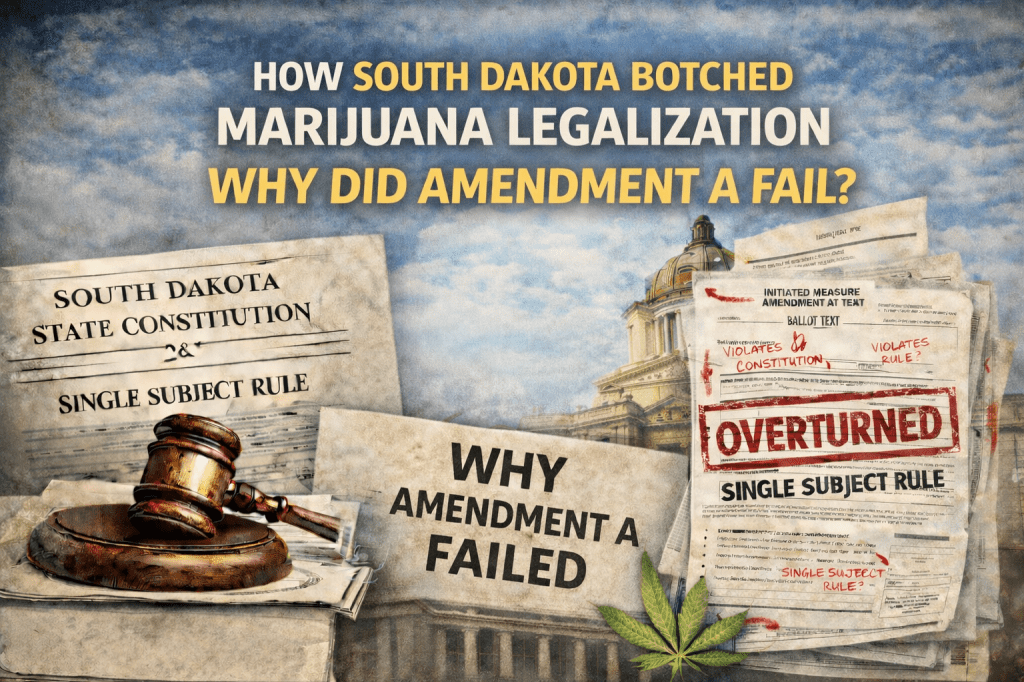
When South Dakota voters approved Constitutional Amendment A in November 2020 to legalize, regulate, and tax marijuana, many supporters saw it as a historic victory for reform. But what followed — a legal challenge and a ruling from the South Dakota Supreme Court — exposed fault lines in strategy and execution that the movement has yet to confront.
What the Court Actually Held
In Thom, Miller v. Barnett, 2021 S.D. 65, the South Dakota Supreme Court upheld a lower court’s ruling that Amendment A violated the state constitution’s single-subject requirement — Article XXIII, § 1 — and therefore could not be submitted to voters in the form it was drafted.
As the Court explained, the 2020 amendment “embraced at least five distinct general subjects” — including recreational marijuana legalization, hemp regulation, medical marijuana access, taxation, and licensing — which meant voters could not choose among them separately.
The Court’s majority opinion stated plainly:
“It is clear that Amendment A contains provisions embracing at least three separate subjects, each with distinct objects or purposes.”
This statement was reported here: https://www.npr.org/2021/11/24/1058884032/south-dakotas-supreme-court-rules-against-legalization-of-recreational-marijuana (retrieved January 18, 2026)
This was not an ideologically charged political rejection. It was constitutional interpretation — the Court was faithfully applying rules voters themselves put into the South Dakota Constitution years earlier.
Misreading the Court Is Not a Strategy
Instead of owning the legal and drafting mistakes, many leaders in the reform movement have blamed the Supreme Court. Headlines and social media posts from proponents portrayed the ruling as judicial activism or an attack on the “will of the voters.” That is a political talking point, not a legal analysis.
Even opponents framed the issue as technical. When the Court’s decision came down, multiple news outlets reported that the measure was struck because it “violated the state’s requirement that constitutional amendments deal with just one subject,” in a rule South Dakotans themselves approved through a 2018 constitutional amendment.
Pointing to a constitutional rule and saying the Court “got it wrong” is not strategy — it’s denial.
A Pattern of Predictable Strategic Missteps
The 2020 setback was not the only warning sign.
In 2022, reform advocates put another recreational legalization initiative before voters — this time a statutory measure in an off-year election with far lower voter turnout than a presidential cycle. South Dakotans rejected that effort at the polls.
Election timing matters. Historically, major ballot initiatives with significant policy change tend to perform better when turnout is high — typically in presidential election years — especially for initiatives that require broad but diffuse support. Attempting a major reform in a low-turnout cycle without the backbone of strong grassroots networks was always going to be an uphill battle.
Then came 2024. After two years in which organizational energy gravitated more toward commercial cannabis operations than rebuilding the grassroots framework that won earlier initiatives, the movement entered the next cycle without a robust activist base. There were fewer local volunteers, fewer active chapters, and less field capacity than was necessary to build sustained voter momentum.
These were not unavoidable misfortunes. They were strategic choices.
Accountability Builds Trust — Excuses Erode It
Movements succeed when leaders are willing to acknowledge flaws, adjust course, and invest in foundational work like network building and legal compliance. They fail when the narrative shifts to blaming external forces instead of examining internal missteps.
If legalization efforts are going to succeed in South Dakota, future campaigns must:
be drafted in strict compliance with constitutional requirements; align campaign timing with broad turnout cycles; rebuild and maintain strong grassroots infrastructure; and prioritize honest messaging over convenient scapegoats.
Blaming the judiciary for following the constitution — a constitution amended by South Dakota voters themselves — is not strategy. It is deflection.
Trust Must Be Earned, Not Assumed
South Dakota voters deserve better than excuses. They deserve leaders who can stand up, take responsibility for missteps, and commit to smart campaign design rooted in law and organization.
The Court didn’t defeat legalization.
Poor strategy did.
And until that reality is acknowledged, future efforts will be just as vulnerable to the same fate.
A Note on Purpose
This critique is not written out of hostility toward any organization or individual. It is written out of concern for the future of cannabis reform in South Dakota. Movements only grow stronger when they are willing to confront hard truths, examine past failures honestly, and change course when the evidence demands it.
Constructive accountability is not the enemy of progress — it is the foundation of it. The goal here is simple: better strategies, better campaigns, and ultimately better outcomes for patients, voters, and advocates. South Dakota can win meaningful reform again, but only if we are willing to learn from what went wrong instead of pretending mistakes never happened.
Sources & Citations
The South Dakota Supreme Court held Amendment A violated the single-subject rule and could not stand. Thom v. Barnett, 2021 S.D. 65.
Amendment A was approved by voters in 2020 but overturned because it combined distinct subjects (recreational legalization, medical access, hemp).
The Court’s majority explained multiple subject areas existed in the amendment, which is prohibited under Article XXIII, § 1.
News outlets reported that the measure failed due to violating the single-subject requirement.
A subsequent recreational measure in 2022 also failed at the ballot box, showing challenges with off-year campaign timing.
 WeedPress: The Paper Trail
Leave a comment