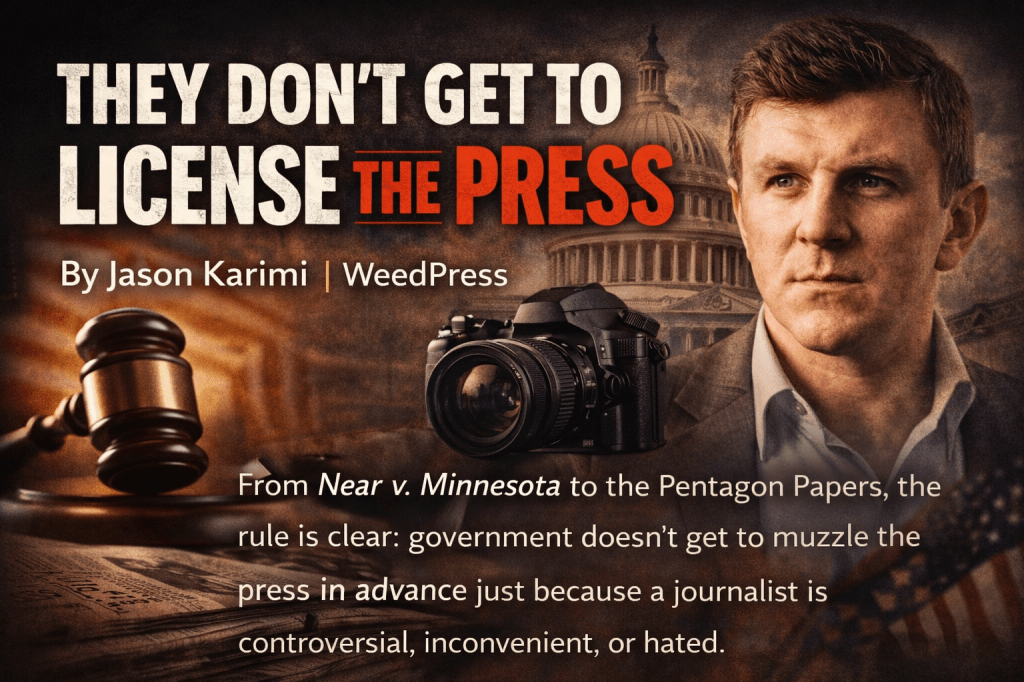
Recent reporting indicates a Florida judge extended a temporary restraining order involving James O’Keefe and also ordered firearm surrender pending further proceedings. Whether that order is a pure First Amendment prior-restraint problem depends on what it actually forbids. If it regulates threats, contact, or violence, that is one thing; if it blocks publication, reporting, or newsgathering in advance, that is another. The prior-restraint cases below are the ones that frame that constitutional line.
They Don’t Get to License the Press
By Jason Karimi | WeedPress
April 1, 2026
There is an old American temptation that never really dies.
Whenever a journalist, publisher, or controversial media figure becomes inconvenient enough, someone in power starts looking for a cleaner word than censorship. They call it “safety.” They call it “order.” They call it “restraint.” They call it a necessary judicial response to an unruly actor.
But the First Amendment is not fooled by euphemisms.
The central question is brutally simple: Is the government punishing unlawful conduct, or is it trying to stop speech before the public can hear it?
If it is the latter, America has already answered.
In Near v. Minnesota, the Supreme Court rejected a state effort to shut down a newspaper in advance because officials considered it scandalous and abusive. That is the original modern rule: government generally does not get to muzzle the press first and litigate later. Prior restraints are presumptively unconstitutional because the whole point of a free press is to prevent official gatekeeping over what reaches the public.
Then came New York Times Co. v. United States, the Pentagon Papers case. The federal government tried to stop publication of leaked documents about the Vietnam War. The Court refused. Why? Because the burden for prior restraint is not “this is embarrassing,” “this is dangerous politically,” or “we really wish this would not come out.” The burden is extraordinarily high, and in that case the government did not come close to meeting it.
And in Nebraska Press Association v. Stuart, the Court drove the point home again: even serious competing interests, including fair-trial concerns, do not magically erase the constitutional hostility to prior restraints. Courts are supposed to exhaust less restrictive alternatives before they start silencing publication.
That is the legal backdrop for the James O’Keefe controversy.
A lot of people are talking past the issue. Some want to defend everything O’Keefe has ever done. Others want to act as if any judicial order touching a reporter or activist automatically becomes a press-freedom apocalypse. Both instincts are lazy.
The real question is narrower and more serious: what exactly is the state trying to control?
If a court is addressing genuine threats, stalking, assault, or unlawful contact, that is not the Pentagon Papers. The First Amendment is not a universal hall pass for criminal conduct. No serious constitutional tradition says otherwise.
But if a court order starts drifting into the terrain of publication bans, source interference, newsroom restrictions, investigative paralysis, or advance suppression of reporting, then the issue changes entirely. Then we are no longer dealing with neutral conduct regulation. We are back in the territory Near warned about and New York Times reaffirmed: the state trying to convert judicial process into prepublication control.
That line matters because censorship in America rarely arrives wearing a sign that says CENSORSHIP.
It arrives wearing a suit.
It arrives with findings, hearings, temporary orders, sealed motions, safety rhetoric, and solemn judicial language. It arrives insisting that this case is unique, this target is irresponsible, this moment is exceptional. It always sounds reasonable for ten minutes—right up until you realize the principle being asserted would let officials shut down disfavored reporting whenever they can package their discomfort as public necessity.
That is why prior restraint doctrine is so unforgiving. It is not based on blind trust in journalists. It is based on deep distrust of government.
And rightly so.
Because the press clause was never written only for respectable institutions with polished anchors and corporate legal departments. It exists for adversarial reporting, oppositional journalism, and the kind of publication that people in power find ugly, unfair, reckless, or infuriating. Rights that protect only approved speakers are not rights. They are permissions.
That is what too many people miss when a controversial figure is involved. Constitutional protections do not become weaker because the speaker is abrasive. If anything, that is when the principle matters most. The First Amendment earns its keep at the margins, not in the easy cases.
So no, the government does not get to create a backdoor licensing regime for journalism through restraining-order practice. A judge does not become a newsroom manager because a publisher makes the establishment nervous. And courts should be very careful not to let “safety” become the all-purpose solvent that dissolves the old rule against previous restraints.
The better rule is the old rule.
Punish actual crimes after proving them.
Allow civil suits where the law truly permits them.
Require precision.
Demand evidence.
Use narrow tools for real misconduct.
But do not tell the public that judges may decide in advance what may be reported, investigated, aired, or published.
That is not constitutional government. That is official supervision of speech.
Near said the state may not shut down publication because it despises the publisher.
The Pentagon Papers said the government carries a crushing burden when it seeks to stop publication before the fact.
Nebraska Press said prior restraints remain the most serious and least tolerable infringement on First Amendment rights.
That is still the rule.
And if courts forget it just because the target is polarizing, then they are not preserving constitutional order. They are teaching the public that press freedom is conditional on establishment approval.
Once that lesson takes hold, every newsroom is on borrowed time.
 WeedPress: The Paper Trail
Leave a comment