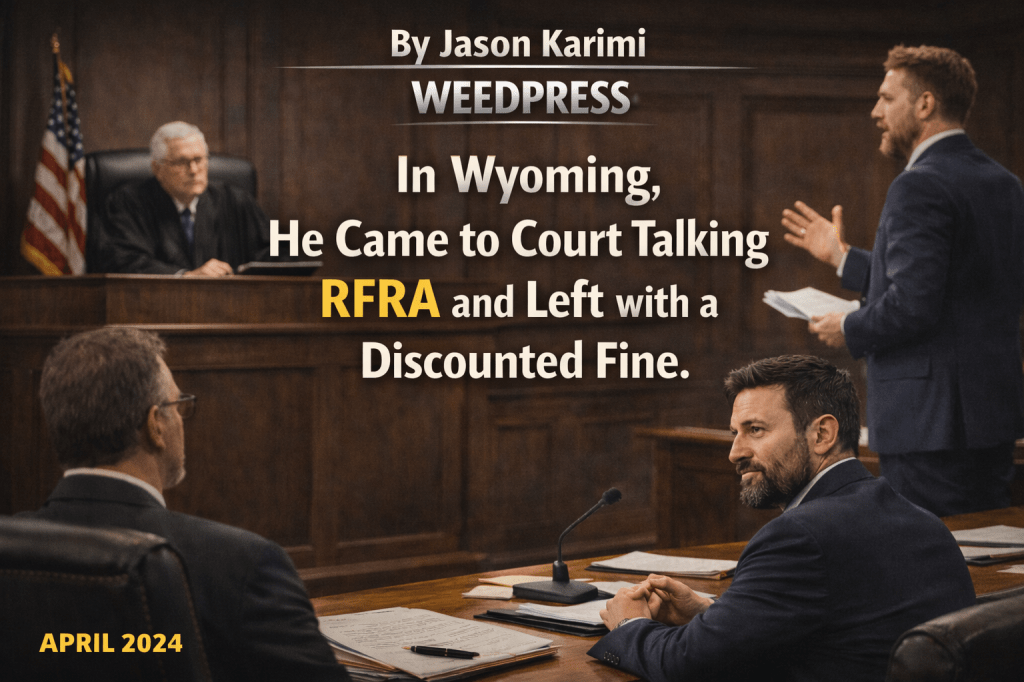
In Wyoming, He Came To Court Talking RFRA And Left With A Discounted Fine
If you do not know the four-part religious-freedom test before you walk into court, do not expect the court to save you from your own lack of preparation.
By Jason Karimi | WeedPress
April 9, 2026
A Wyoming cannabis case recently delivered a brutal but useful lesson: religious freedom is not a costume you put on in the courtroom. It is not a slogan. It is not a panic button. And it is definitely not something you can bluff your way through once the judge starts asking questions.
In this case, a man facing a simple marijuana-possession citation and a $500 fine appeared ready to frame the matter as a religious-freedom issue under RFRA. On paper, that sounds serious. In practice, it went nowhere. He came in unprepared, acted non-credible, visibly panicked, shrugged through key moments, and failed to project command of the law he was supposedly there to invoke. Then, after the hearing exposed the weakness of the effort, the state offered to cut the fine in half. He accepted $250 and walked away.
That is not a religious-liberty win. That is a discounted surrender.
And the lesson matters far beyond one ticket.
Too many cannabis people think rights arguments work by emotional force alone. They think if they say “religion” loudly enough, or invoke RFRA as if it were a magic shield, the court will do the rest. That is fantasy. Courts do not reward vague passion. Courts reward structure, composure, credibility, and command of doctrine. If you want to raise religious freedom in a cannabis case, you need to know the legal machinery cold…before you ever step into the room.
That means understanding the actual RFRA framework. Not your human error prone lawyer…you need to understand it better than all the lawyers in the country. It’s your ass on the line, not theirs, and the system hates you.
Proceed appropriately.
At bottom, the structure is simple enough to memorize and serious enough to decide the case. First, you must establish a sincere religious exercise. Second, you must show that the government action substantially burdens that exercise. Then the burden shifts to the state. Third, the government must show a compelling interest. Fourth, it must show that what it is doing is the least restrictive means of advancing that interest.
That is the fight. That is the terrain. That is the test.
If you do not know that framework well enough to explain it under pressure, you are not ready. If you cannot calmly connect your facts to each part of that structure, you are not ready. If your body language screams uncertainty and your answers sound improvised, you are not pressing a rights claim. You are volunteering to get steamrolled.
That appears to be exactly what happened this time around here in Wyoming.
Instead of building a record, forcing the state to justify itself, and making the court confront a serious religious-liberty question, the defendant projected hesitation. He looked rattled. He looked unsure. He looked like someone who had discovered the language of rights without doing the work required to carry a rights case. Once that happens, the entire posture changes. The judge sees weakness. The prosecutor smells retreat. And before the issue even has a real chance to mature into a legal ruling, the case gets rerouted into the oldest exit in the book: take the deal, pay less, go home.
That may feel pragmatic in the moment. It is still a loss.
A reduced fine is not legal progress. It does not clarify Wyoming law. It does not strengthen religious-cannabis doctrine. It does not educate the bench. It does not help the next defendant. It does not advance sacramental-use claims. It does not create a record worth citing. It just proves that an unprepared litigant can talk himself right up to the edge of a rights argument and then abandon it the second the room gets hot.
That is why this Wyoming story matters.
The cannabis movement has too many people who love rhetoric and too few who respect legal architecture. They love saying government overreach. They love saying religious freedom. They love saying constitutional rights. But when it is time to actually carry those ideas into court, under questioning, with consequences attached, a lot of them collapse. They have not studied the elements. They have not thought through the burden shift. They do not know how to preserve issues. They do not understand that credibility is part of advocacy. And then they wonder why the state keeps winning.
Because the state is usually prepared.
The prosecutor usually knows the file better than the defendant knows his own theory. The court usually has a sharper sense of the legal standard than the person claiming protection under it. That is the ugly truth. Rights belong to everyone, but courtroom competence does not. If you want to do more than posture, you have to earn the argument.
This Wyoming episode should be taken for what it is: a warning shot.
If you are thinking about bringing a RFRA defense in a cannabis case, do not walk in with vibes. Walk in with doctrine. Know what sincerity means and how to explain it without sounding rehearsed or absurd. Know what “substantial burden” means in legal terms, not just emotional terms. Know that once you make that showing, the government is supposed to carry a crushing burden of its own. Know how to say “compelling interest” and “least restrictive means” like you actually understand why those words matter.
Because they do.
And know this above all: if you do not understand the law of your claimed rights before you argue for them, you will often lose before the court ever reaches the question. Sometimes you will lose because the judge rejects you. Sometimes you will lose because the prosecutor corners you. And sometimes, like here, you will lose because you melt, panic, and take the discount before the real fight even begins.
That is not persecution. That is lack of preparation.
The better lesson for serious litigants is harder and more useful. Whether you are filing a lawsuit, defending a charge, or trying to force a religious-liberty question into the record, your first duty is not passion. It is mastery. Learn the test. Learn the burdens. Learn the posture. Learn the cases. Learn how to stay steady when the courtroom turns cold. Otherwise, you are not asserting rights.
You are recklessly gambling with them.
And in Wyoming, this time, the gamble ended exactly how bad courtroom gambles usually end: with a weaker fine, no real ruling, no precedent, and one more reminder that people who do not understand their rights tend to fold before the government ever has to seriously answer them.
WeedPress takeaway:
RFRA is not for people who want to sound brave. It is for people who are prepared to make the state carry the full legal weight of burden, interest, and means. If you cannot do that, the courtroom will expose you fast.

See you at the next case.
 WeedPress: The Paper Trail
Leave a comment