
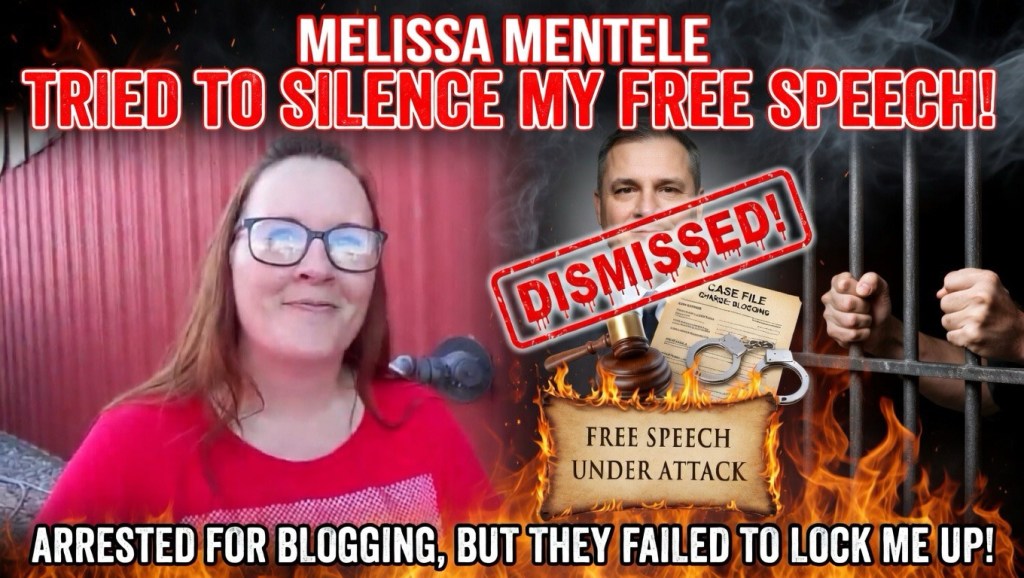
Melissa Mentele Could Not Handle Public Criticism — And That Failure Matters
By Jason Karimi | WeedPress
April , 2026
My fiancée has had enough of Melissa Mentele.
From her perspective, what unfolded here was not a principled defense of law or public ethics. It was the opposite: a public figure reacting badly to criticism and allowing personal offense to drive escalation.
As my fiancée put it:
“You escalated this into something it never needed to become because my fiancé publicly challenged your understanding of federal marijuana law. The article was about ideas, not your ego. This is not mean-girl high school where the loudest person gets her way. This is a court of law, where legal standards are supposed to matter. You’re not helping the movement. You’re hurting it through thin skin, poor judgment, and an inability to handle criticism like an adult. I stayed quiet for months, but this has become ridiculous.”
– South Dakota Cannabis Cardholder Sarah Elarton
That quote is sharp, but it captures a larger point.
Public life comes with criticism. Anyone who seeks influence in a controversial field like cannabis policy should expect disagreement, scrutiny, and public argument. That is not persecution. That is the price of stepping into public debate.
My fiancée’s view is that Melissa Mentele wanted the visibility of public life without the accountability that comes with it. She appears to have wanted the standing, the audience, and the deference, but not the reality that other people may read the law differently, argue back, and say so in public.
That is not a small weakness. It goes to the core of whether someone is fit for serious public advocacy.
Because when criticism is treated as an intolerable personal attack, the result is not leadership. It is distortion. Legal questions become personal drama. Public argument becomes grievance. And the actual issues at stake — marijuana law, constitutional limits, patient interests, religious liberty, public accountability — get pushed aside in favor of ego management.
That is what my fiancée finds so revealing.
This was never supposed to be about personal sensitivity. It was supposed to be about ideas and law. It was supposed to be about whether a public figure’s views could be challenged. It was supposed to be about whether disagreement is still allowed in a movement that claims to value justice, reform, and truth.
Instead, in my fiancée’s view, Melissa Mentele showed that she could not tolerate the ordinary burdens of public life. She did not answer criticism with better arguments. She did not demonstrate confidence under pressure. She did not project seriousness. She projected resentment.
And that distinction matters.
People who are secure in their position do not need to dramatize every challenge. People who understand the law do not need to personalize every disagreement. People who are genuinely serving a cause do not make themselves the center of every conflict involving that cause.
That is why my fiancée sees this episode as more than a personal dispute. To her, it is a case study in how movements get weakened from within: not only by outside opposition, but by thin-skinned insiders who confuse criticism with betrayal and treat accountability as an attack.
Patients deserve better than that. Advocates deserve better than men with guns being sent to someone’s house by Melissa Mentele over first amendment protected speech (lawyers will explain more in future article.)
The public deserves better than that.
And so does the law.
In the end, my fiancée’s judgment is straightforward. Melissa Mentele did not come out of this looking strong, thoughtful, or legally grounded. She came out of it looking unable to withstand criticism without turning it into something larger, messier, and more revealing than it ever needed to be.
That is not seriousness. That is not leadership. And it is not the standard the movement should accept.

 WeedPress: The Paper Trail
Leave a comment